




Missing Teeth Treatment in Frisco & The Colony, TX
Diagnosis & Space Management by Dr. Baharvand & Dr. Kang — Braces, Invisalign, Angel Aligners & Coordination with Restorative Dentists, Oral Surgeons, and Prosthodontists
📞 972.538.4343
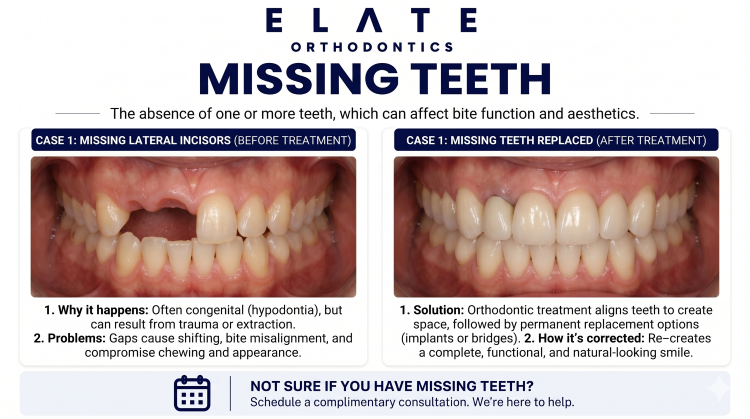
Missing teeth treatment at Elate Orthodontics — managing space, coordinating with restorative specialists, and planning the right long-term solution
Missing Teeth — Frisco & The Colony, TX
Missing Teeth Cases Are Decisions, Not Just Treatments. Close the Space, or Open It for Implant or Bridge?
Missing teeth fall into two main categories: congenitally missing teeth (teeth that never developed) and acquired tooth loss (teeth lost to trauma, decay, periodontal disease, or extraction). Both situations require a decision before treatment begins: close the space orthodontically by moving the adjacent teeth together, or maintain the space and place an implant, bridge, or other restorative replacement. The right answer depends on which tooth is missing, the patient’s age, the bite relationship, the condition of the surrounding teeth and bone, and the patient’s long-term goals. There is no single best approach — there is only the right approach for the specific patient and the specific tooth.
At Elate Orthodontics, Dr. Kevin Baharvand and Dr. Julia Kang manage the orthodontic component of missing teeth cases for patients across Frisco, The Colony, Prosper, and Little Elm. Our role is to evaluate the orthodontic implications of the missing tooth, plan space management as part of comprehensive treatment, and coordinate timing with restorative dentists, oral surgeons placing implants, and prosthodontists who will provide the final restoration when implants or bridges are part of the plan. Missing teeth cases are some of the most multidisciplinary cases in orthodontics, and getting the timing and coordination right is what separates a good outcome from a great one.
As an ABO board-certified practice with a published clinician on staff, our diagnostic approach reflects the depth of training that distinguishes specialty orthodontic care. We take comprehensive records at every consultation including 3D imaging when needed for implant planning, because precise space measurement and bone evaluation matter for these cases. We work alongside experienced restorative dentists, oral and maxillofacial surgeons, and prosthodontists in the Frisco area for cases requiring restorative replacement.
The Common Patterns of Missing Teeth
Congenitally Missing Lateral Incisors
The upper lateral incisors (the teeth next to the two front teeth) are among the most commonly congenitally missing teeth. The condition is often genetic and frequently runs in families. When upper lateral incisors are missing, the adjacent canines often drift toward the center, sometimes ending up directly next to the central incisors. Treatment requires a decision: orthodontically close the space and reshape the canines to look like lateral incisors (canine substitution), or open and maintain the space for future implants.
Both approaches can produce excellent outcomes when planned correctly. The right choice depends on the canine shape and color, the bite relationship, the smile line, and patient preference after honest discussion of tradeoffs.
Congenitally Missing Second Premolars
The lower second premolars (the teeth between the canines and first molars) are the second most commonly congenitally missing teeth. The baby tooth often remains in place into adolescence or early adulthood, sometimes lasting decades, but eventually fails. Treatment planning depends on the condition of the baby tooth, the patient’s age, and bite considerations. Options include extracting the baby tooth and orthodontically closing the space, maintaining the baby tooth as long as possible, or planning for an eventual implant after the baby tooth fails.
For young patients with retained baby second premolars, we often recommend keeping the baby tooth as long as it remains healthy and planning for the future when it fails.
Trauma, Decay & Extraction
Many patients lose teeth through dental trauma (sports injuries, falls, accidents), advanced decay, periodontal disease, or planned extraction. Front teeth lost to trauma during childhood are particularly common after accidents involving the face. When a tooth is lost, the adjacent and opposing teeth begin to drift over months to years, and the bone in the empty space gradually shrinks if no replacement is placed. Early planning prevents these complications.
For patients who have already lost a tooth, our role is to evaluate the current alignment, determine whether orthodontic correction will benefit the case, and coordinate with the restorative team on the timing of any implant or bridge.
Hypodontia & Oligodontia
Hypodontia refers to congenitally missing one or more teeth, while oligodontia (sometimes called severe hypodontia) refers to six or more congenitally missing teeth excluding wisdom teeth. These conditions are often associated with genetic syndromes including ectodermal dysplasia and require highly coordinated care from early childhood. Treatment typically involves multiple specialists working together over many years to manage growth, plan space, and ultimately provide functional and aesthetic restorations.
For multiple missing teeth cases, comprehensive multidisciplinary planning is essential. We work alongside pediatric dentists, restorative dentists, oral surgeons, and prosthodontists from early in the patient’s care.
Many patients have a combination of patterns — for example, a congenitally missing lateral incisor on one side and an acquired loss on another. Comprehensive diagnosis identifies all missing teeth and coordinates the treatment plan.
The Key Decision
Close the Space or Open It? The Decision Framework
When We Close the Space
Closing the space orthodontically (moving the adjacent teeth together to eliminate the gap) is often preferred when: the missing tooth is in a posterior or less aesthetically prominent position, the adjacent teeth can be reshaped to look natural in the new position, the patient has crowding that benefits from the additional space, the bite relationship works well after closure, the patient wants to avoid future implant or bridge surgery, or the patient is too young for implants and wants a permanent solution that does not require ongoing restorative work.
Closure produces a permanent natural-tooth result with no ongoing maintenance, making it appealing for patients who can achieve good aesthetics and function this way.
When We Open & Maintain Space
Opening or maintaining space for an implant or bridge is often preferred when: the missing tooth is in a highly visible position where natural tooth replacement matters most, closure would require significant tooth reshaping that compromises aesthetics, the patient does not have crowding that would benefit from closure, closure would create bite or arch length problems, or the patient has a strong preference for a tooth-shaped restoration in that position.
When opening space, we coordinate carefully with the restorative team on the precise dimensions needed for the planned implant or bridge. Implants typically require both adequate space between teeth and adequate bone height, which sometimes requires bone grafting prior to implant placement.
The decision is collaborative. We discuss the tradeoffs honestly during consultation, often involving the restorative dentist or oral surgeon in the planning conversation when the case is complex.
Underlying Causes
What Causes Missing Teeth?
Congenital tooth absence is largely inherited. If one or both parents have congenitally missing teeth, their children are at significantly higher likelihood of similar patterns. Family history is one of our routine screening questions for children at the age 7 evaluation, particularly when one or both parents have had implants, bridges, or known absent teeth.
Sports injuries, falls, accidents, and other trauma to the face and mouth can avulse (knock out) teeth or damage them severely enough that extraction becomes necessary. Front teeth are most commonly affected. The risk is meaningfully higher for children with significantly protruding upper teeth, which is one reason early orthodontic correction of severe overjet matters during the active years of childhood and teen sports.
Teeth severely damaged by decay or weakened by advanced periodontal disease sometimes cannot be saved and require extraction. This is most commonly seen in adults with long-standing dental neglect or specific risk factors for these conditions. Coordinating with general dentists and periodontists is part of comprehensive care for these patients.
Some teeth that have undergone root canal therapy fail over the years and require extraction. This is most common in heavily restored back teeth. When a previously root-canaled tooth needs to come out, the orthodontic and restorative planning is similar to other acquired tooth loss cases — close the space or replace the tooth.
Some severely impacted teeth — particularly impacted canines that cannot be brought into the arch — require extraction rather than orthodontic eruption. Once extracted, the case becomes a missing tooth situation requiring space management decisions. See our tooth impaction page for more on impaction management.
Some patients have congenital syndromes that affect tooth development, including ectodermal dysplasia, cleft lip and palate, and various craniofacial syndromes. These cases require highly coordinated multidisciplinary care from early childhood and often involve the entire craniofacial team. We work alongside these teams when patients with congenital conditions need orthodontic care.
Why Missing Teeth Need Planned Management
Untreated missing teeth produce predictable downstream problems over years. Adjacent teeth drift toward the empty space, the opposing tooth often erupts into the space (called supereruption), the bite gradually changes, and the bone in the empty space shrinks because there is no tooth root stimulating it. By the time many patients seek treatment, what started as a single missing tooth has become a more complex case requiring orthodontic correction of the drifted teeth, possible bone grafting before implants, and coordination of multiple steps.
Early planning prevents these complications. For patients with congenitally missing teeth, the planning conversation should ideally begin in adolescence even if active treatment waits until later. For patients who have lost a tooth, planning the next step within months rather than years preserves more options and produces better outcomes.
What Untreated Missing Teeth Cause
Drifting of adjacent teeth into the empty space, producing crowded or rotated teeth
Supereruption of the opposing tooth into the empty space, disrupting the bite
Bone loss in the empty space, sometimes requiring bone grafting before future implants
Bite changes affecting chewing function and sometimes contributing to TMJ stress
Aesthetic concerns from visible gaps or shifted teeth, particularly in the front of the mouth
Increased difficulty of treatment as more time passes — what was a simple case becomes complex
Loss of optimal restorative options as bone and adjacent tooth conditions deteriorate
Treatment Approach
How We Manage Missing Teeth at Every Age
Missing teeth treatment timing varies significantly by age and case type. Implants are not placed until skeletal growth is complete (typically late teens for girls, slightly later for boys), so adolescent cases involve interim planning while adult cases can typically proceed directly to definitive treatment.
Children (Ages 7–12)
Diagnosis of congenitally missing teeth typically happens in this age range when adult teeth would normally erupt. Phase 1 planning identifies which teeth are missing, monitors retained baby teeth, and develops the long-term plan. Active treatment is often deferred until adolescence, but the planning conversation matters during this window.
For children with traumatic tooth loss, we coordinate space maintenance to prevent drift while planning long-term restoration after growth completes.
Teens (Ages 13–17)
Most active orthodontic treatment for missing teeth happens during the teen years. We close space when closure is the right answer, or we open and maintain space for future implants. For implant-planned cases, we coordinate with the restorative team on the precise space dimensions needed and the timing of implant placement after growth is complete.
Comprehensive treatment typically takes 18 to 24 months. Implants are typically placed after growth is documented as complete, sometimes a year or more after orthodontic treatment ends.
Adults
Adults with missing teeth typically present in two scenarios: long-standing congenitally missing teeth where the baby tooth has finally failed or is failing, and adult tooth loss from various causes. Treatment proceeds directly to definitive care since growth is complete. Implants can be placed during or shortly after orthodontic treatment based on the coordinated plan with the restorative team.
Adult cases often benefit from coordinated treatment planning with all involved specialists at the start, so timing of orthodontic treatment, extractions, bone grafting, and implant placement is choreographed for the best outcome.
Treatment Options
Treatments We Use & Specialists We Coordinate With
Space Closure with Braces
For cases where closing the space orthodontically is the right answer, traditional braces give us precise control over the tooth movements involved. Closure typically takes 18 to 24 months for a single missing tooth and longer for multiple missing teeth or complex cases. Often combined with cosmetic reshaping of the adjacent teeth at the end of treatment.
Space Opening for Implants
For implant-planned cases, we open and maintain precise space to the dimensions specified by the restorative team. The space must be adequate horizontally between adjacent teeth, vertically between upper and lower teeth, and supported by enough bone for implant placement. Coordination with the surgeon and restorative dentist on these measurements is essential.
Clear Braces & Invisalign
For comprehensive treatment of missing teeth cases with less visibility, clear braces or Invisalign work well for many patients. Modern Invisalign protocols handle most space management cases effectively. For complex cases requiring precise opening to implant dimensions, traditional braces sometimes give us more predictable control.
Angel Aligners
A clear aligner system we offer at Elate Orthodontics for appropriate cases. Like other clear aligner brands, Angel Aligners can support space management for missing teeth cases when treatment plans are designed with the restorative coordination in mind.
Restorative Dentist Coordination
For cases where the final restoration is a crown, bridge, or implant restoration, we coordinate closely with the restorative dentist on space dimensions, occlusion, and timing. Pre-treatment consultations involving the orthodontist and restorative dentist together produce the best outcomes for complex missing teeth cases.
Oral Surgeon Coordination for Implants
When implants are part of the plan, we coordinate with experienced oral and maxillofacial surgeons in the Frisco area on timing, bone evaluation, and surgical planning. Bone grafting is sometimes required before implant placement, particularly when the missing tooth has been absent for years and the bone has shrunk. We sequence orthodontic treatment to support the implant timeline.
Prosthodontist Coordination
For complex cases involving multiple missing teeth, full-mouth rehabilitation, or particularly demanding aesthetic cases, prosthodontists provide specialized restorative expertise. We work alongside prosthodontists in the Frisco area for these cases, with treatment planning typically beginning before any orthodontic movement starts.
Pediatric Orthodontics (Phase 1)
For young children with congenitally missing teeth, Phase 1 care focuses on diagnosis, monitoring, and long-term planning rather than immediate intervention. We document missing teeth, track baby tooth retention, and develop the long-term plan that will guide care over the years ahead.
AAO Recommendation
Age 7 Evaluation Is When Most Congenitally Missing Teeth Are First Diagnosed
The American Association of Orthodontists recommends an evaluation by age 7. For missing teeth, this matters because age 7 is when the panoramic X-ray taken during a comprehensive evaluation typically reveals which permanent teeth are present and which are missing. Many patients first learn that their child has congenitally missing teeth at this evaluation. Early diagnosis allows planning to begin before adjacent teeth drift, before complications develop, and while the most options remain available.
Most children evaluated at age 7 do not need active treatment immediately, even when missing teeth are diagnosed. The point is to identify the situation early and develop the long-term plan with the family. For adults with missing teeth, treatment can typically proceed directly to definitive care, with coordination across the orthodontic and restorative teams determining timing.
See Real Outcomes
Missing Teeth Cases From Our Practice
Our before-and-after gallery includes real missing teeth cases at Elate Orthodontics, ranging from canine substitution cases for congenitally missing lateral incisors, to space opening for implants in adolescent and adult patients, to complex multidisciplinary cases involving multiple missing teeth and full restorative coordination. Each case shows the diagnosis, the appliances used, the coordination with restorative specialists, and the final result.
Common Questions
Missing Teeth FAQ
It depends on which tooth is missing, your bite relationship, the surrounding tooth and bone condition, and your long-term goals. Both approaches can produce excellent outcomes when planned correctly. We discuss the tradeoffs honestly during consultation, often involving the restorative dentist or oral surgeon in the conversation when the case is complex. There is no single right answer — there is the right answer for your specific situation.
Active orthodontic treatment for missing teeth typically begins in the teen years, but the planning conversation should begin earlier. The age 7 evaluation often reveals the missing tooth. Early planning allows space to be managed, retained baby teeth to be monitored, and the long-term restorative plan to be developed with the family. Implants are not placed until skeletal growth is complete, typically late teens for girls and slightly later for boys.
Sometimes, particularly with retained baby second premolars where the adult tooth is congenitally missing. If the baby tooth is structurally sound, the bite is functional, and the patient prefers to delay restorative work, keeping the baby tooth as long as it remains healthy is a reasonable approach. Baby teeth eventually fail in most cases, but some last decades. We discuss this option honestly when it applies.
No, but treatment is often more complex when missing teeth have been left untreated for years. Adjacent teeth have likely drifted, the opposing tooth may have supererupted, and bone in the empty space has shrunk. Treatment may now involve orthodontic correction of the drifted teeth, possible bone grafting before implant placement, and coordination of multiple steps. Excellent outcomes are still achievable, but the complexity is greater than catching the situation early.
Orthodontic treatment for missing teeth typically takes 18 to 24 months for single missing teeth and longer for multiple missing teeth or complex cases. Implant placement adds additional months for healing and final restoration. Total treatment time from start to completed implant restoration is often 24 to 36 months when implants are part of the plan, depending on age and case complexity.
Orthodontic portions are typically covered by PPO dental insurance plans that include orthodontic benefits. Implant placement and restorations are typically covered separately under dental insurance with varying coverage limits, sometimes with annual maximums that affect timing decisions. Coordination across the orthodontic and restorative components is part of comprehensive treatment planning. We help patients understand what each component is likely to cost and offer flexible financing through Cherry to make care accessible.
Why Frisco & The Colony Patients Choose Elate Orthodontics for Missing Teeth
Missing teeth cases are some of the most multidisciplinary in orthodontics. The willingness to discuss tradeoffs honestly between space closure and implant restoration, the discipline to coordinate with restorative dentists and oral surgeons throughout the case, and the experience to know when each approach is appropriate are what separate good outcomes from great ones. Dr. Baharvand and Dr. Kang manage missing teeth cases across the full spectrum, from canine substitution for congenitally missing lateral incisors to comprehensive multidisciplinary cases coordinated with restorative specialists.
Dr. Baharvand and Dr. Kang are a husband-and-wife orthodontic team based in Frisco, with three convenient locations serving families across Frisco, The Colony, Prosper, and Little Elm. Dr. Baharvand is ABO board-certified and a published clinician whose work has appeared in the American Journal of Orthodontics and Dentofacial Orthopedics.
1,000+
Five-star reviews across 3 locations
ABO
Board-certified orthodontist
Published
AJO-DO cover clinician
Free
Consultation with full diagnostic records
Our Locations
5605 FM 423, Suite 600
Frisco, TX 75036
FM 423 & Lebanon Rd — next to the UPS Store
4713 Highway 121, Suite 304
The Colony, TX 75056
FM 423 & Hwy 121 — next to Ross
2155 University Dr, Suite 110
Frisco, TX 75033
On 380 across from Cook Children’s Medical Center Prosper
Hours: Mon–Fri 8:00am–5:00pm | 972.538.4343
Missing Teeth? Let’s Plan the Right Path Together.
Free consultations at all three Elate Orthodontics locations include a complete diagnostic workup: digital scans, panoramic X-rays, clinical photos, and 3D imaging when needed for implant planning. We discuss space closure versus implant or bridge replacement honestly and coordinate with restorative dentists, oral surgeons, and prosthodontists in the Frisco area for the right comprehensive plan. No pressure, no surprises, no commitment to treatment.
Also see: All Conditions We Treat | Gapped Teeth | Tooth Impaction | Ectopic Eruption | Before & After