




Jaw Misalignment Treatment in Frisco & The Colony, TX
Diagnosis & Correction by Dr. Baharvand & Dr. Kang — Growth Modification, Braces, Invisalign, Angel Aligners & Surgical Coordination
📞 972.538.4343
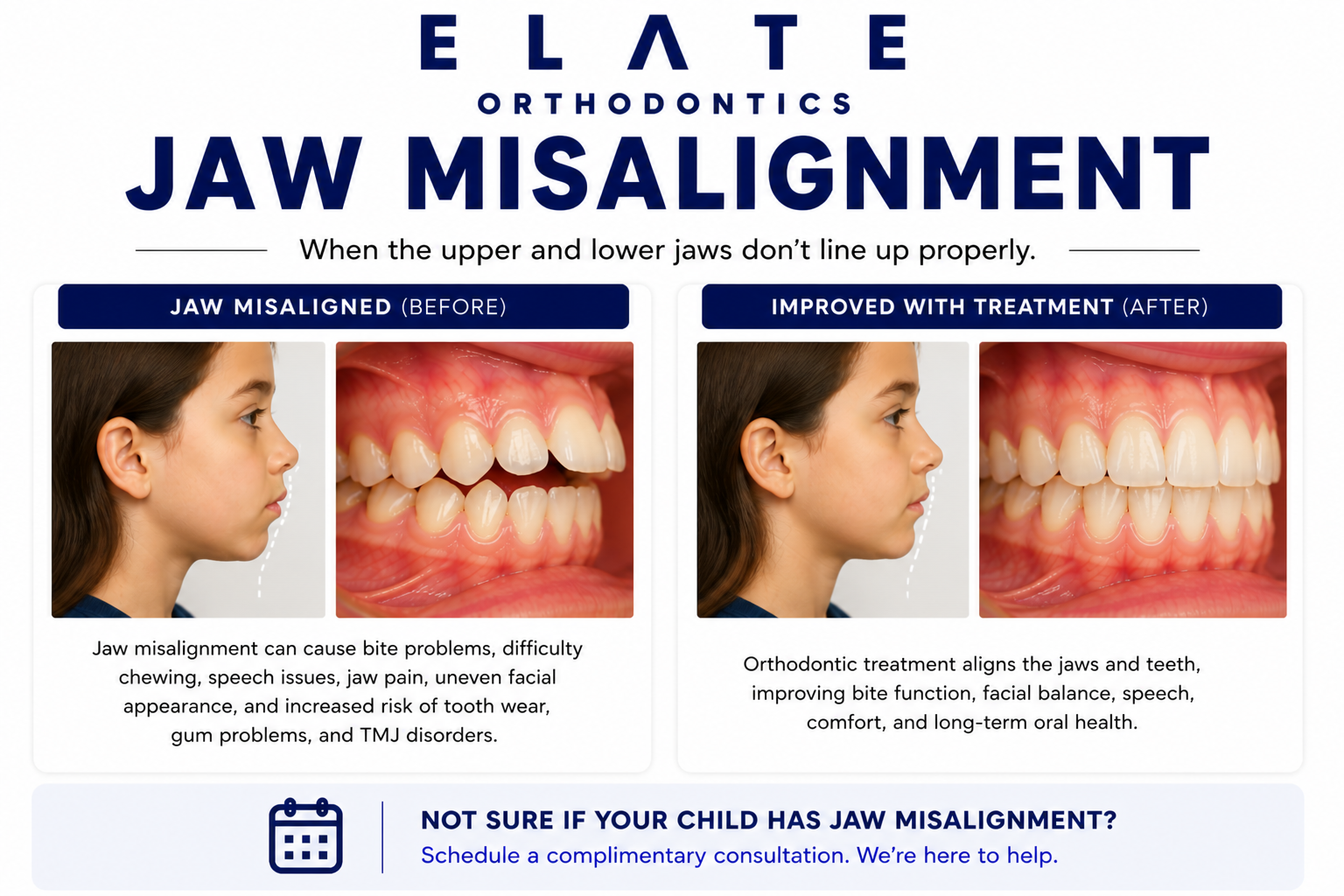
Jaw misalignment correction at Elate Orthodontics — diagnosing the skeletal pattern and planning the right path
Jaw Misalignment — Frisco & The Colony, TX
Jaw Misalignment Is a Skeletal Condition. Treatment Depends Heavily on Whether the Patient Is Still Growing.
Jaw misalignment refers to the upper and lower jaws not being properly positioned relative to each other or relative to the face. Unlike specific bite issues like overbite or crossbite that describe how the teeth meet, jaw misalignment describes the underlying skeletal relationship of the jaws themselves. The most common patterns are a lower jaw that is set back relative to the upper (Class II skeletal pattern), a lower jaw that is positioned forward relative to the upper (Class III skeletal pattern), and asymmetric jaw position where one or both jaws are shifted off-center. Jaw misalignment often coexists with bite issues, facial asymmetry, and sometimes with TMJ-related symptoms or sleep concerns.
At Elate Orthodontics, Dr. Kevin Baharvand and Dr. Julia Kang treat the orthodontic and growth-modification components of jaw misalignment in patients across Frisco, The Colony, Prosper, and Little Elm. The most important question for any jaw misalignment case is age. In growing children and young adolescents, the jaws are still developing, and orthopedic appliances can guide growth in beneficial directions during the active growth window. In adults, the jaws are no longer growing — orthodontic treatment can address the dental compensation and alignment, but true skeletal correction requires coordinated care with an oral and maxillofacial surgeon for orthognathic surgery. We are direct about which path is appropriate for each patient and what each can realistically achieve.
As an ABO board-certified practice with a published clinician on staff, our diagnostic approach reflects the depth of training that distinguishes specialty orthodontic care. We take comprehensive records at every consultation including 3D imaging when needed, because precise skeletal diagnosis is the foundation of any jaw misalignment treatment plan. We coordinate with experienced oral and maxillofacial surgeons throughout the Frisco area for cases that genuinely require surgical correction.
The Most Common Patterns of Jaw Misalignment
Class II Skeletal Pattern (Lower Jaw Set Back)
The most common form of jaw misalignment. The lower jaw has not grown forward enough to meet the upper jaw in a balanced relationship. This pattern is largely genetic and runs in families. The visible signs include a recessed chin, protruding upper teeth, and the appearance that the upper teeth and jaw are too far forward relative to the lower face.
In growing patients, functional appliances can encourage the lower jaw to develop forward during active growth, sometimes producing dramatic improvement and avoiding surgery later. See our overbite page and protruding teeth page for more on the dental components.
Class III Skeletal Pattern (Lower Jaw Forward)
A skeletal pattern where the lower jaw projects forward of the upper jaw, or the upper jaw is underdeveloped. This is the underlying skeletal pattern behind underbite. The visible signs include a prominent chin, retruded upper lip, and a dished-in appearance to the middle face.
Class III is one of the most time-sensitive jaw misalignment patterns. In children ages 7 to 9, reverse-pull headgear and palatal expansion can produce meaningful skeletal change. By age 12 to 13, the window for non-surgical correction has typically closed. See our underbite page for more.
Asymmetric Jaw Misalignment
One or both jaws are positioned off-center relative to the face. The lower jaw shifts to one side, the upper jaw is canted, or both. Asymmetric jaw misalignment often develops over years of asymmetric chewing in patients with unilateral crossbite, producing a true skeletal asymmetry by adulthood. The visible signs include a noticeably off-center chin, asymmetric facial features on close inspection, and midline shifts in the smile.
Catching asymmetric jaw growth early is one of the strongest practical reasons for the AAO age-7 evaluation. See our midline misalignment page for more on the dental component.
Vertical Jaw Discrepancies
The upper and lower jaws can also be misaligned vertically — too long, too short, or rotated open or closed in ways that affect facial proportions and bite function. Common patterns include the long face pattern (often associated with chronic mouth breathing) and short face pattern with deep bite. These vertical issues affect both how the face looks and how the bite functions.
Vertical jaw misalignment in growing patients responds to growth modification and orthopedic appliances. In adults, dental compensation through orthodontics or surgical correction in severe cases is the path forward. See our mouth breathing page for more on long face pattern development.
Many patients have combined patterns. Comprehensive 3D diagnosis identifies which jaw is the primary contributor and the right approach for the patient’s age.
Underlying Causes
What Causes Jaw Misalignment?
Jaw size, jaw position, and growth direction are largely inherited. Class II and Class III skeletal patterns often run in families, with siblings showing similar profiles. Family history is one of our routine screening questions for children at the age 7 evaluation, particularly when one or both parents have had orthodontic treatment, surgery, or visible jaw asymmetry.
When children with unilateral crossbite shift their lower jaw to one side every time they bite down, years of this asymmetric function during growth can produce true skeletal asymmetry. What started as a dental functional shift becomes a real jaw misalignment by adulthood. Catching unilateral crossbite early prevents this progression.
Years of chronic mouth breathing during growth alter jaw development. The lower jaw rotates downward and backward, the face lengthens, and the upper jaw develops narrow. This pattern produces the long face syndrome with characteristic vertical jaw misalignment. Addressing the underlying airway cause early supports more balanced jaw growth.
Injuries to the jaws or face during childhood — particularly to the temporomandibular joint where the lower jaw connects to the skull — can affect subsequent jaw growth. A childhood injury that seemed minor at the time can disrupt growth on one side, producing asymmetric jaw development that becomes apparent during adolescence.
Prolonged thumb sucking, tongue thrust, and other persistent habits during the active growth years influence jaw development. While these habits more commonly affect the dental arches and bite, intense and prolonged habits can also influence skeletal jaw growth patterns over time. Addressing habits early supports more balanced development.
Some patients have congenital or developmental conditions that affect jaw growth, including cleft lip and palate, hemifacial microsomia, and other syndromes. These cases require coordinated multidisciplinary care from early childhood and often involve the entire craniofacial team. We work alongside these teams when patients with congenital conditions need orthodontic care.
Why the Treatment Window Matters So Much
Jaw misalignment is one of the conditions where the difference between catching it during the growth window and catching it after growth is complete is most dramatic. In growing children, orthopedic appliances can encourage the jaws to develop in more balanced relationships, sometimes producing changes that would not be possible later. The same Class II case caught at age 9 with functional appliance therapy may achieve a fundamentally different outcome than the same case caught at age 25, where the patient may now need orthognathic surgery for true skeletal correction.
For adults with established jaw misalignment, treatment options divide into two paths: orthodontic camouflage (using tooth movement to compensate for the underlying skeletal discrepancy) or orthognathic surgery (true skeletal correction). We discuss both honestly during consultation. Camouflage is appropriate for many cases. Surgery is appropriate when camouflage cannot produce a stable, healthy result. We do not push patients toward surgery they do not need, and we do not pretend orthodontics alone can correct severe skeletal cases when it cannot.
What Untreated Jaw Misalignment Causes
Bite issues including overbite, underbite, crossbite, and open bite from the underlying skeletal pattern
Facial asymmetry that becomes more obvious in adulthood when growth is complete
Difficulty chewing, biting, and speaking from misaligned jaw position
TMJ-related symptoms including jaw clicking, popping, soreness, or pain in some patients
Loss of the non-surgical correction window once skeletal growth is complete in late adolescence
Self-consciousness about facial appearance, particularly during adolescence and adulthood
Compensatory dental issues including front tooth wear, gum recession, and uneven bite forces
Treatment Approach
How We Treat Jaw Misalignment at Every Age
Jaw misalignment treatment is one of the most age-dependent decisions in orthodontics. The treatment options narrow significantly as growth completes through late adolescence. Our approach is direct: we tell you honestly what is achievable at your age, what is not, and what each path involves. Some cases need surgery. Many cases do not. Comprehensive diagnosis is the foundation of the right answer.
Children (Ages 7–10) — The Skeletal Window
This is the prime treatment window for skeletal jaw misalignment. Growth is active, jaws are still developing, and orthopedic appliances can guide growth in beneficial directions. Class III patterns particularly benefit from early intervention with reverse-pull headgear and palatal expansion. Class II patterns may benefit from functional appliances during the pubertal growth spurt.
Catching skeletal misalignment in this window can sometimes eliminate the need for surgery later. Most children evaluated at age 7 do not need active treatment immediately, but timing decisions made at this age affect what is possible later.
Teens (Ages 11–17)
Class II growth modification using functional appliances or elastics is most effective during the pubertal growth spurt and remains an option through middle adolescence. Class III growth modification options narrow significantly by this age and may require surgical planning for severe cases. Comprehensive orthodontics with braces or aligners typically combines with growth modification or extends into surgical preparation as appropriate.
For teens with severe skeletal misalignment that growth modification alone cannot correct, orthodontic treatment is often planned alongside future orthognathic surgery in late adolescence once growth is complete.
Adults — Camouflage or Surgery
In adults, growth modification is no longer an option. Treatment paths divide into orthodontic camouflage (compensating for skeletal discrepancy through strategic tooth movement) and orthognathic surgery (true skeletal correction). Mild to moderate jaw misalignment can often be camouflaged effectively with comprehensive orthodontics using braces, Invisalign, or Angel Aligners. Severe skeletal misalignment that produces significant functional or aesthetic concerns typically benefits from orthognathic surgery combined with orthodontic treatment.
We coordinate with experienced oral and maxillofacial surgeons in the Frisco area for surgical cases. We discuss the tradeoffs honestly during consultation and never push surgery for patients whose cases can be successfully managed with orthodontic camouflage alone.
Treatment Options
Treatments We Use to Address Jaw Misalignment
Functional Appliances (Class II)
For growing children and teens with Class II skeletal patterns (lower jaw set back), functional appliances encourage the lower jaw to grow forward during active growth. These include twin block, Herbst, Forsus, and similar appliances. Most effective during the pubertal growth spurt, typically ages 10 to 14. Often combined with comprehensive orthodontics in adolescence.
Reverse-Pull Headgear (Class III)
For young children with Class III skeletal patterns (lower jaw forward of upper), reverse-pull headgear (also called face mask therapy) encourages forward growth of the upper jaw. Most effective ages 7 to 9, with effectiveness declining sharply after age 11. Often combined with palatal expansion to coordinate upper jaw growth.
Palatal Expander (Growing Patients)
For growing patients with narrow upper jaw contributing to jaw misalignment, palatal expansion widens the upper jaw and improves the relationship with the lower jaw. Often a foundational element of Phase 1 treatment for skeletal misalignment cases. Highly effective during the active growth window.
Traditional Braces
The most reliable platform for comprehensive treatment of jaw misalignment cases requiring complex tooth movements, growth modification coordination, or surgical preparation. Braces give us precise control and remain the gold standard for the most demanding skeletal cases.
Clear Braces & Invisalign
For comprehensive treatment that includes orthodontic camouflage of mild to moderate adult jaw misalignment, clear braces or Invisalign provide effective tooth movement with minimal visibility during treatment. Modern protocols handle most camouflage cases with excellent outcomes.
Angel Aligners
A clear aligner system we offer at Elate Orthodontics for appropriate cases. Like other clear aligner brands, Angel Aligners can support orthodontic camouflage of mild to moderate adult jaw misalignment with treatment plans tailored to each patient’s anatomy and goals.
Orthognathic Surgery Coordination
For severe adult skeletal misalignment where camouflage will not produce a stable, healthy outcome, we coordinate with experienced oral and maxillofacial surgeons for orthognathic surgery combined with orthodontic treatment. This typically involves pre-surgical orthodontics to align the teeth within each jaw, the surgery itself, and post-surgical orthodontics to refine the bite. Reserved for cases where it is genuinely the right path.
Pediatric Orthodontics (Phase 1)
For young children with developing skeletal misalignment, Phase 1 interceptive treatment combines growth modification, palatal expansion, habit appliances, and other early interventions during the most consequential window for skeletal change. Catching jaw misalignment in this window often produces outcomes that would not be possible later.
AAO Recommendation
Jaw Misalignment Has the Most Time-Sensitive Treatment Window in Orthodontics
The American Association of Orthodontists recommends an evaluation by age 7. For jaw misalignment, this matters more than for almost any other condition because the treatment options change dramatically as growth progresses. Class III correction has the narrowest window — most effective ages 7 to 9 with effectiveness declining sharply after age 11. Class II growth modification works best during the pubertal growth spurt, typically ages 10 to 14. By late adolescence, growth modification options have largely closed and adult cases either pursue camouflage or surgery.
Most children evaluated at age 7 do not need orthodontic treatment immediately. The point of early evaluation is to identify children with developing skeletal patterns and time intervention precisely for maximum benefit. For adults with established jaw misalignment, treatment is still possible — we are direct about whether camouflage or surgery is the right path for each case.
See Real Outcomes
Jaw Misalignment Cases From Our Practice
Our before-and-after gallery includes real jaw misalignment cases at Elate Orthodontics, ranging from Phase 1 growth modification cases that prevented surgical needs later, to teen comprehensive cases combining functional appliances with full orthodontic treatment, to adult camouflage and surgical coordination cases. Each case shows the diagnosis, the appliances used, and the final result.
Common Questions
Jaw Misalignment FAQ
It depends on severity and age. Many adult jaw misalignment cases can be successfully camouflaged with comprehensive orthodontic treatment, producing excellent functional and aesthetic outcomes without surgery. Severe skeletal misalignment that camouflage cannot adequately address often benefits from orthognathic surgery combined with orthodontic treatment. We discuss both paths honestly during consultation and recommend surgery only when it is genuinely the right answer for your case.
Often yes, when caught early enough. In growing children, functional appliances, reverse-pull headgear, palatal expansion, and other orthopedic interventions can guide jaw growth in beneficial directions during the active growth window. Caught at age 7 to 10, many cases that would otherwise have required surgery can be addressed without it. The age 7 evaluation is the right time to determine whether your child falls into this category.
Orthodontic camouflage uses strategic tooth movement to compensate for an underlying skeletal jaw discrepancy. The skeletal pattern remains, but the teeth are positioned to produce a balanced bite, attractive smile, and good function. Camouflage is appropriate for many mild to moderate adult cases. It has limits — for severe skeletal patterns, camouflage cannot adequately compensate and surgery becomes the better path.
Sometimes, but not always. Many people with jaw misalignment have no TMJ symptoms, while others with seemingly minor misalignment have significant TMJ concerns. The relationship is not simple. We screen for TMJ symptoms during evaluation and coordinate with TMJ specialists when needed. Treating jaw misalignment can sometimes improve TMJ symptoms, though we do not promise specific TMJ outcomes from orthodontic treatment alone.
Phase 1 growth modification in young children typically takes 9 to 14 months, often followed by Phase 2 comprehensive treatment in adolescence. Comprehensive teen orthodontic treatment alongside growth modification typically takes 18 to 30 months. Adult camouflage cases typically take 18 to 24 months. Surgical cases involve pre-surgical orthodontics, the surgery itself, and post-surgical refinement, with total treatment time often 24 to 36 months.
Orthodontic portions are typically covered by PPO dental insurance plans that include orthodontic benefits. Orthognathic surgery is typically covered under medical insurance when documented functional needs are met, with coverage requirements varying by carrier and case. We help patients understand what each component is likely to cost and offer flexible financing through Cherry to make comprehensive care accessible.
Why Frisco & The Colony Patients Choose Elate Orthodontics for Jaw Misalignment
Jaw misalignment is one of the conditions where honest assessment matters most. The willingness to recommend Phase 1 growth modification when it is the right path, the discipline to discuss camouflage versus surgery openly with adult patients, and the experience to coordinate with oral and maxillofacial surgeons for the cases that genuinely need them are what separate good outcomes from great ones. Dr. Baharvand and Dr. Kang have managed jaw misalignment cases across the full spectrum, from Phase 1 functional appliance therapy in young children to complex adult cases combining orthodontic camouflage or surgical coordination.
Dr. Baharvand and Dr. Kang are a husband-and-wife orthodontic team based in Frisco, with three convenient locations serving families across Frisco, The Colony, Prosper, and Little Elm. Dr. Baharvand is ABO board-certified and a published clinician whose work has appeared in the American Journal of Orthodontics and Dentofacial Orthopedics.
1,000+
Five-star reviews across 3 locations
ABO
Board-certified orthodontist
Published
AJO-DO cover clinician
Free
Consultation with full diagnostic records
Our Locations
5605 FM 423, Suite 600
Frisco, TX 75036
FM 423 & Lebanon Rd — next to the UPS Store
4713 Highway 121, Suite 304
The Colony, TX 75056
FM 423 & Hwy 121 — next to Ross
2155 University Dr, Suite 110
Frisco, TX 75033
On 380 across from Cook Children’s Medical Center Prosper
Hours: Mon–Fri 8:00am–5:00pm | 972.538.4343
Jaws Don’t Line Up? Let’s Diagnose the Pattern and Plan the Right Path.
Free consultations at all three Elate Orthodontics locations include a complete diagnostic workup: digital scans, panoramic X-rays, clinical photos, and 3D imaging when needed for skeletal analysis. We identify the jaw misalignment pattern and discuss honestly whether growth modification, orthodontic camouflage, or surgical coordination is the right approach for your specific case. No pressure, no surprises, no commitment to treatment.
Also see: All Conditions We Treat | Overbite | Underbite | Midline Misalignment | Narrow Palate | Before & After