




Tooth Impaction Treatment in Frisco & The Colony, TX
Impacted Canines, Wisdom Teeth, Second Molars & Premolars — Treated by Dr. Baharvand & Dr. Kang with Braces, Invisalign, Angel Aligners & Surgical Coordination
📞 972.538.4343
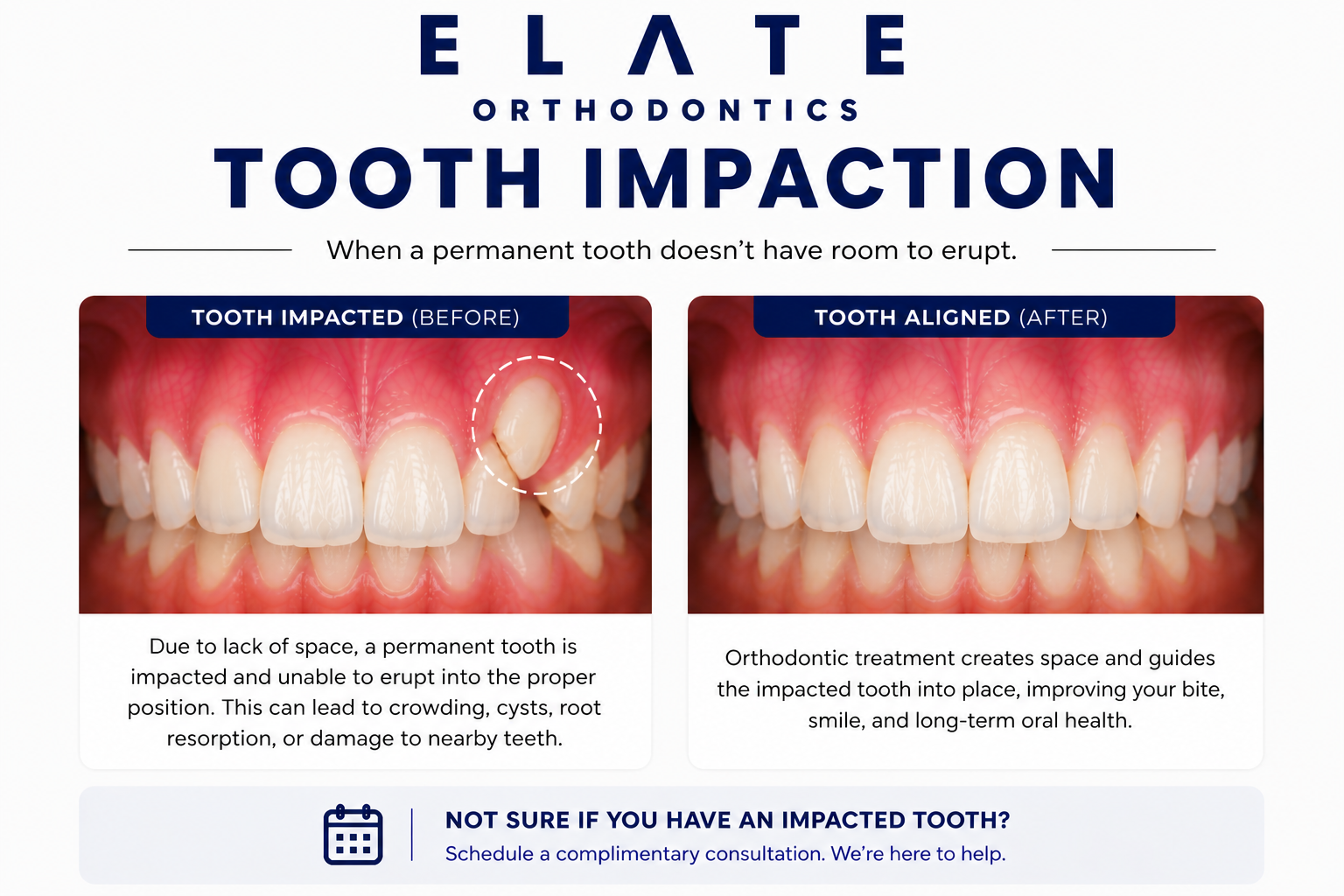
Tooth impaction treatment at Elate Orthodontics — bringing impacted teeth into the arch through coordinated surgical-orthodontic care
Tooth Impaction — Frisco & The Colony, TX
An Impacted Tooth Is a Tooth That Got Stuck. The Plan to Bring It Out Determines the Outcome.
A tooth is impacted when it fails to erupt into its normal position in the dental arch and remains partially or fully buried in the bone or gum tissue. Some impacted teeth simply have not had room to come in. Others are pointing in the wrong direction. Others are blocked by neighboring teeth, cysts, or supernumerary teeth. Whatever the reason, an impacted tooth that is left untreated can damage adjacent teeth, develop cysts around it, cause infection, or contribute to crowding and bite issues that affect the entire dental arch over time.
At Elate Orthodontics, Dr. Kevin Baharvand and Dr. Julia Kang treat impacted teeth in patients across Frisco, The Colony, Prosper, and Little Elm. Impaction management is one of the most coordination-heavy areas of orthodontics. The right plan depends on which tooth is impacted, why it became impacted, the patient’s age, and what the long-term goal is for that tooth. Some impacted teeth need to be brought into the arch with surgical exposure and orthodontic traction. Others are best removed entirely. We work alongside experienced oral surgeons throughout the Frisco area to coordinate every step of the process.
As an ABO board-certified practice with a published clinician on staff, our diagnostic approach reflects the depth of training that distinguishes specialty orthodontic care. We take comprehensive records at every consultation including 3D imaging when needed for impaction cases, because precise localization of the impacted tooth determines whether and how it can be saved. Our existing impacted teeth treatment page covers the surgical-orthodontic protocol in more detail.
The Most Common Tooth Impactions We Treat
Impacted Wisdom Teeth (Third Molars)
Wisdom teeth are by far the most commonly impacted teeth, affecting most adults at some point. Wisdom teeth typically attempt to erupt in late adolescence or early adulthood (ages 17 to 25), and modern jaws often do not have room to accommodate them. Impacted wisdom teeth can grow sideways, push against the second molars, develop cysts, cause pain, become infected, or contribute to crowding of the lower front teeth.
Wisdom teeth are usually managed by extraction rather than orthodontic alignment. We coordinate with oral surgeons for the timing of wisdom tooth removal when it benefits the orthodontic plan, particularly during or after comprehensive treatment when the lower front teeth need to be protected from drift.
Impacted Canines
Canines are the second most commonly impacted teeth and are the most clinically important to save. Upper canines have a long path of eruption from high in the bone down to their final position, and they often become blocked by crowding, neighboring teeth, or simply lose their way during eruption. Roughly 1 to 2 percent of the population has an impacted canine, with upper canines impacted about ten times more often than lower canines.
Impacted canines are almost always brought into the arch through surgical exposure and orthodontic traction rather than extracted. Canines are essential for proper bite function, smile aesthetics, and arch stability. They are worth saving in nearly every case. Catching them early in adolescence dramatically simplifies treatment.
Impacted Second Molars
Second molar impaction is less common than canine or wisdom tooth impaction but more clinically demanding. The lower second molar can become tipped forward and trapped under the first molar, often due to insufficient arch space behind the first molar or eruption disturbance. Catching second molar impaction early in adolescence allows orthodontic uprighting and recovery of the tooth into proper position.
Treatment usually involves selective use of brackets, springs, or appliances designed specifically to upright the tipped tooth. In some cases, removal of an unerupted wisdom tooth helps create the room needed to bring the second molar back into position. We diagnose precisely and design the recovery plan based on the angle of impaction.
Impacted Premolars
Premolar impaction is uncommon but worth understanding because it is sometimes missed during routine dental exams. The most common pattern is impaction of the lower second premolar, often related to a lingering primary molar that did not fall out on time, severe crowding, or an abnormal eruption path. Lower second premolars sometimes drift to unusual positions if their primary tooth predecessor is lost too early.
Treatment depends on the position of the impacted premolar, the available space in the arch, and whether the long-term plan calls for keeping the tooth or extracting it as part of crowding correction. We coordinate with oral surgeons for surgical exposure and design the orthodontic plan around the recovery sequence.
Other less common impactions we manage include central incisors blocked by supernumerary teeth and lateral incisors blocked by malposition or cysts. Every impaction is individual. Comprehensive 3D diagnosis is essential.
Underlying Causes
What Causes Tooth Impaction?
The most common cause of impaction is simply not enough room in the arch for the tooth to come in. This is the underlying issue for most wisdom tooth impactions and a frequent driver of canine and second molar impaction. Severe crowding caught and treated early can sometimes prevent canines from becoming impacted in the first place.
Some teeth simply lose their way during eruption and travel in the wrong direction. Upper canines are particularly prone to this — they have the longest eruption path of any tooth, and small early deviations can compound into significant impaction by the time eruption should be complete. Genetic factors play a major role.
When a baby tooth does not fall out on schedule, the permanent tooth underneath it can be blocked or deflected from its normal eruption path. This is a common cause of premolar impaction. Routine pediatric dental visits should identify these cases, but they are sometimes missed and only become apparent during orthodontic evaluation.
Extra teeth that develop in the bone (called supernumerary teeth) and cysts that form around developing teeth can both physically block normal eruption. These cases require surgical removal of the obstruction before the impacted tooth can erupt or be brought into position orthodontically. Front tooth impactions in children are often due to supernumerary teeth.
Impaction has a strong genetic component, particularly for canine impaction. If a parent or sibling had an impacted canine, screening for canine eruption issues is especially important. Family history is one of our routine evaluation questions for patients in the canine eruption window (ages 8 to 12).
Injury to the face during childhood can disrupt the developing tooth bud underneath and lead to abnormal eruption or impaction years later. Similarly, early loss of a baby tooth without space maintenance can allow neighboring teeth to drift into the space, blocking the developing permanent tooth from erupting normally.
Why Impaction Should Not Be Ignored
Impacted teeth do not stay quietly in place. Over time, they can damage the roots of adjacent teeth, develop cysts that destroy bone, become infected, and cause progressive crowding as they push against neighboring teeth. The longer an impacted tooth is left untreated, the more complicated the eventual treatment becomes — and in some cases, the window to save the tooth closes entirely.
For canines specifically, the timing of intervention is critical. Caught between ages 8 and 12, a canine that is heading toward impaction can sometimes be redirected with relatively simple intervention (such as removing the baby canine to clear the path). Caught at age 25, the same case requires surgical exposure, orthodontic traction, and 18 to 30 months of treatment.
What Untreated Impaction Causes
Root resorption (damage) of adjacent teeth from pressure of the impacted tooth, particularly with canine impactions
Cyst formation around the crown of the impacted tooth, which can destroy surrounding bone
Infection, abscess, and pain when impacted teeth partially erupt and become contaminated
Progressive crowding of the lower front teeth from wisdom tooth pressure
Bite issues from missing teeth in the arch when impacted teeth fail to erupt at all
Loss of the tooth entirely when impaction is left long enough that ankylosis (fusion to bone) develops
More complex and longer treatment when impaction is caught in adulthood rather than adolescence
Treatment Approach
How We Treat Impaction at Every Age
Impaction treatment is highly age-dependent and always coordinated with oral surgeons. The earlier the impaction is identified, the more options are available and the more predictable the outcome. This is one of the strongest practical reasons for the AAO age-7 evaluation.
Children (Ages 7–10) — The Prevention Window
For children showing early signs of canine impaction (most often visible on a panoramic X-ray as the canine heading in the wrong direction), simple interventions can sometimes prevent full impaction. Removing a baby canine that is blocking the eruption path, or addressing crowding with palatal expansion, can let the canine find its way to the proper position. This is also the window to identify and remove supernumerary teeth blocking eruption.
Most children evaluated at age 7 do not have impaction concerns. The point is to identify the small percentage where early intervention will prevent a much larger problem.
Teens (Ages 11–17) — The Recovery Window
The teen years are the prime treatment window for impacted canine and second molar recovery. Treatment involves comprehensive orthodontics combined with surgical exposure of the impacted tooth and orthodontic traction (a small chain or attachment that gently pulls the tooth into the arch over 6 to 12 months). Total treatment time for impacted canine cases is typically 18 to 24 months.
Wisdom teeth that are clearly impacted and not going to erupt properly are often removed during or after comprehensive teen treatment to prevent later crowding and complications.
Adults
Adult impaction treatment is more complex but very much possible. Canines impacted into adulthood can often still be brought into the arch, though treatment is typically longer (24 to 30 months) and the outcome depends on whether ankylosis has developed. Wisdom teeth in adults are usually managed by extraction.
For some adult cases — particularly impacted canines with significant root damage to neighboring teeth or with ankylosis — the most predictable outcome is to remove the impacted tooth and either close the space orthodontically or coordinate with a restorative dentist for an implant. We discuss these tradeoffs honestly when they apply.
Treatment Options
Treatments We Use to Manage Impacted Teeth
Surgical Exposure & Orthodontic Traction
The standard approach for impacted canines and second molars worth saving. An oral surgeon exposes the crown of the impacted tooth and bonds a small attachment to it. We then apply gentle, sustained orthodontic force through a chain or wire to gradually bring the tooth into its proper position over 6 to 12 months. Treatment is highly predictable when the tooth has not become ankylosed.
Traditional Braces
The most reliable option for most impaction cases. Braces give us precise control over the traction direction and timing for impacted teeth and work seamlessly with the surgical exposure protocol. The gold standard for canine and second molar impaction recovery.
Clear Braces
Same effective mechanics as traditional braces with tooth-colored brackets that blend with natural enamel. A great option for teens and adults treating impaction who want the predictability of braces with less visibility during treatment.
Invisalign with Auxiliaries
Modern Invisalign protocols can manage some impaction cases, typically combining clear aligners for the rest of the arch with separate fixed attachments and elastics to bring the impacted tooth into position. Used selectively — most complex impactions still benefit from the precision of fixed braces, but aligners can be appropriate for milder cases.
Angel Aligners
A clear aligner system we offer at Elate Orthodontics for appropriate cases. Like other clear aligner brands, Angel Aligners can be used selectively in mild impaction cases combined with fixed auxiliary attachments for the impacted tooth itself. We discuss appropriateness during consultation.
Palatal Expansion (Pediatric)
For young children with crowding-driven impaction concerns, palatal expansion can create the space the impacted tooth needs to find its way into the arch naturally. This is most relevant for early canine impaction prevention and is often the first phase of treatment for at-risk patients.
Wisdom Tooth Extraction Coordination
For impacted wisdom teeth, we coordinate timing of extraction with our oral surgery partners. Removal during or after comprehensive teen treatment helps protect the lower front teeth from late crowding pressure. For adult patients, we coordinate the surgical timing with any retreatment plan.
Selective Extraction & Restorative Coordination
For impacted teeth that cannot be successfully brought into the arch — typically due to ankylosis, severe damage to roots of adjacent teeth, or unfavorable position — the best path is sometimes extraction followed by space closure or implant placement. We coordinate with restorative dentists when implant replacement is planned for an impacted tooth that cannot be saved.
AAO Recommendation
Impaction Caught Early Often Prevents Years of Treatment
The American Association of Orthodontists recommends an evaluation by age 7. For tooth impaction, this matters because the canine eruption window starts around age 9 and continues until age 13, with early signs of canine impaction visible on a panoramic X-ray well before the tooth becomes truly stuck. A child whose canine is heading the wrong direction at age 9 can sometimes be redirected with simple intervention (removing the baby canine, addressing crowding). The same case caught at age 16 may require surgical exposure and 18 months of orthodontic traction.
For wisdom teeth, the timing of evaluation and removal varies more by individual case. We work with our oral surgery partners to determine when removal makes sense based on the patient’s age, jaw space, eruption pattern, and overall orthodontic plan.
See Real Outcomes
Impaction Cases From Our Practice
Our before-and-after gallery includes real impaction recovery cases at Elate Orthodontics, ranging from impacted canines brought into the arch through coordinated surgical-orthodontic care, to impacted second molars uprighted and recovered, to comprehensive teen cases combining wisdom tooth coordination with full orthodontic treatment. Each case shows the diagnosis, the appliances used, and the final result.
Common Questions
Tooth Impaction FAQ
It depends on which tooth and the patient’s age. Wisdom teeth are usually extracted because they rarely have a useful function and often cause complications. Canines are almost always brought into the arch through surgical exposure and orthodontic traction because they are essential for proper bite function and smile aesthetics. Second molars are typically uprighted and saved when caught early. Premolars depend on the case. We discuss the tradeoffs at consultation.
Total treatment time for an impacted canine case is typically 18 to 24 months. The active traction phase (gradually pulling the impacted tooth into position) usually takes 6 to 12 months, with the rest of the time devoted to comprehensive alignment and bite correction. Adult cases or cases where the tooth has been impacted for many years can take longer.
No. Some patients have enough space for wisdom teeth to erupt properly and function in the bite. The decision to remove wisdom teeth depends on whether they are erupting normally, whether they have enough space, and whether they are causing or likely to cause complications. We coordinate with oral surgeons to make these recommendations on an individual basis. Routine removal of all wisdom teeth is no longer the standard of care everywhere.
The surgical exposure procedure itself is performed under local anesthesia or sedation by an oral surgeon. Post-surgical recovery typically involves mild discomfort for several days. The orthodontic traction phase that follows is generally not painful — the forces are gentle and applied over months. Most patients report that the treatment is much more manageable than they expected.
In some cases. Modern Invisalign protocols can manage milder impaction cases, typically combining aligners for the rest of the arch with fixed auxiliary attachments and elastics to bring the impacted tooth into position. Most complex impaction cases still benefit from the precision of fixed braces during the active traction phase. We assess each case individually.
Most PPO dental insurance plans include orthodontic benefits that apply to impaction cases. Coverage often includes both the surgical exposure procedure (under medical or dental insurance) and the orthodontic treatment. Coverage varies by plan. We are in-network with most major PPO carriers and offer flexible financing through Cherry to make treatment accessible regardless of insurance coverage.
Why Frisco & The Colony Patients Choose Elate Orthodontics for Impacted Teeth
Impaction management is one of the most clinically demanding areas of orthodontics. The depth of the diagnosis, the precision of the surgical-orthodontic coordination, and the experience to recognize when an impacted tooth can be saved versus when extraction is the better path are what separate good outcomes from great ones. Dr. Baharvand and Dr. Kang have managed thousands of impaction cases across the full spectrum, working closely with experienced oral surgeons throughout the Frisco area.
Dr. Baharvand and Dr. Kang are a husband-and-wife orthodontic team based in Frisco, with three convenient locations serving families across Frisco, The Colony, Prosper, and Little Elm. Dr. Baharvand is ABO board-certified and a published clinician whose work has appeared in the American Journal of Orthodontics and Dentofacial Orthopedics.
1,000+
Five-star reviews across 3 locations
ABO
Board-certified orthodontist
Published
AJO-DO cover clinician
Free
Consultation with full diagnostic records
Our Locations
5605 FM 423, Suite 600
Frisco, TX 75036
FM 423 & Lebanon Rd — next to the UPS Store
4713 Highway 121, Suite 304
The Colony, TX 75056
FM 423 & Hwy 121 — next to Ross
2155 University Dr, Suite 110
Frisco, TX 75033
On 380 across from Cook Children’s Medical Center Prosper
Hours: Mon–Fri 8:00am–5:00pm | 972.538.4343
Concerned About an Impacted Tooth? Let’s Plan the Recovery.
Free consultations at all three Elate Orthodontics locations include a complete diagnostic workup: digital scans, panoramic X-rays, clinical photos, and 3D imaging when needed for impaction localization. We diagnose precisely, coordinate with our oral surgery partners, and walk you through the recovery plan step by step. No pressure, no surprises, no commitment to treatment.
Also see: All Conditions We Treat | Impacted Teeth Treatment | Crowded Teeth | Crooked Teeth | Before & After