





Open Bite Treatment in Frisco & The Colony, TX
Anterior & Posterior Open Bite Correction by Dr. Baharvand & Dr. Kang — Braces, Invisalign, Angel Aligners & Habit Therapy
📞 972.538.4343
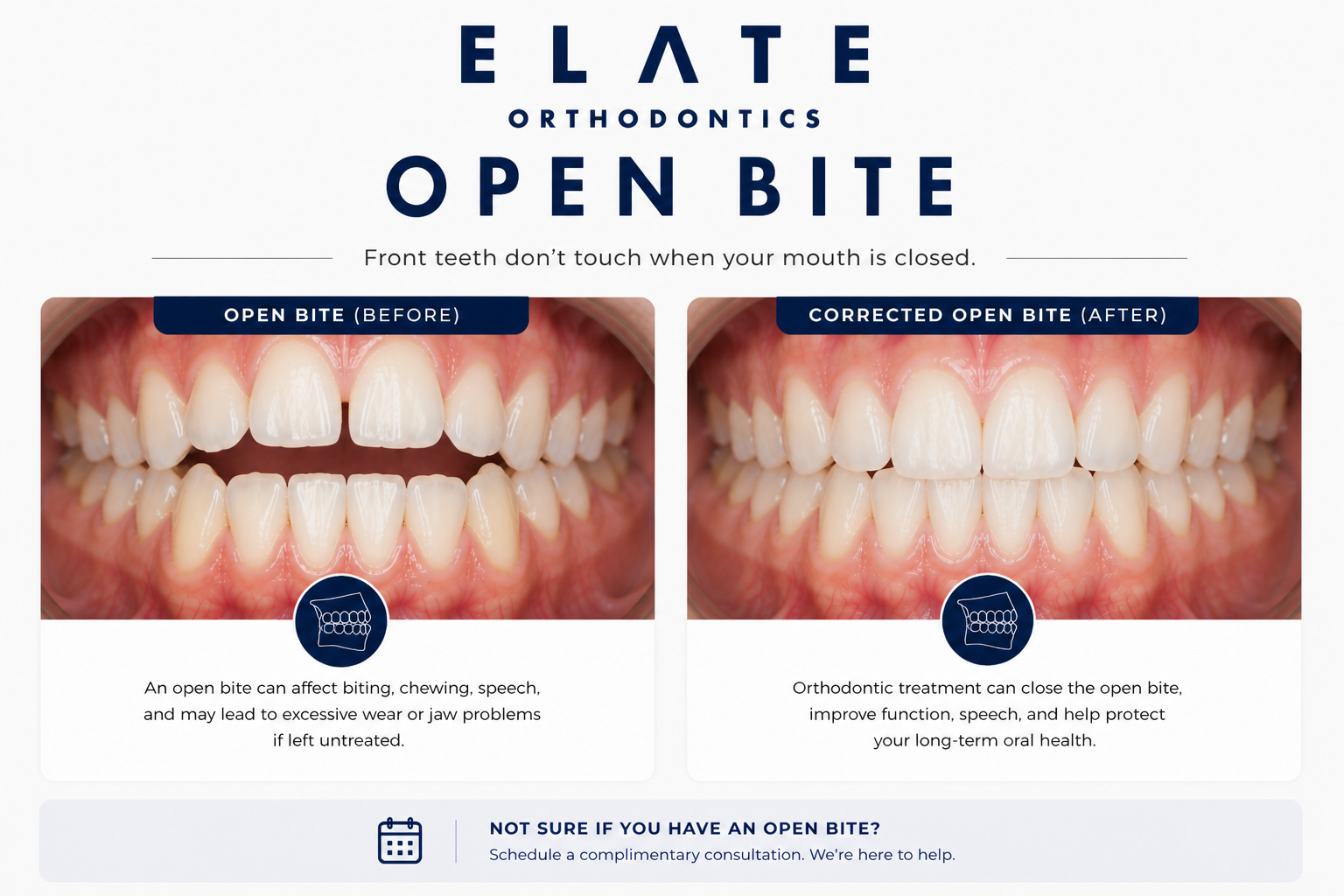
Open bite correction at Elate Orthodontics — addressing the bite and the underlying cause for stable, lasting results
Open Bite — Frisco & The Colony, TX
When Front Teeth Don’t Touch, the Cause Matters as Much as the Correction
An open bite is a malocclusion where the upper and lower teeth do not touch when the back teeth are closed, leaving a visible gap. The most common type is anterior open bite, where the front teeth fail to meet. Less commonly, the back teeth do not touch while the front teeth do, called posterior open bite. Open bites can be skeletal, dental, or driven by habits like thumb sucking and tongue thrust. Of all the bite conditions, open bite is the one most likely to relapse if the underlying cause is not addressed alongside the orthodontic correction.
At Elate Orthodontics, Dr. Kevin Baharvand and Dr. Julia Kang treat open bites in patients across Frisco, The Colony, Prosper, and Little Elm. Our diagnostic process always identifies what is causing the open bite before recommending treatment. Closing an open bite without addressing a tongue thrust or mouth breathing pattern often results in the bite reopening within months. We treat the cause, not just the symptom.
As an ABO board-certified practice with a published clinician on staff, our diagnostic approach reflects the depth of training that distinguishes specialty orthodontic care. We take comprehensive records at every consultation and explain exactly what we see using your own digital scans, panoramic X-rays, and clinical photos. For open bite cases, we also screen for tongue posture, breathing patterns, and habit history because these factors determine whether the correction will hold.
The Two Types of Open Bite (And Why the Difference Matters)
Anterior Open Bite
An anterior open bite occurs when the upper and lower front teeth do not touch when the back teeth are biting down. There is a visible vertical gap between the upper and lower incisors. This is the most common form of open bite and is often associated with prolonged thumb sucking, pacifier use, tongue thrust, or vertical skeletal growth patterns where the lower jaw rotates open during development.
Anterior open bites cause functional difficulty biting into food with the front teeth and frequently affect speech, particularly sounds like S, Z, T, and TH that require the tongue to seal against the front teeth. Treatment depends on the underlying cause and almost always involves addressing both the bite and the contributing habit.
Posterior Open Bite
A posterior open bite occurs when one or more back teeth fail to meet their counterparts when the front teeth are touching. There is a vertical gap on one or both sides where the molars or premolars do not contact. This is much less common than anterior open bite and is often caused by tongue posture issues, ankylosis where a tooth fuses to the bone and stops erupting, or eruption disturbances.
Posterior open bites can cause uneven distribution of bite forces, accelerated wear on the teeth that do touch, and TMJ strain. Treatment is more individualized than for anterior cases and depends heavily on identifying why the back teeth are not erupting fully into contact.
Some patients have combined open bites or bilateral patterns. Comprehensive diagnosis identifies every dimension of the open bite and the contributing factors.
Underlying Causes
What Causes an Open Bite?
Persistent thumb sucking or pacifier use past age 4 to 5 is the most common cause of anterior open bite in children. The thumb or pacifier physically holds the front teeth apart and pushes the upper teeth forward, while also narrowing the upper jaw. Stopping the habit is the first and most important step. Once the habit has stopped, the open bite may partially self-correct in young children, but most cases still need orthodontic intervention.
Tongue thrust is when the tongue pushes forward against or between the front teeth during swallowing or at rest. Over thousands of swallows per day, this constant pressure prevents the front teeth from coming together and drives them apart. Tongue thrust is often the underlying reason an open bite reopens after orthodontic correction. Treating it usually requires myofunctional therapy alongside braces or aligners.
Chronic mouth breathing changes resting tongue posture and head position. The tongue rests low instead of against the palate, the lower jaw rotates open and downward, and over years of growth this rotation produces a longer face shape and an anterior open bite. Mouth breathing is often related to enlarged tonsils, allergies, or airway obstruction, which is why we screen for these issues and refer to ENTs and sleep specialists when needed.
Some patients are genetically predisposed to a vertical, downward-and-backward growth pattern of the lower jaw rather than a forward growth pattern. This rotates the jaw open and produces a long-face appearance with an anterior open bite. Skeletal open bites are the most challenging to treat because the underlying jaw geometry resists closure. Severe adult skeletal open bites sometimes require coordination with an oral surgeon.
Posterior open bites are sometimes caused by ankylosis, a condition where a tooth fuses to the surrounding bone and stops erupting while neighboring teeth continue to grow into the bite. This creates a localized vertical gap. Eruption disturbances, missing teeth, and mechanical interferences can also produce focal open bites that need targeted treatment.
Like other malocclusions, open bite has a meaningful genetic component. Vertical jaw growth patterns, tongue size, and airway anatomy all run in families. If you or your spouse have an open bite or a long-face appearance, your children should be evaluated early to identify and address developing patterns before they fully express.
Why an Untreated Open Bite Is Worth Addressing
Open bites are not just cosmetic. The front teeth are designed to meet during biting, chewing, speech, and swallowing. When they cannot, the entire system compensates in ways that accumulate damage over years. The back teeth take on more bite force, accelerating wear. Speech often suffers. Swallowing patterns become abnormal. And when the cause is something like a tongue thrust or mouth breathing, the bite continues to worsen until those underlying drivers are addressed.
Beyond the function and the bite itself, open bites are unique among malocclusions in their tendency to relapse. Treating them well requires identifying and resolving the cause, not just closing the gap.
What Happens If Open Bite Is Left Untreated
Difficulty biting into food with the front teeth
Speech difficulties with sounds like S, Z, T, and TH
Accelerated wear on the back teeth from carrying disproportionate bite force
Persistent or worsening tongue thrust as the tongue continues to fill the open space
TMJ strain and jaw fatigue from compensatory chewing patterns
Progressive worsening when driven by ongoing habits like mouth breathing or thumb sucking
Higher likelihood of needing surgery later if a vertical skeletal pattern goes uncorrected through growth
Self-consciousness about smile appearance when the gap is visible
Treatment Approach
How We Treat Open Bite at Every Age
Open bite treatment depends on the cause, the age of the patient, and whether contributing habits are still active. The single most important principle is that treatment must address the underlying driver, not just the gap. This is why we evaluate carefully before recommending an approach.
Children (Ages 7–10)
For young children, the priority is ending the contributing habit and intercepting skeletal patterns before they fully develop. Habit appliances can help eliminate persistent thumb sucking or tongue thrust. Once the habit has stopped, mild open bites in young children sometimes self-correct as the front teeth continue to erupt.
For developing skeletal open bites caused by mouth breathing or vertical growth patterns, we screen for airway issues and refer to ENTs or sleep specialists when indicated, because addressing the airway is foundational to controlling the growth pattern.
Teens (Ages 11–17)
The teen years are an effective treatment window for most open bites. Comprehensive treatment with braces or clear aligners can intrude back teeth and erupt front teeth into proper contact, often combined with elastics that help close the bite. Myofunctional therapy is frequently prescribed alongside orthodontic treatment when a tongue thrust is present.
For severe skeletal open bites in teens, we monitor growth carefully and may plan combined orthodontic and surgical treatment in late adolescence once growth is complete.
Adults
In adults, mild to moderate open bites can be corrected with braces or clear aligners, often using temporary anchorage devices (TADs) to intrude back teeth and close the bite. Modern Invisalign and Angel Aligner protocols are particularly effective for many adult open bites because the aligners themselves prevent the tongue from thrusting between the teeth during treatment.
For severe skeletal open bites in adults where orthodontic treatment alone cannot produce a stable result, we coordinate with experienced oral surgeons for jaw surgery. We will tell you honestly which path is realistic for your case.
Treatment Options
Treatments We Use to Correct Open Bite
Traditional Braces
The most versatile option for moderate to severe open bites. Braces give us precise control to extrude the front teeth, intrude the back teeth, and use vertical elastics to close the bite. The gold standard for complex open bite cases and for cases requiring TADs (temporary anchorage devices).
Clear Braces
Same effective mechanics as traditional braces with tooth-colored brackets that blend with natural enamel. A great option for teens and adults treating open bite who want the predictability of braces with less visibility during treatment.
Invisalign
Clear aligners are uniquely effective for many open bite cases. The aligners physically cover the back teeth and prevent over-eruption, while the planned tooth movements bring the front teeth into contact. The aligners also block tongue thrust during treatment, helping retrain swallowing patterns. A strong option for cooperative teens and adults.
Angel Aligners
A clear aligner system we offer at Elate Orthodontics for appropriate cases. Like other clear aligner brands, Angel Aligners can correct many open bites with the added benefit of physically blocking tongue thrust during treatment. Treatment plans are tailored to each patient’s specific anatomy and habit history.
Habit Appliances & Myofunctional Therapy
Habit appliances help children stop persistent thumb sucking or tongue thrust by providing a physical reminder during normal function. For tongue thrust, we frequently coordinate with myofunctional therapists who retrain tongue posture and swallowing patterns. Without addressing the habit, open bite correction is at high risk of relapse.
Temporary Anchorage Devices (TADs)
TADs are small mini-implants placed in the bone that serve as fixed anchor points for orthodontic forces. They allow us to intrude back teeth predictably, which is one of the most powerful ways to close an anterior open bite without surgery. TADs have transformed adult open bite treatment over the past decade.
Airway Coordination
For open bites driven by chronic mouth breathing, we coordinate with ENTs and sleep specialists to address enlarged tonsils, allergies, or airway obstruction. Without resolving the airway issue, the open bite often returns even after orthodontic correction. See our airway orthodontics page for more on our integrated approach.
Orthognathic Surgery (Severe Adult Cases)
For adults with severe skeletal open bites where orthodontic treatment alone cannot produce a stable, healthy bite, we coordinate with experienced oral surgeons for jaw surgery combined with orthodontic treatment. This is reserved for cases that genuinely require it. We will tell you clearly when this is the right path.
AAO Recommendation
Open Bite Has Multiple Root Causes — Catching Them Early Matters
The American Association of Orthodontists recommends an evaluation by age 7. For open bite, this recommendation is particularly important because the contributing causes (thumb sucking, tongue thrust, mouth breathing, vertical growth patterns) often need to be addressed during active growth. Catching them early allows us to intercept skeletal development before a long-face vertical pattern becomes fully established.
Even if your child’s open bite seems mild, an evaluation can identify whether a habit, tongue posture issue, or airway concern is driving the bite. Addressing those factors early dramatically improves the long-term stability of treatment.
See Real Outcomes
Open Bite Cases From Our Practice
Our before-and-after gallery includes real open bite corrections at Elate Orthodontics, ranging from habit-driven cases in children corrected with appliances and orthodontics to adult cases corrected with clear aligners, TADs, or surgical coordination. Each case shows the diagnosis, the appliances used, and the final result.
Common Questions
Open Bite FAQ
In children, prolonged thumb sucking or pacifier use is the most common cause. In teens and adults, tongue thrust and chronic mouth breathing are leading drivers. Skeletal vertical growth patterns and genetic factors contribute in many cases. Identifying the underlying cause is essential because treatment that does not address it has a high relapse rate.
Yes, and clear aligners are often particularly effective for open bite cases. The aligners physically cover the back teeth and prevent over-eruption while the front teeth move into contact. They also block tongue thrust during treatment, which helps retrain swallowing patterns. Severe skeletal cases may still require braces with TADs or surgical coordination.
In young children, mild open bites sometimes partially self-correct after the habit stops, particularly if the front teeth are still erupting. However, most cases still need orthodontic correction to fully close the bite, and skeletal effects on jaw width and shape often persist. Stopping the habit is essential, but it is rarely the entire solution.
Open bite relapse is almost always driven by an unaddressed underlying cause, most commonly tongue thrust or chronic mouth breathing. If the tongue continues to push against the front teeth thousands of times a day after treatment, it gradually reopens the bite. This is why we screen for tongue posture, habits, and airway issues during evaluation and treat them alongside the orthodontic correction.
Most comprehensive open bite treatments take 18 to 30 months. Cases involving habit appliances or myofunctional therapy may include additional time before active orthodontic treatment begins. Adult cases using TADs to intrude back teeth typically take 18 to 24 months. Combined surgical and orthodontic treatment can take 24 to 36 months total.
Most PPO dental insurance plans include orthodontic benefits that apply to open bite treatment, particularly when there is documented functional concern such as speech difficulty or chewing problems. Coverage varies by plan. We are in-network with most major PPO carriers and offer flexible financing through Cherry to make treatment accessible regardless of insurance coverage.
Why Frisco & The Colony Families Choose Elate Orthodontics for Open Bite Correction
Open bite is one of the most relapse-prone conditions in orthodontics if not treated properly. The depth of the diagnosis, the willingness to address the underlying cause alongside the bite, and the experience to know when myofunctional therapy or airway coordination is needed are what separate good outcomes from great ones. Dr. Baharvand and Dr. Kang have managed open bite cases across the full spectrum, from habit-driven cases in elementary school children to complex adult cases requiring TADs or surgical coordination.
Dr. Baharvand and Dr. Kang are a husband-and-wife orthodontic team based in Frisco, with three convenient locations serving families across Frisco, The Colony, Prosper, and Little Elm. Dr. Baharvand is ABO board-certified and a published clinician whose work has appeared in the American Journal of Orthodontics and Dentofacial Orthopedics.
1,000+
Five-star reviews across 3 locations
ABO
Board-certified orthodontist
Published
AJO-DO cover clinician
Free
Consultation with full diagnostic records
Our Locations
5605 FM 423, Suite 600
Frisco, TX 75036
FM 423 & Lebanon Rd — next to the UPS Store
4713 Highway 121, Suite 304
The Colony, TX 75056
FM 423 & Hwy 121 — next to Ross
2155 University Dr, Suite 110
Frisco, TX 75033
On 380 across from Cook Children’s Medical Center Prosper
Hours: Mon–Fri 8:00am–5:00pm | 972.538.4343
Suspect an Open Bite? Let’s Diagnose the Cause and Build a Plan.
Free consultations at all three Elate Orthodontics locations include a complete diagnostic workup: digital scans, panoramic X-rays, clinical photos, and screening for habits and airway factors. We identify whether the open bite is dental, skeletal, habit-driven, or a combination. No pressure, no surprises, no commitment to treatment.
Also see: All Conditions We Treat | Overbite | Underbite | Crossbite | Airway Orthodontics | Before & After