





Gapped Teeth Treatment in Frisco & The Colony, TX
Diagnosis & Correction by Dr. Baharvand & Dr. Kang — Braces, Invisalign, Angel Aligners & Frenectomy Coordination
📞 972.538.4343
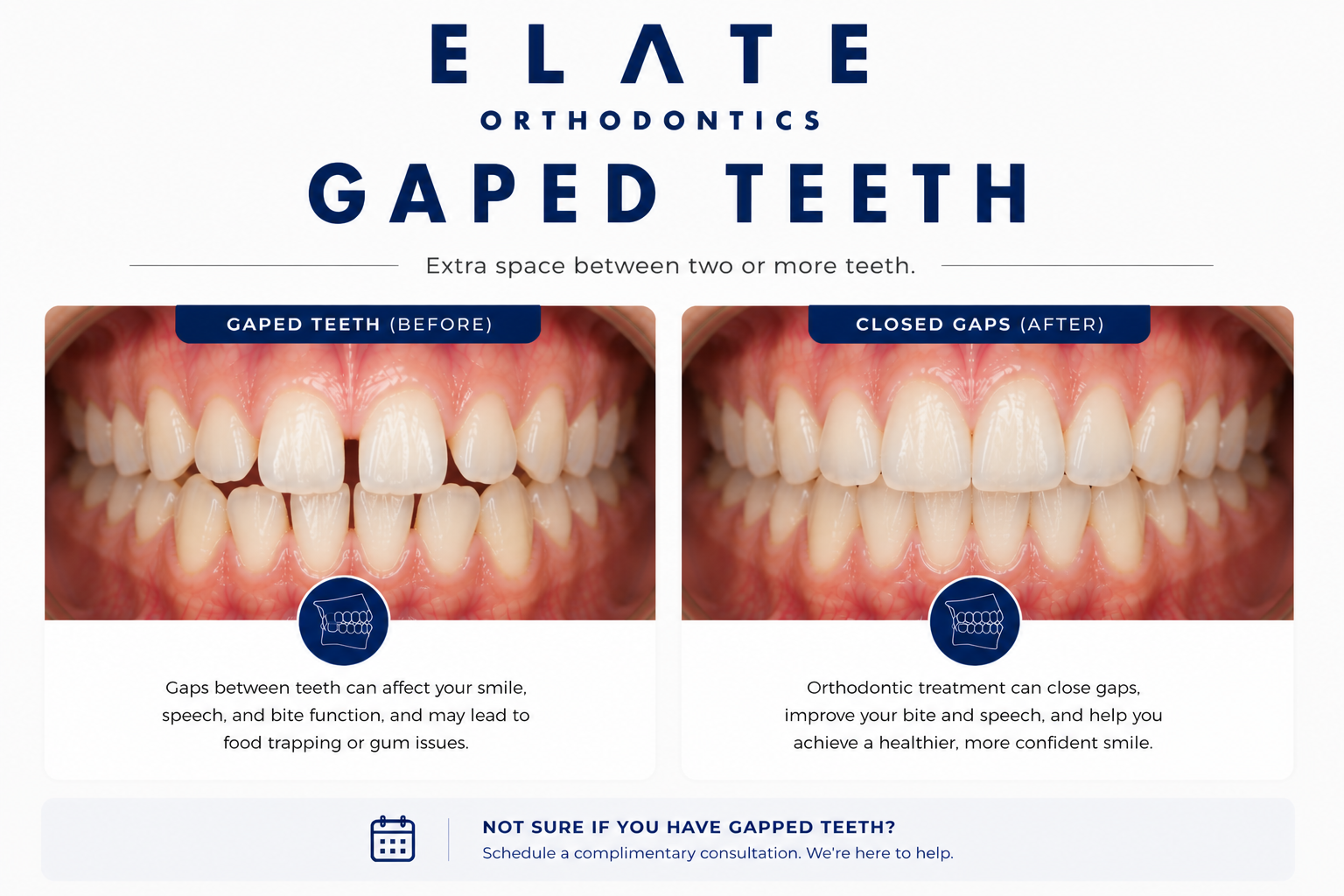
Gapped teeth correction at Elate Orthodontics — closing spaces and addressing the underlying cause for stable, lasting results
Gapped Teeth — Frisco & The Colony, TX
Closing Gaps Is Easy. Keeping Them Closed Is Where Diagnosis Matters Most.
Gapped teeth, also called spacing or diastema, refers to visible gaps between two or more teeth. The most common type is the midline diastema — the gap between the upper two front teeth. Gaps can also appear between any two teeth in the arch and can range from a single small space to widespread spacing throughout both arches. Some people love their gaps and choose to keep them. Others find them affect their confidence, their speech, or their bite. Either is a valid choice.
At Elate Orthodontics, Dr. Kevin Baharvand and Dr. Julia Kang treat gapped teeth in patients across Frisco, The Colony, Prosper, and Little Elm. Closing a gap with braces or aligners is technically straightforward. The harder part — and the part that determines whether the result lasts — is identifying why the gap formed in the first place. A diastema caused by an oversized labial frenum behaves very differently from a diastema caused by a missing tooth or a tongue thrust. Treatment that does not address the underlying cause has a high relapse rate.
As an ABO board-certified practice with a published clinician on staff, our diagnostic approach reflects the depth of training that distinguishes specialty orthodontic care. We take comprehensive records at every consultation and explain exactly what we see using your own digital scans, panoramic X-rays, and clinical photos. For gapped teeth cases, we identify every contributing factor before designing the treatment plan and the retention strategy.
The Common Patterns of Gapped Teeth
Midline Diastema
A midline diastema is a gap between the upper two front teeth — the most recognizable form of gapped teeth and what most patients are referring to when they search for treatment. Midline diastemas are common in childhood and often close naturally as the canines erupt. When they persist into adulthood, they are usually caused by an oversized labial frenum, a tooth size discrepancy, or missing lateral incisors.
Closing a midline diastema is straightforward orthodontically. The challenge is keeping it closed, which often requires addressing the frenum or planning for permanent retention.
Multiple Gaps & Generalized Spacing
Some patients have spaces between many or all of their teeth rather than a single midline gap. This usually indicates that the teeth are smaller than the jaws (microdontia or arch-tooth size discrepancy) or that the patient has missing teeth that have allowed the remaining teeth to drift. Generalized spacing requires a comprehensive treatment plan because simply closing all the gaps may leave teeth in non-ideal positions.
In some cases, the right answer is to redistribute the spaces and have a restorative dentist add veneers or build up tooth size. We coordinate with restorative dentists for these cases.
Some patients have a single isolated gap. Others have widespread spacing. Comprehensive diagnosis identifies the pattern, the cause, and the right approach.
Underlying Causes
What Causes Gapped Teeth?
When the teeth are smaller than the available space in the jaws, gaps appear naturally between teeth. This is often genetic and is the most common cause of generalized spacing. The teeth themselves are healthy and well-formed, just smaller than the arch they sit in. Treatment usually involves either closing all the spaces and accepting the new positions or redistributing the spaces for restorative buildup.
The labial frenum is the small band of tissue connecting the upper lip to the gums between the two front teeth. When this frenum is unusually large or attaches too low, it can prevent the front teeth from coming together and produce a persistent midline diastema. In these cases, the orthodontic gap closure is typically combined with a small surgical procedure called a frenectomy to remove the excess tissue and prevent the gap from reopening.
When a tooth is missing — most commonly the upper lateral incisors next to the front teeth — the remaining teeth often drift into the empty space, creating gaps. Treatment depends on whether we close the space and bring the canine forward or open the space and coordinate with a restorative dentist for an implant or bridge. Both approaches are valid and depend on the patient’s bite, age, and aesthetic goals.
When the tongue pushes forward against the front teeth during swallowing or at rest, it can flare the front teeth outward and create gaps. Tongue thrust is one of the most common reasons gapped teeth relapse after orthodontic correction — if the tongue continues pushing, the teeth gradually drift back apart. We screen for tongue posture during evaluation and frequently coordinate with myofunctional therapists when needed.
In adults, gapped teeth can develop or worsen due to periodontal disease that has damaged the supporting bone around the teeth. The teeth become loose and can drift apart, often flaring outward. Treating gapped teeth in this scenario requires close coordination with a periodontist to first stabilize the gum and bone health before orthodontic alignment.
In children, persistent thumb sucking or tongue thrust can hold the front teeth apart. Lingering baby teeth that have not fallen out on time can also block adult teeth from settling into proper positions, leaving gaps. Most childhood diastemas of this type close naturally once the habit stops or the baby tooth is lost, but persistent cases benefit from focused orthodontic intervention.
Should You Treat Gapped Teeth?
Whether to treat gapped teeth is more of a personal decision than most malocclusions. Some patients love their gaps as a signature feature and choose to keep them. Others want them closed for cosmetic, functional, or self-esteem reasons. Both choices are valid. We do not pressure anyone into treatment.
However, there are some scenarios where untreated gapped teeth do cause real problems beyond appearance — particularly when the gaps are caused by ongoing factors like tongue thrust, periodontal disease, or missing teeth that are allowing further drift. In these cases, treating the gaps is also treating the underlying issue.
When Gapped Teeth Become a Problem
Speech difficulties, particularly with sounds like S, F, and TH that require sealing against the front teeth
Food trapping in gaps, increasing the risk of decay and gum inflammation
Progressive widening over time when caused by ongoing tongue thrust, periodontal disease, or drift from missing teeth
Bite instability when teeth drift into non-ideal positions
Self-consciousness about smile appearance when patients want their gaps closed but have not pursued treatment
Increased risk of gum recession on flared front teeth that have drifted outward
Compounding orthodontic problems when gaps coexist with bite issues like overbite or crossbite
Treatment Approach
How We Treat Gapped Teeth at Every Age
Gapped teeth treatment depends on the patient’s age, the cause of the spacing, and whether contributing factors like a tongue thrust or oversized frenum need to be addressed. The mechanical part is straightforward. The diagnostic and retention strategy is what determines whether the result lasts.
Children (Ages 7–10)
Many midline diastemas in young children close naturally as the upper canines erupt and push the lateral incisors and central incisors into proper position. This natural closure is sometimes called “the ugly duckling stage” because the gap looks worrying but typically resolves without treatment.
We evaluate at age 7 to determine whether the gap is the normal developmental kind that will close on its own, or whether something like an oversized frenum, missing tooth, or persistent habit is preventing closure. Most children do not need treatment at this age. We monitor and intervene only when needed.
Teens (Ages 11–17)
By the teen years, we know whether a gap is going to close on its own. Persistent diastemas at this stage are usually treated as part of comprehensive orthodontic care. Braces or clear aligners close the spaces and align the teeth simultaneously. If a frenectomy is needed to prevent relapse, we coordinate the timing with the orthodontic treatment.
Teens treated for gapped teeth typically need permanent bonded retention behind the front teeth to keep the gap closed long-term, particularly for midline diastemas.
Adults
Adult gapped teeth treatment is typically focused on the spaces themselves, often with shorter overall treatment times than full orthodontic cases. Clear aligners are an excellent option for many adult diastema cases. For adults with widespread spacing or missing teeth, we coordinate with restorative dentists for the final aesthetic result.
Adults with periodontal disease must address gum and bone health before orthodontic treatment. We work alongside periodontists for these cases.
Treatment Options
Treatments We Use to Close Gaps
Invisalign
One of the most popular options for closing gaps in adults and teens. Clear aligners excel at predictable, controlled space closure with minimal visibility during treatment. For mild diastemas, treatment can sometimes be completed in as little as 6 to 12 months. Severity, comprehensive needs, and patient compliance all affect timing.
Angel Aligners
A clear aligner system we offer at Elate Orthodontics for appropriate cases. Like other clear aligner brands, Angel Aligners can effectively close gaps and align teeth simultaneously, with treatment plans tailored to each patient’s specific spacing and bite goals.
Traditional Braces
The most versatile option for cases involving widespread spacing, complex tooth movements, or coordination with restorative work. Braces give us precise control over each tooth and are particularly valuable when gap closure is part of comprehensive orthodontic treatment with bite correction.
Clear Braces
Same effective mechanics as traditional braces with tooth-colored brackets that blend with natural enamel. A great middle-ground option for teens and adults treating gapped teeth who want the predictability of braces with less visibility during treatment.
Frenectomy Coordination
For midline diastemas caused by an oversized labial frenum, we coordinate with an oral surgeon or periodontist for a small frenectomy procedure to remove the excess tissue. Timing matters — typically performed during or after orthodontic gap closure rather than before. This is a key step in preventing relapse.
Restorative Coordination
For patients with missing teeth or significant tooth size discrepancies, we coordinate with restorative dentists. The orthodontic phase positions the teeth correctly and creates ideal spaces for veneers, bonding, or implants. For congenitally missing lateral incisors, we plan whether to close space orthodontically or open space for a future implant based on the patient’s bite, age, and aesthetic goals.
Permanent Bonded Retainers
For patients with closed midline diastemas or other gap closures, we typically place a small wire bonded behind the front teeth to keep the gap closed long-term. This permanent retainer is invisible from the front, easy to maintain, and dramatically reduces the risk of the gap reopening over time. Retention strategy is critical for diastema cases.
Myofunctional Therapy
When tongue thrust is contributing to gapped teeth, we frequently coordinate with myofunctional therapists who retrain tongue posture and swallowing patterns. Without addressing the tongue thrust, gap closure is at high risk of relapse no matter how well the orthodontic treatment goes.
AAO Recommendation
Diagnose the Cause Before Treating the Gap
The American Association of Orthodontists recommends an evaluation by age 7. For gapped teeth, the goal of the early evaluation is not to start treatment but to determine whether the gap will close naturally as more teeth erupt, or whether something specific is preventing closure. This is the difference between unnecessary intervention and well-timed treatment.
For adults, the right time for diastema treatment is when you decide you want to close the gap. There is no biological deadline like there is for skeletal conditions. We treat gapped teeth in patients of all ages with excellent outcomes when the underlying cause is properly addressed.
See Real Outcomes
Gapped Teeth Cases From Our Practice
Our before-and-after gallery includes real diastema and spacing corrections at Elate Orthodontics, ranging from simple midline gap closures with clear aligners to complex cases involving missing teeth, frenectomy coordination, and restorative work. Each case shows the diagnosis, the appliances used, and the final result.
Common Questions
Gapped Teeth FAQ
A diastema is the clinical term for a visible gap between two teeth, most commonly between the upper two front teeth (called a midline diastema). Diastemas can occur between any two teeth in either arch and can range from a small space to a wide gap. The term applies regardless of cause and is the same word patients and clinicians use.
Yes — closing a midline diastema is one of the most common and predictable cases for clear aligners. Invisalign and Angel Aligners both excel at controlled space closure. For mild gaps with no underlying frenum issue, treatment can sometimes be completed in 6 to 12 months. Larger gaps or comprehensive cases take longer.
Many midline diastemas in young children close naturally as the upper canines erupt and push the front teeth into proper position. This is sometimes called “the ugly duckling stage” because the gap looks worrying but typically resolves without treatment. Persistent gaps, gaps caused by an oversized frenum, or gaps in patients with missing teeth usually need orthodontic intervention. An evaluation at age 7 will tell you which category your child falls into.
Gap relapse is almost always caused by an unaddressed underlying factor. The most common culprits are an untreated oversized frenum, persistent tongue thrust, or inconsistent retainer wear. This is why we identify the cause during evaluation and plan retention strategy alongside treatment. For midline diastemas, a small permanent bonded retainer behind the front teeth is often the most reliable long-term solution.
For an isolated midline diastema with no other concerns, treatment can sometimes be completed in 6 to 12 months. Cases involving multiple gaps, missing teeth, or comprehensive bite correction typically take 18 to 24 months. Treatment time depends entirely on the complexity of the case, which we determine at consultation.
Most PPO dental insurance plans include orthodontic benefits that apply to gapped teeth treatment, particularly when there is documented functional concern such as speech difficulty or food trapping. Coverage varies by plan. We are in-network with most major PPO carriers and offer flexible financing through Cherry to make treatment accessible regardless of insurance coverage.
Why Frisco & The Colony Patients Choose Elate Orthodontics for Gap Closure
Closing gaps is straightforward orthodontically. Keeping them closed long-term is where experience matters. The depth of the diagnosis, the willingness to address contributing factors like an oversized frenum or tongue thrust, and the planning of retention strategy are what separate good outcomes from great ones. Dr. Baharvand and Dr. Kang have managed gapped teeth cases across the full spectrum, from simple midline diastema closures with clear aligners to complex cases involving missing teeth and restorative coordination.
Dr. Baharvand and Dr. Kang are a husband-and-wife orthodontic team based in Frisco, with three convenient locations serving families across Frisco, The Colony, Prosper, and Little Elm. Dr. Baharvand is ABO board-certified and a published clinician whose work has appeared in the American Journal of Orthodontics and Dentofacial Orthopedics.
1,000+
Five-star reviews across 3 locations
ABO
Board-certified orthodontist
Published
AJO-DO cover clinician
Free
Consultation with full diagnostic records
Our Locations
5605 FM 423, Suite 600
Frisco, TX 75036
FM 423 & Lebanon Rd — next to the UPS Store
4713 Highway 121, Suite 304
The Colony, TX 75056
FM 423 & Hwy 121 — next to Ross
2155 University Dr, Suite 110
Frisco, TX 75033
On 380 across from Cook Children’s Medical Center Prosper
Hours: Mon–Fri 8:00am–5:00pm | 972.538.4343
Ready to Close the Gap? Let’s Plan It the Right Way.
Free consultations at all three Elate Orthodontics locations include a complete diagnostic workup: digital scans, panoramic X-rays, clinical photos, and identification of every factor contributing to your spacing. We design treatment that closes the gap and keeps it closed. No pressure, no surprises, no commitment to treatment.
Also see: All Conditions We Treat | Overbite | Underbite | Crossbite | Open Bite | Deep Bite | Before & After