





Mouth Breathing Treatment in Frisco & The Colony, TX
Diagnosis & Coordinated Care by Dr. Baharvand & Dr. Kang — Palatal Expansion for Growing Patients, Plus Braces, Invisalign, Angel Aligners & ENT Coordination
📞 972.538.4343
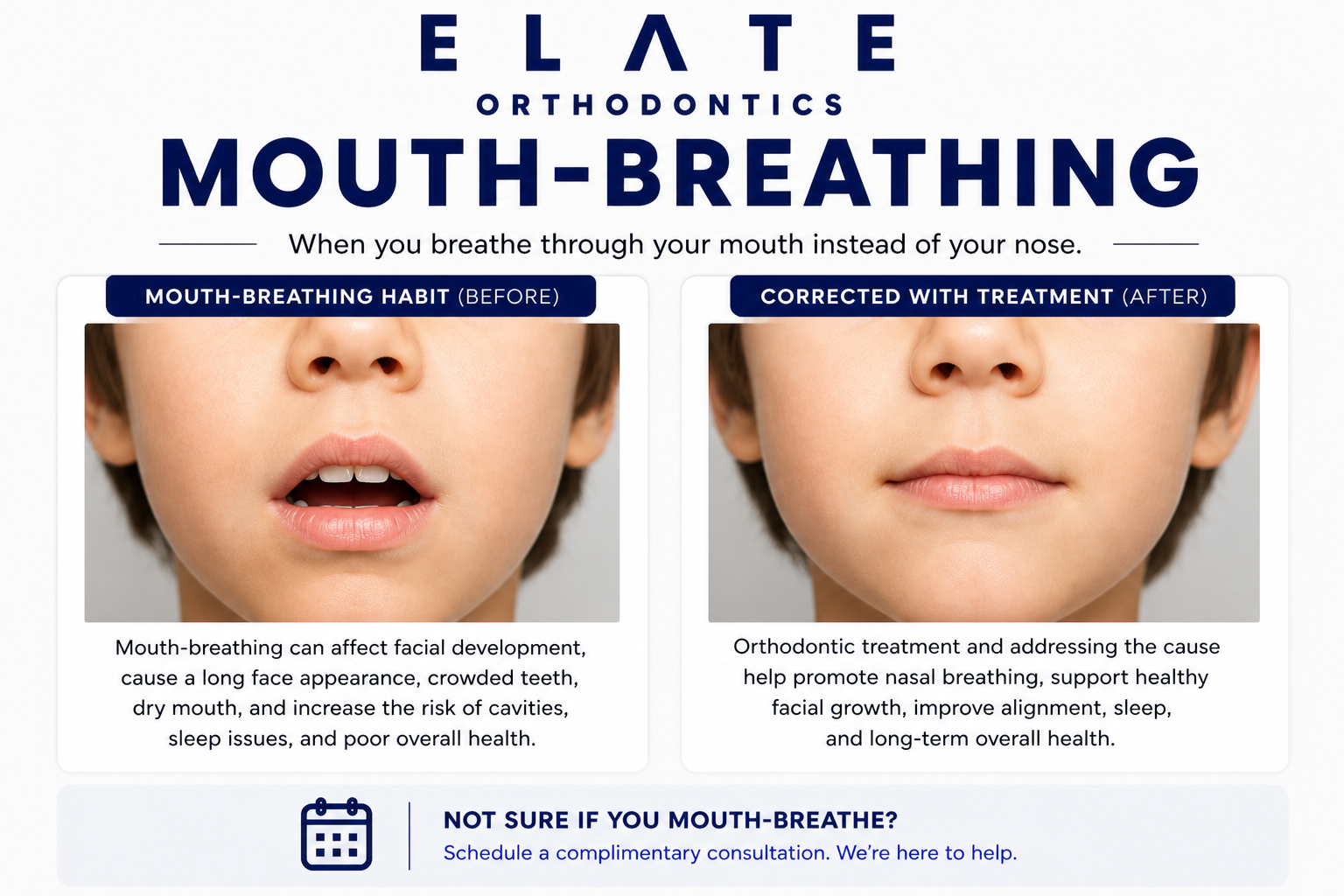
Mouth breathing treatment at Elate Orthodontics — addressing the airway, the jaws, and the long-term effects together
Mouth Breathing — Frisco & The Colony, TX
Chronic Mouth Breathing in Children Reshapes the Face, the Jaws, and the Bite Over Years of Growth
Mouth breathing refers to the chronic habit of breathing through the mouth rather than through the nose, both during the day and during sleep. Occasional mouth breathing during a cold or strenuous exercise is normal. Persistent mouth breathing that becomes the default pattern is not. In children, chronic mouth breathing during the growth years has profound downstream effects: a narrow upper jaw develops because the tongue rests low rather than against the palate, the lower jaw rotates downward and backward, the face lengthens, and the bite often develops with crowding, crossbite, open bite, or protruding upper teeth. The pattern is sometimes called “long face syndrome” or “adenoid facies” in clinical literature.
At Elate Orthodontics, Dr. Kevin Baharvand and Dr. Julia Kang treat the orthodontic consequences of mouth breathing in patients across Frisco, The Colony, Prosper, and Little Elm. Mouth breathing is rarely a standalone orthodontic concern. It typically coexists with narrow palate, tongue thrust, and crowding, and it is also closely connected to enlarged tonsils and adenoids, allergies, and pediatric airway issues. Effective treatment requires identifying the root cause of the mouth breathing (which is often outside the orthodontist’s scope) and coordinating care alongside ENT specialists, allergists, sleep physicians, and myofunctional therapists.
As an ABO board-certified practice with a published clinician on staff, our diagnostic approach reflects the depth of training that distinguishes specialty orthodontic care. We take comprehensive records at every consultation and explain exactly what we see using your own digital scans, panoramic X-rays, and clinical photos. For mouth breathing cases, we identify the orthodontic consequences and coordinate with the right specialists to address the underlying airway issues. Our airway orthodontics page covers our coordinated approach in more depth.
Recognizing Chronic Mouth Breathing
Most Common
Daytime Mouth Breathing
Children with chronic daytime mouth breathing typically have their lips parted at rest, breathe audibly through the mouth even when not exerting themselves, and often have dry, chapped lips year-round. Parents may notice that their child’s mouth is open during quiet activities like reading, watching TV, or focusing on schoolwork. The habit becomes so automatic that the child does not realize they are doing it.
When daytime mouth breathing has been the pattern for years during growth, structural changes in the jaws and face are usually visible during orthodontic evaluation.
Sleep Pattern
Nighttime Mouth Breathing & Snoring
Many children breathe through their nose during the day but mouth breathe heavily during sleep. Common signs include snoring, restless sleep, drooling on the pillow, waking with a dry mouth, and morning irritability or fatigue despite adequate sleep hours. Some children also exhibit sleep-disordered breathing patterns that may warrant sleep medicine evaluation.
Nighttime mouth breathing produces the same downstream growth effects as daytime mouth breathing because the tongue and jaw position during sleep also influences how the face develops over years.
Visible Pattern
Long Face Pattern
Children with years of chronic mouth breathing often develop a recognizable facial pattern: a long, narrow face shape, narrow nose, dark circles under the eyes, slightly retruded chin, and an open lip posture even at rest. The clinical literature sometimes calls this “adenoid facies” because it was first associated with chronically enlarged adenoids. The changes are real but they are downstream of the mouth breathing itself.
Recognizing this pattern in childhood — particularly between ages 6 and 10 — opens the window for intervention that can meaningfully change the trajectory of facial growth.
Adult Pattern
Adult Legacy Mouth Breathing
Many adults who chronically mouth-breathed as children continue the habit into adulthood and now present with the structural consequences: narrow palate, crowding, retruded lower jaw, and sometimes sleep-related concerns. Adult mouth breathers often also experience chronic dry mouth, increased dental decay risk, gum inflammation, and snoring that affects their partner.
In adults, true skeletal expansion is no longer possible through routine orthodontic appliances since the midpalatal suture has fused. We address adult mouth breathing consequences through arch development and comprehensive orthodontics, while coordinating with ENT and sleep medicine when indicated. We do not provide adult palatal expansion.
Most patients have a combination of daytime and nighttime mouth breathing, with downstream structural changes that vary by how long the habit has been present and at what age it started.
Underlying Causes
What Causes Chronic Mouth Breathing?
Enlarged Tonsils & Adenoids
The single most common cause of chronic mouth breathing in children. Enlarged tonsils and adenoids physically obstruct the upper airway, making nasal breathing difficult or impossible. Children adapt by breathing through their mouth, often without consciously realizing the airway obstruction. Coordinating with an ENT specialist for evaluation and possible tonsillectomy or adenoidectomy is often the foundation of treatment.
Chronic Allergies & Nasal Congestion
Children with persistent environmental allergies, recurrent sinusitis, or chronic rhinitis often default to mouth breathing because nasal breathing is uncomfortable. Even after allergies improve, the mouth breathing habit can persist because it has become the muscle memory pattern. Coordinating with allergists alongside orthodontic treatment is part of comprehensive care.
Deviated Septum & Nasal Anatomy
A deviated nasal septum, narrow nasal passages, or other anatomic variations of the nose can make nasal breathing physically difficult. These cases typically need ENT evaluation and sometimes surgical correction to restore comfortable nasal breathing. Orthodontic treatment alone cannot address structural nasal issues.
Narrow Upper Jaw & Constricted Airway
A narrow upper jaw produces a constricted nasal floor, since the roof of the mouth and the floor of the nasal cavity are the same bone. This contributes to nasal airway resistance and reinforces mouth breathing. In growing children, palatal expansion can sometimes improve nasal airway dimensions and support better nasal breathing alongside the orthodontic benefits.
Tongue-Tie & Low Tongue Posture
A restrictive frenum under the tongue can prevent the tongue from resting against the palate, contributing to low tongue posture and the open-mouth position that becomes mouth breathing. We screen for tongue-tie during evaluation and coordinate with appropriate specialists when release is needed.
Habit Persistence After Underlying Cause Resolves
Even after the underlying cause of mouth breathing is addressed (tonsils removed, allergies controlled, septum corrected), the habit pattern often persists because it has become the established muscle memory. Myofunctional therapy is often essential for retraining nasal breathing and proper tongue posture once the airway is patent.
Why Mouth Breathing Matters During Growth
Mouth breathing during the years of facial growth is one of the most consequential conditions in pediatric orthodontics. The tongue is one of the strongest forces shaping the upper jaw during development. When the tongue rests against the palate during nasal breathing, it provides the lateral pressure that helps the upper jaw develop wide and well-formed. When mouth breathing forces the tongue to drop low, that lateral pressure disappears, and the upper jaw develops narrow and high-arched. The jaw rotates downward, the face lengthens, and the bite develops with crowding and other problems.
These changes are largely permanent once growth is complete. This is why catching mouth breathing early — and addressing both the underlying airway cause and the orthodontic consequences during the active growth window — produces a fundamentally different outcome than addressing the same case in adulthood.
What Untreated Mouth Breathing Causes
Narrow upper jaw with high arched palate, often producing crowding and crossbite
Long, narrow face shape with retruded chin (long face syndrome pattern)
Anterior open bite from low tongue posture during growth
Higher rates of dental decay and gum disease from chronic dry mouth
Snoring, restless sleep, and potential sleep-disordered breathing concerns
Daytime fatigue, attention difficulties, or behavioral concerns potentially related to disrupted sleep
Loss of the growth-modification window once skeletal development is complete in late adolescence
Treatment Approach
How We Address Mouth Breathing at Every Age
Mouth breathing treatment is fundamentally a multidisciplinary effort. Our role as orthodontists is to address the structural consequences and to coordinate with specialists who can address the underlying airway cause. We do not treat the airway directly — we treat the orthodontic conditions that mouth breathing produces, while working alongside ENT, allergy, sleep medicine, and myofunctional specialists.
Children (Ages 7–10) — Highest Impact Window
This is the most consequential treatment window for mouth breathing. The midpalatal suture is open, palatal expansion is highly effective, growth modification is possible, and the underlying causes (enlarged tonsils, allergies) are typically most accessible to specialist care. Phase 1 treatment combined with ENT evaluation, allergy management, and myofunctional therapy can meaningfully change the trajectory of facial growth.
Most children with mouth breathing benefit from at least an evaluation in this window, even if active treatment is not started immediately.
Teens (Ages 11–17)
Through early adolescence, palatal expansion remains effective for most patients. Treatment combines comprehensive orthodontics with continued coordination with ENT specialists if airway issues persist. By late adolescence, growth modification options narrow significantly as the midpalatal suture begins fusing.
Teens with established structural changes from years of mouth breathing typically need comprehensive orthodontic treatment alongside myofunctional therapy to retrain nasal breathing patterns once the airway is patent.
Adults — Arch Development & Coordinated Care
In adults, the midpalatal suture has fused and we do not offer adult palatal expansion. We address the legacy structural changes through arch development and comprehensive orthodontics using braces, Invisalign, or Angel Aligners. We coordinate with ENT specialists for ongoing airway issues and with sleep medicine for adults with snoring or sleep-disordered breathing concerns.
For adults with severe legacy effects of childhood mouth breathing, we discuss what orthodontic treatment can and cannot achieve. Myofunctional therapy can support retraining nasal breathing patterns at any age.
Treatment Options
Treatments We Use & Specialists We Coordinate With
Palatal Expander (Growing Patients)
For growing children with narrow palate from chronic mouth breathing, palatal expansion widens the upper jaw and can sometimes support better nasal airway dimensions alongside the orthodontic benefits. Often a foundational part of Phase 1 treatment for mouth breathing cases. Highly effective during the active growth window.
Arch Development (Adults & Late Teens)
For adults and patients whose midpalatal suture has fused, arch development uses comprehensive orthodontic treatment to broaden the dental arch within the available bone. This addresses the alignment and crowding consequences of mouth breathing without claiming to widen the underlying jaw. We do not offer adult palatal expansion.
ENT Coordination
For most chronic mouth breathing cases, ENT evaluation is foundational. Tonsillectomy, adenoidectomy, septoplasty, or other airway interventions may be needed before orthodontic treatment can produce stable results. We coordinate timing with ENT specialists in the Frisco area as part of comprehensive care.
Allergy Specialist Coordination
For children whose mouth breathing is driven by chronic allergies or recurrent sinusitis, working with an allergist to control the underlying allergic disease is part of comprehensive care. Treating the orthodontic component without addressing chronic nasal congestion often produces incomplete results.
Myofunctional Therapy
Even after the underlying airway cause is addressed, the mouth breathing habit and low tongue posture often persist as established muscle patterns. Myofunctional therapy retrains nasal breathing and proper tongue posture through structured daily exercises. We coordinate with myofunctional therapists in the Frisco area for these cases.
Sleep Medicine Coordination
For children with significant nighttime mouth breathing, snoring, or signs of sleep-disordered breathing, sleep medicine evaluation is appropriate. Pediatric sleep specialists can determine whether further evaluation is needed. We refer when indicated and coordinate orthodontic timing with their findings.
Traditional Braces & Clear Braces
For comprehensive orthodontic treatment of the structural consequences of mouth breathing (crowding, crossbite, open bite, protrusion), braces give us precise control over each tooth. Used in teens and adults to address the dental and skeletal effects of years of mouth breathing.
Invisalign & Angel Aligners
Modern Invisalign and Angel Aligner protocols handle most adolescent and adult cases addressing mouth breathing consequences. Particularly effective for adult cases where arch development is the right approach. Combined with myofunctional therapy, aligner therapy produces excellent outcomes for legacy mouth breathing effects.
AAO Recommendation
Mouth Breathing Is One of the Most Important Reasons to Evaluate Children at Age 7
The American Association of Orthodontists recommends an evaluation by age 7. For mouth breathing, this matters more than for almost any other condition because the structural consequences accumulate over years of growth and become largely permanent once growth is complete. A child with chronic mouth breathing identified at age 7, evaluated by an ENT, treated for any underlying airway obstruction, and supported with palatal expansion and myofunctional therapy as appropriate often does not develop the long face pattern, narrow palate, or significant malocclusion that the same untreated child would have by age 16.
Most children evaluated at age 7 do not need orthodontic treatment immediately. The point is to identify mouth breathing patterns early and coordinate with the right specialists during the most consequential window for intervention. For adults with legacy mouth breathing effects, treatment is still effective but the goals are different — we address the dental and arch-level consequences through arch development and comprehensive orthodontics.
See Real Outcomes
Mouth Breathing Cases From Our Practice
Our before-and-after gallery includes real mouth breathing cases at Elate Orthodontics, ranging from Phase 1 cases combining palatal expansion with ENT coordination, to teen comprehensive cases combining orthodontic treatment with myofunctional therapy, to adult arch development cases addressing legacy structural effects. Each case shows the diagnosis, the appliances used, and the final result.
Common Questions
Mouth Breathing FAQ
How do I know if my child is a chronic mouth breather?
Common signs include lips parted at rest, audible breathing through the mouth during quiet activities, dry chapped lips year-round, snoring or noisy sleep, drooling on the pillow, waking with dry mouth, dark circles under the eyes, and a long, narrow face shape. If you notice these patterns consistently, an orthodontic evaluation combined with ENT or pediatrician input is appropriate.
Will orthodontic treatment fix mouth breathing?
Orthodontic treatment alone does not fix the underlying cause of mouth breathing. We address the structural consequences (narrow palate, crowding, crossbite) and coordinate with ENT specialists, allergists, and myofunctional therapists who address the airway cause. In growing children, palatal expansion can sometimes improve nasal airway dimensions and support better breathing patterns alongside the orthodontic benefits.
Should my child see an ENT or an orthodontist first?
Either is appropriate, and they often complement each other. An ENT can evaluate tonsils, adenoids, and nasal anatomy. An orthodontist can evaluate jaw development, palate width, and dental consequences. We frequently see children referred from ENT for orthodontic evaluation after airway concerns are identified, and we refer children to ENT when our orthodontic exam reveals signs that warrant airway evaluation. The age 7 orthodontic evaluation is a natural starting point.
Can adults reverse the effects of childhood mouth breathing?
Adults can absolutely improve the dental and arch-level consequences of childhood mouth breathing through comprehensive orthodontic treatment and arch development. The skeletal changes (long face pattern, narrow jaw structure) are largely permanent once growth is complete, but the orthodontic outcomes and quality of life improvements are still significant. We address what is achievable honestly during consultation.
How long does treatment take for mouth breathing cases?
Treatment timelines vary significantly because mouth breathing cases involve coordination with multiple specialists. Phase 1 palatal expansion typically takes 6 to 9 months. Comprehensive orthodontic treatment in adolescents typically takes 18 to 24 months. Adult arch development with comprehensive orthodontics typically takes 18 to 24 months. ENT, allergy, and myofunctional therapy timelines run alongside orthodontic treatment.
Is mouth breathing treatment covered by insurance?
Orthodontic portions are typically covered by PPO dental insurance plans that include orthodontic benefits. ENT, allergy, and sleep medicine evaluations are typically covered under medical insurance. Myofunctional therapy coverage varies. We help patients understand what each component is likely to cost and offer flexible financing through Cherry to make comprehensive care accessible.
Why Frisco & The Colony Families Choose Elate Orthodontics for Mouth Breathing
Mouth breathing treatment is one of the most multidisciplinary categories in orthodontics. The willingness to recognize the orthodontic role within a broader airway picture, the experience to coordinate with ENT specialists, allergists, sleep physicians, and myofunctional therapists, and the discipline to time interventions for maximum benefit during the growth window are what separate good outcomes from great ones. Dr. Baharvand and Dr. Kang have managed mouth breathing cases across the full spectrum, from Phase 1 cases combined with ENT coordination to adult arch development addressing legacy childhood effects.
Dr. Baharvand and Dr. Kang are a husband-and-wife orthodontic team based in Frisco, with three convenient locations serving families across Frisco, The Colony, Prosper, and Little Elm. Dr. Baharvand is ABO board-certified and a published clinician whose work has appeared in the American Journal of Orthodontics and Dentofacial Orthopedics.
1,000+
Five-star reviews across 3 locations
ABO
Board-certified orthodontist
Published
AJO-DO cover clinician
Free
Consultation with full diagnostic records
Our Locations
West Frisco
5605 FM 423, Suite 600
Frisco, TX 75036
FM 423 & Lebanon Rd — next to the UPS Store
The Colony
4713 Highway 121, Suite 304
The Colony, TX 75056
FM 423 & Hwy 121 — next to Ross
North Frisco / Prosper
2155 University Dr, Suite 110
Frisco, TX 75033
On 380 across from Cook Children’s Medical Center Prosper
Hours: Mon–Fri 8:00am–5:00pm | 972.538.4343
Mouth Breathing? Let’s Address the Whole Picture Together.
Free consultations at all three Elate Orthodontics locations include a complete diagnostic workup: digital scans, panoramic X-rays, clinical photos, and assessment of mouth breathing patterns and downstream effects. We coordinate with ENT specialists, allergists, sleep physicians, and myofunctional therapists in the Frisco area to design comprehensive care that addresses the root cause and the orthodontic consequences. No pressure, no surprises, no commitment to treatment.
Also see: All Conditions We Treat | Narrow Palate | Tongue Thrust | Open Bite | Airway Orthodontics | Before & After