




Extra Teeth Treatment in Frisco & The Colony, TX
Diagnosis & Coordinated Care by Dr. Baharvand & Dr. Kang — Oral Surgeon Coordination, Plus Braces, Invisalign & Angel Aligners for Comprehensive Treatment
📞 972.538.4343
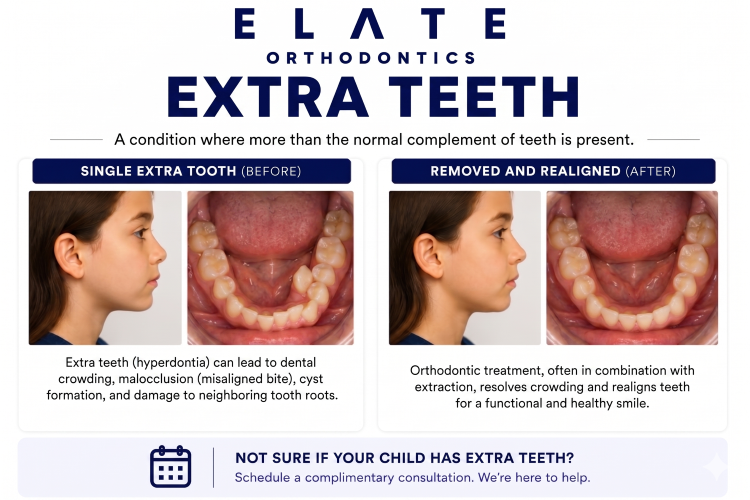
Extra teeth treatment at Elate Orthodontics — diagnosing supernumerary teeth, coordinating extraction timing, and aligning the bite
Extra Teeth — Frisco & The Colony, TX
Extra Teeth Are Often Hidden in the Bone. Catching Them Early Prevents the Problems They Would Otherwise Cause.
Extra teeth — clinically called supernumerary teeth or hyperdontia — are teeth that develop in addition to the normal complement of teeth a person should have. Most people have 20 baby teeth followed by 32 adult teeth (including wisdom teeth). When extra teeth develop, they can erupt visibly into the mouth or remain hidden within the bone where they cause problems below the surface. The most common locations are between the upper two front teeth (called a mesiodens) and around the upper molars. Many supernumerary teeth are first discovered on routine dental X-rays before any symptoms appear, which is one of the reasons the AAO age-7 evaluation matters.
At Elate Orthodontics, Dr. Kevin Baharvand and Dr. Julia Kang manage the orthodontic component of extra teeth cases for patients across Frisco, The Colony, Prosper, and Little Elm. Our role is to diagnose the supernumerary tooth, evaluate its effects on adjacent teeth and bite development, coordinate with oral and maxillofacial surgeons for extraction when needed, and provide comprehensive orthodontic treatment to align the teeth properly afterward. Most cases are straightforward when caught early. Cases left undiagnosed for years often become more complex because the supernumerary tooth has caused crowding, blocked eruption of adjacent teeth, created cysts, or shifted nearby teeth out of position.
As an ABO board-certified practice with a published clinician on staff, our diagnostic approach reflects the depth of training that distinguishes specialty orthodontic care. We take comprehensive records at every consultation including panoramic X-rays and 3D imaging when needed for surgical planning, because precise localization of the supernumerary tooth matters for safe extraction. We work alongside experienced oral and maxillofacial surgeons in the Frisco area for cases requiring surgical removal of an extra tooth.
The Common Types of Extra Teeth
Mesiodens (Between Upper Front Teeth)
A mesiodens is an extra tooth that develops between the two upper front teeth (central incisors). It is the most common type of supernumerary tooth, accounting for the majority of cases. The mesiodens is often small, sometimes peg-shaped, and frequently fails to erupt on its own — remaining hidden in the bone where it can block or delay eruption of the permanent front teeth, create midline gaps, push the front teeth apart, or form cysts around its crown.
Treatment typically involves surgical extraction by an oral surgeon followed by orthodontic treatment to close any space the mesiodens created and align the front teeth. Catching this in childhood often produces straightforward outcomes.
Paramolars & Distomolars (Around the Molars)
Paramolars erupt next to the upper molars (typically on the cheek side), while distomolars develop behind the last molar. These extra teeth are often discovered on dental X-rays as patients approach adolescence and adulthood. They can complicate wisdom tooth surgery, contribute to bite irregularities, and create areas that are difficult to clean and prone to decay.
Treatment depends on whether the extra tooth is causing problems, its position, and what other dental work is being planned. Some are removed at the same surgery as wisdom teeth.
Multiple Supernumerary Teeth
Some patients have multiple extra teeth distributed across different areas of the mouth. Multiple supernumerary teeth are sometimes associated with genetic syndromes including cleidocranial dysplasia and Gardner syndrome, although many cases are isolated findings with no syndromic association. These cases require careful diagnostic imaging to identify all extra teeth and coordinated treatment planning.
For multiple supernumerary teeth, we coordinate with oral surgeons, pediatric dentists, and sometimes geneticists when syndromic association is suspected.
Erupted Supernumerary Teeth
Some supernumerary teeth fully erupt into the mouth, where they appear as an obvious extra tooth crowding the dental arch. These are often easier to diagnose because they are visible, but they typically need extraction because there is no proper space for them and they disrupt the alignment of the normal teeth. Erupted extra teeth in the front of the mouth are particularly noticeable and motivate prompt evaluation.
After extraction, comprehensive orthodontic treatment aligns the remaining teeth into proper positions. Treatment timing depends on the patient’s age and what other orthodontic concerns are present.
Most patients have a single supernumerary tooth, with mesiodens being by far the most common type. Comprehensive panoramic and sometimes 3D imaging identifies the precise location and relationship to adjacent teeth.
Underlying Causes
What Causes Extra Teeth?
Supernumerary teeth often run in families. If a parent or sibling has had an extra tooth, the likelihood of similar findings in other family members is meaningfully higher. Family history is one of our routine screening questions for children at the age 7 evaluation, particularly when a parent has had a mesiodens removed or had unexplained delays in front tooth eruption.
During fetal development, the dental lamina (the tissue that produces tooth buds) sometimes generates additional buds beyond the normal complement. This is the underlying mechanism behind most isolated supernumerary teeth. The variation is generally considered benign and not a sign of a broader health concern when it occurs in isolation.
A genetic syndrome characterized by underdeveloped collarbones, dental abnormalities including multiple supernumerary teeth and delayed tooth eruption, and other skeletal findings. Patients with cleidocranial dysplasia often have many extra teeth and require highly coordinated multidisciplinary care from early childhood. Comprehensive treatment typically involves pediatric dentists, oral surgeons, orthodontists, and prosthodontists working together over many years.
A genetic syndrome that includes multiple supernumerary teeth alongside intestinal polyps and other findings. The dental findings sometimes precede other clinical signs, making early dental diagnosis important. Patients suspected of having Gardner syndrome should be evaluated by appropriate medical specialists for the broader systemic findings.
Patients with cleft lip and palate frequently have supernumerary or missing teeth in the area of the cleft. The dental findings are part of the broader craniofacial picture and require coordinated care from the entire craniofacial team. Orthodontics is one of multiple specialties involved in these cases throughout childhood and adolescence.
Several other genetic conditions can include supernumerary teeth as one feature, including Ehlers-Danlos syndrome and Apert syndrome. These cases require coordinated medical and dental care. Most patients with extra teeth do not have any of these syndromes, but multiple supernumerary teeth in a young patient warrants consideration of broader evaluation.
Why Extra Teeth Need Prompt Diagnosis
Untreated extra teeth produce predictable downstream problems over years. The most common pattern is delayed or blocked eruption of an adjacent permanent tooth — often the central incisor when a mesiodens is present. By the time many patients seek treatment, what started as a small extra tooth identifiable on a routine X-ray has become a complex case involving an impacted permanent tooth that requires surgical exposure, orthodontic eruption, and comprehensive treatment to align the dental arch.
Early diagnosis matters most for mesiodens and other anterior supernumerary teeth where they directly affect erupting permanent front teeth. Adolescent and adult patients with previously undiagnosed extra teeth still benefit from treatment, though the case may now involve impacted teeth, midline shifts, and other secondary issues that would have been avoided with earlier intervention.
What Untreated Extra Teeth Cause
Delayed or blocked eruption of permanent teeth, particularly upper central incisors
Impaction of adjacent permanent teeth that cannot erupt around the obstruction
Midline gaps and spacing in the upper front teeth from a mesiodens pushing teeth apart
Crowding from extra teeth occupying space the normal teeth need
Cysts that can form around the crowns of unerupted supernumerary teeth and damage adjacent bone
Root resorption of adjacent teeth from pressure of the supernumerary tooth
More complex and longer treatment when finally addressed years after diagnosis was possible
Treatment Approach
How We Manage Extra Teeth at Every Age
Extra teeth treatment is fundamentally a coordinated effort between orthodontists and oral surgeons. Our role is to diagnose the supernumerary tooth, determine whether and when extraction is needed, coordinate the surgical timing, and provide comprehensive orthodontic treatment to align the remaining teeth. The right timing depends heavily on the patient’s age and what the extra tooth is doing to adjacent teeth.
Children (Ages 7–10) — Highest Impact Window
This is the prime treatment window for most extra teeth, particularly mesiodens. The age 7 panoramic X-ray taken during a comprehensive orthodontic evaluation is when most supernumerary teeth are first diagnosed. When a mesiodens is identified, prompt extraction often allows the upper central incisors to erupt normally without further intervention. Catching it in this window can prevent impaction, midline shifts, and the more complex treatment that becomes necessary if the mesiodens is left in place.
Most cases caught at this age require extraction by an oral surgeon followed by monitoring or limited orthodontic treatment.
Teens (Ages 11–17)
Teens with previously undiagnosed extra teeth often present with secondary issues — impacted central incisors, midline shifts, or crowding caused by the extra tooth. Treatment typically combines surgical extraction of the supernumerary tooth, surgical exposure and orthodontic eruption of any impacted teeth it blocked, and comprehensive orthodontic treatment to align the dental arch. Treatment timelines are longer than cases caught earlier but outcomes are still excellent.
Posterior supernumerary teeth (paramolars, distomolars) are sometimes addressed during wisdom tooth surgery in late adolescence.
Adults
Adults with extra teeth typically present in two scenarios: previously undiagnosed supernumerary teeth discovered on dental X-rays during routine care, and known extra teeth that were left in place for years. Treatment depends on whether the extra tooth is currently causing problems. Some unerupted supernumerary teeth in adults that are not causing issues can be monitored. Others require extraction and comprehensive orthodontic treatment to address the secondary effects.
Adult cases benefit from coordinated treatment planning at the start, with timing of extraction and orthodontic treatment choreographed for the best outcome.
Treatment Options
Treatments We Use & Specialists We Coordinate With
Diagnostic Imaging & Localization
Comprehensive panoramic X-rays identify most supernumerary teeth. For complex cases or when precise three-dimensional localization is needed for surgical planning, 3D cone-beam imaging shows the exact position of the extra tooth, its relationship to adjacent roots, and its proximity to vital anatomic structures. Accurate diagnosis is the foundation of safe, effective treatment.
Oral Surgeon Coordination for Extraction
Most supernumerary teeth require surgical extraction by an oral and maxillofacial surgeon. The surgery is typically straightforward for fully erupted extra teeth and more involved for unerupted teeth deep in the bone. We coordinate timing with experienced oral surgeons in the Frisco area, providing them with our diagnostic records and orthodontic plan.
Surgical Exposure & Orthodontic Eruption
When a supernumerary tooth has blocked eruption of a permanent tooth, the impacted permanent tooth often requires surgical exposure and orthodontic eruption after the extra tooth is removed. The surgeon places a small bracket on the impacted tooth, and we use orthodontic forces to gently bring the tooth into its proper position over months. This combined surgical and orthodontic approach saves teeth that might otherwise have been lost.
Traditional Braces
For comprehensive treatment after extra tooth extraction, traditional braces give us precise control over space management, midline correction, and any orthodontic eruption of previously impacted teeth. Often the most reliable platform for cases requiring complex coordinated movements.
Clear Braces
Same effective mechanics as traditional braces with tooth-colored brackets. A great option for teens and adults treating extra-teeth-related orthodontic issues who want the predictability of braces with less visibility during treatment.
Invisalign & Angel Aligners
For comprehensive treatment of straightforward cases after extraction, modern Invisalign and Angel Aligner protocols handle most adult cases addressing residual alignment issues. For complex cases involving orthodontic eruption of previously impacted teeth, traditional braces sometimes give us more predictable control.
Pediatric Orthodontics (Phase 1)
For young children with diagnosed supernumerary teeth, Phase 1 care typically involves coordinating extraction with the oral surgeon and providing limited orthodontic treatment to support normal eruption of the affected permanent teeth. Catching the condition early in this window often produces the simplest outcomes.
Multidisciplinary Coordination for Syndromic Cases
For patients with cleidocranial dysplasia, Gardner syndrome, cleft lip and palate, or other syndromic associations, comprehensive care involves multiple specialists. We coordinate with pediatric dentists, oral surgeons, prosthodontists, geneticists, and craniofacial teams as appropriate for each case.
AAO Recommendation
Age 7 Evaluation Is When Most Extra Teeth Are First Diagnosed
The American Association of Orthodontists recommends an evaluation by age 7. For extra teeth, this matters because age 7 is when the panoramic X-ray taken during a comprehensive evaluation typically reveals supernumerary teeth that may not yet be causing visible symptoms. Many parents first learn that their child has an extra tooth at this evaluation. Early diagnosis allows the extra tooth to be removed before it blocks eruption of permanent teeth, before midline shifts develop, and before more complex treatment becomes necessary. The same case caught at age 7 versus age 14 can mean the difference between a simple extraction with no orthodontic treatment versus comprehensive treatment to correct multiple downstream issues.
Most children evaluated at age 7 do not need active orthodontic treatment immediately, even when extra teeth are diagnosed. The point is to identify the situation early and develop the right plan with the family. For adults with previously undiagnosed extra teeth, treatment is still effective — we coordinate extraction and orthodontic care to address whatever secondary issues have developed.
See Real Outcomes
Extra Teeth Cases From Our Practice
Our before-and-after gallery includes real extra teeth cases at Elate Orthodontics, ranging from young children with diagnosed mesiodens treated with extraction and minor orthodontic intervention, to teen and adult cases combining surgical removal with comprehensive orthodontic treatment for impacted teeth and midline shifts. Each case shows the diagnosis, the surgical and orthodontic plan, and the final result.
Common Questions
Extra Teeth FAQ
In most cases, yes — particularly for mesiodens and other supernumerary teeth that block eruption of permanent teeth or cause midline issues. Some unerupted supernumerary teeth deep in the bone that are not causing problems can be monitored, but the majority of clinically relevant extra teeth benefit from extraction. We discuss your child’s specific case after reviewing the diagnostic imaging.
Timing depends on the type of extra tooth and what it is doing. For a mesiodens blocking eruption of upper central incisors, prompt removal in early childhood often allows normal eruption to proceed. For posterior supernumerary teeth that are not currently causing problems, removal is sometimes timed with wisdom tooth surgery. We coordinate timing with the oral surgeon and your child’s overall dental development.
Sometimes yes, sometimes no. When the extra tooth is caught early and removed before causing significant problems, the permanent teeth often erupt and align normally without orthodontic treatment. When the extra tooth has caused impaction of a permanent tooth, midline shift, or significant crowding, comprehensive orthodontic treatment is typically needed to address those secondary issues. We can often estimate the likelihood at consultation.
Most isolated supernumerary teeth (single extra teeth without other unusual findings) are not associated with genetic syndromes and are simply developmental variations. Multiple supernumerary teeth, particularly in young children, sometimes warrant evaluation for cleidocranial dysplasia, Gardner syndrome, or other conditions. We screen for the broader clinical picture during evaluation and refer for medical evaluation when appropriate.
Extraction is performed by an oral and maxillofacial surgeon, typically as an outpatient procedure. For erupted supernumerary teeth, the procedure is straightforward and similar to a routine extraction. For unerupted teeth deep in the bone, the surgery requires more careful access but is well-tolerated by most patients. The oral surgeon will explain the specific approach and recovery expectations for your child’s case.
Surgical extraction of supernumerary teeth is typically covered by dental insurance, sometimes with portions covered under medical insurance for complex cases. Orthodontic portions are typically covered by PPO dental insurance plans that include orthodontic benefits. Coverage varies by plan. We help patients understand what each component is likely to cost and offer flexible financing through Cherry to make care accessible.
Why Frisco & The Colony Families Choose Elate Orthodontics for Extra Teeth
Extra teeth cases are some of the most coordinated cases in pediatric orthodontics. The willingness to take a thorough panoramic X-ray at the age 7 evaluation, the experience to interpret what we see, and the discipline to coordinate with oral surgeons on the right surgical timing are what separate good outcomes from great ones. Dr. Baharvand and Dr. Kang have managed extra teeth cases across the full spectrum, from straightforward childhood mesiodens cases to complex multidisciplinary cases involving multiple supernumerary teeth and impacted permanent teeth.
Dr. Baharvand and Dr. Kang are a husband-and-wife orthodontic team based in Frisco, with three convenient locations serving families across Frisco, The Colony, Prosper, and Little Elm. Dr. Baharvand is ABO board-certified and a published clinician whose work has appeared in the American Journal of Orthodontics and Dentofacial Orthopedics.
1,000+
Five-star reviews across 3 locations
ABO
Board-certified orthodontist
Published
AJO-DO cover clinician
Free
Consultation with full diagnostic records
Our Locations
5605 FM 423, Suite 600
Frisco, TX 75036
FM 423 & Lebanon Rd — next to the UPS Store
4713 Highway 121, Suite 304
The Colony, TX 75056
FM 423 & Hwy 121 — next to Ross
2155 University Dr, Suite 110
Frisco, TX 75033
On 380 across from Cook Children’s Medical Center Prosper
Hours: Mon–Fri 8:00am–5:00pm | 972.538.4343
Extra Teeth on the X-Ray? Let’s Plan the Right Path Together.
Free consultations at all three Elate Orthodontics locations include a complete diagnostic workup: digital scans, panoramic X-rays, clinical photos, and 3D imaging when needed for surgical planning. We coordinate with experienced oral and maxillofacial surgeons in the Frisco area for extraction timing and provide comprehensive orthodontic treatment for any secondary issues. No pressure, no surprises, no commitment to treatment.
Also see: All Conditions We Treat | Missing Teeth | Tooth Impaction | Ectopic Eruption | Gapped Teeth | Before & After