




Midline Misalignment Treatment in Frisco & The Colony, TX
Off-Center Smile Correction by Dr. Baharvand & Dr. Kang — Braces, Invisalign, Angel Aligners & Skeletal Coordination
📞 972.538.4343
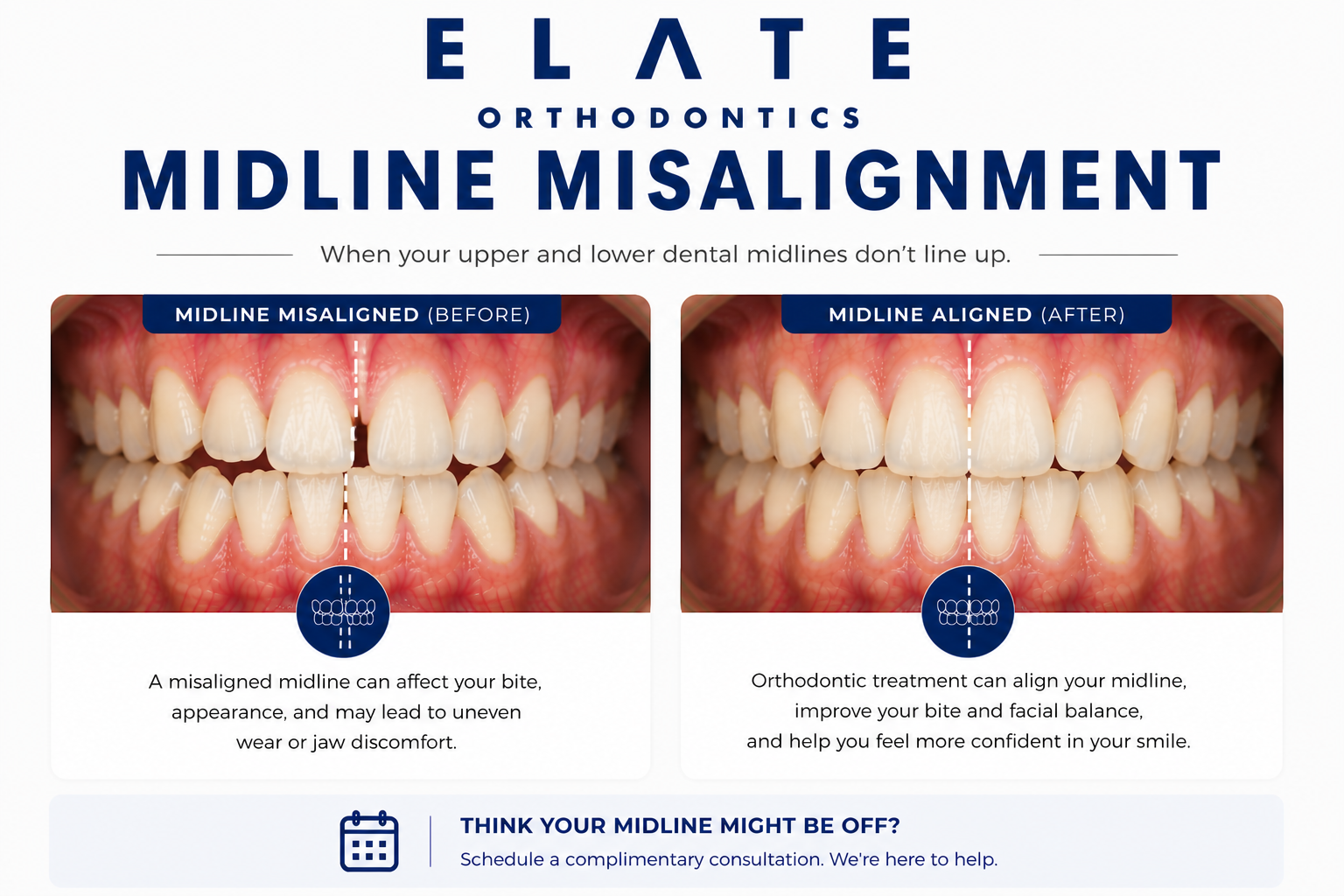
Midline correction at Elate Orthodontics — diagnosing whether the shift is dental, skeletal, or both
Midline Misalignment — Frisco & The Colony, TX
An Off-Center Smile Looks Cosmetic, But the Cause Often Runs Deeper
Midline misalignment, sometimes called a midline shift or dental midline discrepancy, occurs when the center line between your upper two front teeth does not line up with the center line between your lower two front teeth — or with the center of your face. A small midline discrepancy of 1 to 2 millimeters often goes unnoticed and is considered within normal range. Anything larger becomes visually apparent in photos and video, and patients frequently come to us asking why their smile “looks tilted” or off-center even though their teeth appear straight.
At Elate Orthodontics, Dr. Kevin Baharvand and Dr. Julia Kang treat midline misalignment in patients across Frisco, The Colony, Prosper, and Little Elm. The most important diagnostic question is whether the shift is dental (the teeth are off-center on otherwise balanced jaws), skeletal (one or both jaws are positioned off-center), or both. Each requires a different treatment approach, and an off-center finishing result is one of the most common reasons patients are dissatisfied with prior orthodontic work. Getting the diagnosis right at the start is what makes the difference between a good outcome and a great one.
As an ABO board-certified practice with a published clinician on staff, our diagnostic approach reflects the depth of training that distinguishes specialty orthodontic care. We take comprehensive records at every consultation and explain exactly what we see using your own digital scans, panoramic X-rays, clinical photos, and facial measurements. For midline cases, we evaluate not just the teeth but also the jaw position, facial symmetry, and how the bite functions on each side.
Dental vs. Skeletal Midline Misalignment
Dental Midline Misalignment
Dental midline misalignment means the teeth themselves are off-center on otherwise well-positioned jaws. This often results from missing teeth that allowed neighboring teeth to drift, asymmetric tooth size, single tooth rotations or tipping, or crowding that pushed teeth to one side. The skeletal foundation is balanced, the teeth simply need to be repositioned.
Dental midlines are usually correctable with braces or clear aligners using strategic elastics or sequential tooth movement. They are among the more straightforward midline cases and typically do not require extractions or surgical coordination.
Skeletal Midline Misalignment
Skeletal midline misalignment means one or both jaws are positioned off-center relative to the face. The most common pattern is a lower jaw that has shifted to one side due to a unilateral crossbite, asymmetric growth, or a functional shift the patient developed years ago to avoid a bite interference. Skeletal cases often involve facial asymmetry that becomes more obvious on close inspection.
Skeletal midline misalignment is best caught and addressed during active growth in children. In adults, mild to moderate cases can be camouflaged with orthodontic treatment, but severe cases sometimes require coordination with an oral surgeon for true correction.
Many patients have both components. Comprehensive diagnosis identifies how much of the shift is dental, how much is skeletal, and the right combination of treatments to address each.
Underlying Causes
What Causes Midline Misalignment?
When a tooth is lost — whether a baby tooth lost too early, a permanent tooth extracted, or a tooth that never developed — neighboring teeth often drift toward the empty space. If this drift happens on one side only, the entire arch shifts off-center, taking the dental midline with it. This is one of the most common causes of dental midline misalignment in adults.
When a child has a unilateral posterior crossbite, they often shift the lower jaw to one side every time they bite down. Over years of growth, this functional shift can become a real skeletal asymmetry, and the lower midline ends up genuinely off-center. Catching unilateral crossbites early is one of the most important things parents can do to prevent skeletal midline misalignment from developing. See our crossbite page for more.
When crowding is more severe on one side of the arch than the other, the front teeth often shift toward the more crowded side as a release valve. Treating the crowding usually resolves the midline issue at the same time, but planning the space distribution carefully is what determines whether the final midline ends up centered.
Some patients have genuinely asymmetric jaw development, where one side of the upper jaw, lower jaw, or both grew differently than the other. This is the underlying cause of true skeletal midline misalignment. It can be related to genetics, early childhood injury, persistent unilateral habits, or developmental conditions. Identifying skeletal asymmetry on imaging is essential for treatment planning.
When upper and lower tooth sizes are mismatched (for example, when upper lateral incisors are unusually small), it becomes mathematically impossible to align both midlines and have the teeth fit properly. These cases often need restorative coordination after orthodontic treatment to build up undersized teeth and finalize midline aesthetics.
Many adults come to us with midline misalignment as a leftover from prior orthodontic treatment that focused on straightening teeth without correcting the midline. Off-center finishing is one of the most common reasons patients are dissatisfied with previous braces or aligner work and is highly correctable with focused retreatment.
Should You Treat Midline Misalignment?
Whether to treat midline misalignment depends on how much it bothers you and whether there is an underlying functional issue driving it. Small midline discrepancies of 1 to 2 millimeters are within normal range and most patients are not aware of them. Larger shifts or those causing visible asymmetry typically motivate patients to seek correction, and the results can dramatically improve smile aesthetics.
More importantly, when midline misalignment is driven by a unilateral functional shift in a growing child, treating it early prevents the development of true skeletal asymmetry that becomes much harder to correct in adulthood. This is why we recommend evaluation at age 7 even when the midline shift seems mild.
When Midline Misalignment Becomes a Problem
Visible asymmetry in photos, video, and close-up smile situations
Progressive worsening when caused by ongoing unilateral functional shifts in growing children
Development of true skeletal facial asymmetry over years of asymmetric jaw use
Uneven wear patterns from teeth meeting in non-ideal relationships
TMJ strain from chronic compensation in jaw position
Difficulty achieving cosmetic finishing for restorative work like veneers when midline is unaddressed
Self-consciousness in adults who notice the shift in selfies or professional photos
Treatment Approach
How We Treat Midline Misalignment at Every Age
Midline treatment depends entirely on whether the shift is dental, skeletal, or a combination. Children with developing skeletal asymmetry have the best outcomes when intervention happens during growth. Dental midline cases respond well at any age. Comprehensive diagnosis at the consultation determines the right path.
Children (Ages 7–10)
For young children with developing midline issues, the priority is identifying and correcting any underlying functional shift before it becomes a true skeletal asymmetry. Unilateral crossbites should be addressed with palatal expansion to prevent years of asymmetric jaw movement. Phase 1 treatment can intercept many midline cases before they fully develop.
Most children evaluated at age 7 with mild midline discrepancies do not need treatment yet. We monitor and intervene only when intervention will benefit the long-term outcome.
Teens (Ages 11–17)
The teen years are an excellent treatment window for midline cases. Comprehensive treatment with braces or clear aligners — often combined with strategic asymmetric elastics — corrects dental midline shifts and addresses underlying crowding or bite issues simultaneously. Most cases take 18 to 24 months.
For teens with significant skeletal asymmetry, treatment may be planned alongside future orthognathic surgery in late adolescence once growth is complete.
Adults
Adult dental midline correction is highly treatable with braces or clear aligners using asymmetric elastics and strategic tooth movement. Mild to moderate skeletal cases can be camouflaged orthodontically with excellent aesthetic results. Many adult retreatment cases — patients dissatisfied with prior orthodontic finishing — focus specifically on midline correction.
For adults with severe skeletal midline asymmetry, we coordinate with oral surgeons for orthognathic surgery combined with orthodontic treatment. Reserved for cases where camouflage cannot produce a stable, balanced result.
Treatment Options
Treatments We Use to Correct Midline Misalignment
Traditional Braces
The most versatile option for midline correction in cases requiring asymmetric mechanics, complex tooth repositioning, or coordination with bite correction. Braces give us precise control to shift teeth in specific directions and apply asymmetric elastics that move one side of the arch differently than the other.
Clear Braces
Same effective mechanics as traditional braces with tooth-colored brackets. A great option for teens and adults treating midline issues who want the predictability of braces with less visibility during treatment.
Invisalign
Modern Invisalign protocols include precision attachments and asymmetric elastics that effectively correct dental midline shifts. The aligners are programmed with the desired midline correction built into each stage, and patient compliance with the elastics drives the asymmetric movement.
Angel Aligners
A clear aligner system we offer at Elate Orthodontics for appropriate cases. Like other clear aligner brands, Angel Aligners can correct dental midline misalignment with precision attachments and asymmetric mechanics tailored to each patient’s case.
Palatal Expansion (Pediatric)
For children with midline misalignment driven by a unilateral crossbite, palatal expansion eliminates the asymmetric bite that is causing the lower jaw to shift. This often resolves the midline shift at its source and prevents the development of true skeletal asymmetry. The single most powerful intervention for early midline cases.
Asymmetric Elastics
Carefully placed elastics that pull teeth in specific directions to shift the midline back to center. Worn between braces or aligners, these elastics are one of the workhorse tools for dental midline correction. Patient compliance is the variable that determines how quickly and predictably the midline shifts.
Restorative Coordination
For midline cases involving tooth size discrepancies (such as undersized lateral incisors), we coordinate with restorative dentists. The orthodontic phase positions the teeth optimally, and the restorative phase builds up undersized teeth with bonding or veneers to finalize the midline aesthetic.
Orthognathic Surgery (Severe Skeletal Cases)
For adults with severe skeletal midline asymmetry where camouflage will not produce a balanced result, we coordinate with experienced oral surgeons for jaw surgery combined with orthodontic treatment. Reserved for cases where the underlying jaw asymmetry is significant and orthodontics alone cannot create the desired symmetry.
AAO Recommendation
Early Evaluation Prevents Skeletal Asymmetry From Developing
The American Association of Orthodontists recommends an evaluation by age 7. For midline misalignment, this matters because the most common driver of skeletal midline asymmetry — a unilateral functional shift caused by a crossbite — develops over years of asymmetric chewing during growth. Caught and corrected at age 7 to 9, this pattern resolves before it becomes a true skeletal issue. Caught at age 25, the same case may have developed into facial asymmetry that requires surgical correction.
For adults whose midline shift came from a prior orthodontic treatment that did not fully address it, focused retreatment with braces or aligners often produces excellent improvements in 12 to 18 months. There is no biological deadline for dental midline correction in adults.
See Real Outcomes
Midline Cases From Our Practice
Our before-and-after gallery includes real midline corrections at Elate Orthodontics, ranging from early Phase 1 cases that prevented skeletal asymmetry, to teen comprehensive cases corrected with asymmetric mechanics, to adult retreatment cases focused specifically on midline finishing. Each case shows the diagnosis, the appliances used, and the final result.
Common Questions
Midline Misalignment FAQ
Most clinicians consider a midline discrepancy of 1 to 2 millimeters within normal range and not requiring correction. Most patients are not aware of shifts in this range. Anything larger typically becomes visually apparent in photos and video and is what motivates patients to seek treatment.
Yes, for most dental midline cases. Modern Invisalign protocols include precision attachments and asymmetric elastics that effectively shift the midline back to center. Patient compliance with the elastics is the variable that determines how predictable the correction is. Severe skeletal midline cases may still require traditional braces or surgical coordination.
Yes. Off-center finishing from prior orthodontic treatment is one of the most common reasons adults seek retreatment. Focused treatment with clear aligners or braces typically improves the midline significantly in 12 to 18 months. We diagnose what was missed in the original treatment and design a plan to correct it specifically.
It can, particularly when the shift is driven by a unilateral functional pattern like a crossbite. Years of asymmetric chewing during growth translate into asymmetric jaw development. This is why we recommend evaluation at age 7 — catching and correcting the underlying pattern early prevents the skeletal asymmetry from developing.
Adult dental midline retreatment typically takes 12 to 18 months. Comprehensive teen and adult cases that include midline correction alongside crowding or bite issues take 18 to 24 months. Phase 1 treatment in growing children to prevent developing midline issues typically takes 9 to 14 months. Treatment time depends on severity and the underlying cause.
Most PPO dental insurance plans include orthodontic benefits that apply to comprehensive midline treatment, particularly when there is documented functional concern such as a crossbite or skeletal asymmetry. Coverage varies by plan. We are in-network with most major PPO carriers and offer flexible financing through Cherry to make treatment accessible regardless of insurance coverage.
Why Frisco & The Colony Patients Choose Elate Orthodontics for Midline Correction
Midline misalignment is one of the most diagnostic-dependent conditions we treat. The depth of the diagnosis (dental vs. skeletal vs. combined), the experience to time intervention correctly in growing patients, and the willingness to address midline as part of every comprehensive case are what separate good outcomes from great ones. Dr. Baharvand and Dr. Kang have managed midline cases across the full spectrum, from Phase 1 functional shift correction in young children to complex adult retreatment focused specifically on midline finishing.
Dr. Baharvand and Dr. Kang are a husband-and-wife orthodontic team based in Frisco, with three convenient locations serving families across Frisco, The Colony, Prosper, and Little Elm. Dr. Baharvand is ABO board-certified and a published clinician whose work has appeared in the American Journal of Orthodontics and Dentofacial Orthopedics.
1,000+
Five-star reviews across 3 locations
ABO
Board-certified orthodontist
Published
AJO-DO cover clinician
Free
Consultation with full diagnostic records
Our Locations
5605 FM 423, Suite 600
Frisco, TX 75036
FM 423 & Lebanon Rd — next to the UPS Store
4713 Highway 121, Suite 304
The Colony, TX 75056
FM 423 & Hwy 121 — next to Ross
2155 University Dr, Suite 110
Frisco, TX 75033
On 380 across from Cook Children’s Medical Center Prosper
Hours: Mon–Fri 8:00am–5:00pm | 972.538.4343
Smile Looks Off-Center? Let’s Diagnose What’s Causing the Shift.
Free consultations at all three Elate Orthodontics locations include a complete diagnostic workup: digital scans, panoramic X-rays, clinical photos, and facial measurements. We identify whether the midline shift is dental, skeletal, or both, and design treatment that produces a balanced, lasting result. No pressure, no surprises, no commitment to treatment.
Also see: All Conditions We Treat | Crossbite | Crowded Teeth | Crooked Teeth | Before & After