





TMJ & Jaw Pain Orthodontic Care in Frisco & The Colony, TX
The Orthodontic Side of TMJ Concerns — Dr. Baharvand & Dr. Kang Coordinate with TMJ Specialists, Plus Braces, Invisalign & Angel Aligners
📞 972.538.4343
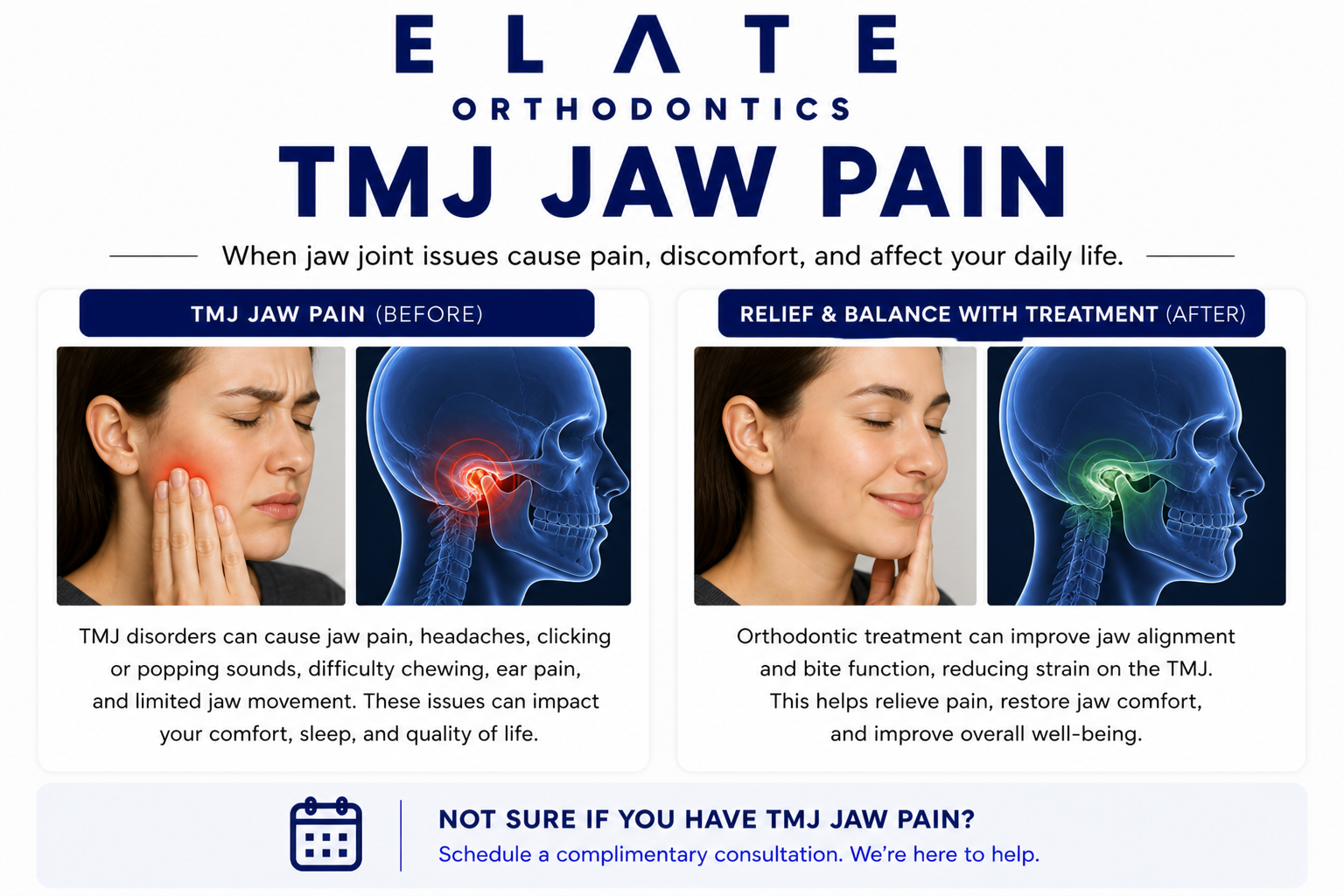
TMJ orthodontic care at Elate Orthodontics — addressing the bite alignment and coordinating with TMJ specialists for comprehensive care
TMJ & Jaw Pain — Frisco & The Colony, TX
Orthodontists Treat the Bite. TMJ Disorders Are Often Multidisciplinary. We Are Direct About What Each Side of Care Involves.
The temporomandibular joint (TMJ) is the joint where the lower jaw connects to the skull, just in front of each ear. Temporomandibular disorders (TMD or TMJ disorders) refer to a group of conditions that produce pain, clicking, popping, limited jaw movement, headaches, or facial discomfort related to the joint, the muscles around it, or both. TMJ disorders are common, often multifactorial, and frequently require care from more than one type of provider. The orthodontic role within TMJ care is specific and limited: we address the bite alignment, coordinate with TMJ specialists, and avoid making promises that orthodontic treatment alone can resolve TMJ disorders.
At Elate Orthodontics, Dr. Kevin Baharvand and Dr. Julia Kang see patients across Frisco, The Colony, Prosper, and Little Elm who come to us with TMJ symptoms or jaw pain. Some are seeking orthodontic treatment and want to know whether their bite contributes to their symptoms. Others have already been evaluated by a TMJ specialist or dentist and are looking for the orthodontic component of a coordinated treatment plan. Our approach is the same in either case: we are direct about what orthodontic treatment can and cannot do for TMJ symptoms, we screen carefully for TMJ concerns during every comprehensive evaluation, and we coordinate with experienced TMJ specialists, oral surgeons, and dental professionals throughout the Frisco area when broader care is needed.
As an ABO board-certified practice with a published clinician on staff, our diagnostic approach reflects the depth of training that distinguishes specialty orthodontic care. We take comprehensive records at every consultation and explain exactly what we see using your own digital scans, panoramic X-rays, and clinical photos. For patients with TMJ concerns, we explain what role orthodontics may play in your specific case and what other specialists you may benefit from seeing.
Common TMJ-Related Symptoms Patients Bring Up
Jaw Clicking, Popping & Crepitus
Audible clicking or popping sounds when opening or closing the mouth, sometimes accompanied by a grinding or grating sensation (called crepitus). These sounds typically come from the disc within the joint moving abnormally relative to the bone. Many patients with clicking have no pain and may not need treatment, while others have clicking that is associated with discomfort or limited movement.
Clicking by itself does not always require intervention. We screen for it during evaluation and coordinate with TMJ specialists when it is associated with pain, locking, or progressive limitation.
Jaw Pain & Muscle Soreness
Pain in or around the jaw joint, in the muscles of the cheek, temple, or around the ear. Patients sometimes describe it as a deep ache that worsens with chewing, talking, or stress. The pain may come and go or remain constant. Muscle pain is often the dominant feature in TMD, and it frequently coexists with bruxism (teeth grinding or clenching), neck tension, and stress patterns.
Treatment typically requires a multidisciplinary approach including a TMJ specialist, sometimes a physical therapist, and sometimes coordination with mental health support for stress-related contributors.
Limited Jaw Movement or Locking
Difficulty opening the mouth fully, sensation that the jaw catches or locks during movement, or inability to fully close the mouth temporarily. Limitation can be subtle (slight tightness when yawning) or severe (jaw locked open or closed and requiring manipulation). Locking episodes warrant prompt evaluation by a TMJ specialist or oral surgeon.
We refer patients with significant locking or sudden change in jaw mobility for specialist evaluation rather than attempting orthodontic management of these symptoms in isolation.
Headaches, Ear Pressure & Bite Awareness
Tension-type headaches, ear pressure or fullness, ringing in the ears, and a sense that the bite has changed or feels off are commonly reported alongside TMJ concerns. Many of these symptoms have non-TMJ causes as well — headaches and ear symptoms in particular often come from sources outside the jaw — which is why thorough evaluation matters before assuming TMJ is the cause.
When patients describe a bite change associated with TMJ symptoms, that is one of the patterns where orthodontic evaluation is most relevant. Other patterns may need primary care or ENT evaluation alongside TMJ specialist input.
Many patients have several of these symptoms together. The right diagnostic path depends on which symptoms are dominant and what has already been evaluated.
Honest Scope
What Orthodontic Care Can & Cannot Do for TMJ Concerns
What Orthodontics May Help With
When TMJ symptoms are associated with a bite that is significantly off (severe overbite, crossbite, open bite, or jaw misalignment), orthodontic treatment can sometimes improve the bite to a more balanced position. For some patients, the improved bite reduces certain mechanical stresses that may have contributed to TMJ symptoms. We do not promise specific symptom relief from orthodontic treatment alone — outcomes vary widely from patient to patient — but we acknowledge the bite component honestly when it is part of the picture.
Orthodontic treatment can also help by addressing functional shifts, severe misalignment, and other dental factors that may contribute to TMJ-related discomfort in some patients.
What Orthodontics Cannot Do
Orthodontic treatment is not a treatment for TMJ disorder itself. We do not promise that braces or aligners will eliminate jaw pain, headaches, clicking, or muscle soreness. Many TMJ disorders involve muscle, joint, behavioral, and stress factors that are outside the scope of orthodontic care. Patients seeking primary TMJ disorder treatment should see a TMJ specialist, oral surgeon, or appropriately trained dentist who manages these conditions directly.
We also do not pursue orthodontic treatment specifically for TMJ relief in patients whose orthodontic problems are mild. Treating mild bite issues to chase TMJ symptom relief typically does not produce predictable outcomes.
Honest scope is part of good care. We tell you what we can do, what we cannot do, and which other specialists may be helpful for your specific situation.
Contributing Factors
What Contributes to TMJ Disorders?
Bruxism is one of the most common contributors to TMJ-related muscle pain, jaw soreness, and headaches. Many patients grind their teeth at night without realizing it. The repetitive muscle activity strains the jaw muscles and the joint over time. Treatment typically involves a custom night guard prescribed by a dentist, sometimes alongside stress management strategies.
Chronic stress increases muscle tension throughout the body, including the muscles of the jaw, neck, and face. Many TMJ disorders flare during high-stress periods and improve when stress levels decrease. Stress management, sleep quality, and overall wellness are part of comprehensive TMJ care that goes beyond what orthodontists provide directly.
Direct trauma to the jaw, whiplash injuries, or sustained microtrauma from activities like dental procedures with prolonged mouth opening can affect the joint and surrounding muscles. Some TMJ disorders date back to specific injuries. Patients with trauma-related TMJ concerns benefit from evaluation by oral surgeons or TMJ specialists familiar with these patterns.
Significant bite issues — particularly unilateral crossbites that cause the jaw to shift to one side, severe overbites, or substantial jaw misalignment — can contribute to mechanical stresses on the joint. This is the area where orthodontic treatment is most relevant. We diagnose the bite component honestly and discuss whether orthodontic correction may be part of broader TMJ care.
The TMJ can be affected by arthritis, disc displacement, and other joint-specific conditions. These typically require evaluation by an oral surgeon or TMJ specialist who can interpret advanced imaging (MRI, CT) and recommend appropriate treatment, which may include physical therapy, medication, splint therapy, or in some cases joint procedures.
Poor posture, neck tension, and cervical spine issues commonly accompany TMJ symptoms. The muscles of the jaw, neck, and shoulders are interconnected, and addressing posture and neck health is often part of comprehensive TMJ care. Physical therapists who specialize in TMD play an important role for many patients.
Multidisciplinary Care
Specialists We Coordinate With for TMJ Cases
TMJ Specialists & TMD-Trained Dentists
Some dentists complete additional training in temporomandibular disorders and offer focused TMJ care including splint therapy, occlusal evaluation, and conservative management. We refer to qualified TMJ specialists in the Frisco area when patients need primary TMJ disorder care.
Oral & Maxillofacial Surgeons
For complex joint issues, locking episodes, severe pain that has not responded to conservative care, or when imaging suggests structural joint changes, oral and maxillofacial surgeons provide advanced evaluation and treatment. We coordinate with experienced oral surgeons throughout the area for these cases.
Physical Therapists Specializing in TMD
Physical therapists with TMD training provide manual therapy, exercises, posture work, and movement retraining that often produces meaningful improvement for muscle-driven TMJ symptoms. Many patients benefit significantly from this care alongside whatever else they are doing.
General Dentists for Bruxism Management
For patients whose TMJ symptoms are associated with grinding or clenching, a custom-fitted night guard from a general dentist or TMD-trained dentist is often the first-line intervention. This is outside the scope of orthodontic care but is frequently the most impactful early step.
Sleep Medicine for Sleep-Related Bruxism
Sleep bruxism is sometimes associated with sleep-disordered breathing or other sleep concerns. For patients whose grinding occurs primarily at night and is severe enough to drive significant TMJ symptoms, sleep medicine evaluation can identify underlying contributors that benefit from specific treatment.
Mental Health & Stress Management
For TMJ symptoms with significant stress or anxiety contributors, mental health support can be a meaningful part of comprehensive care. This is well outside the scope of orthodontic care but is sometimes the missing piece for patients whose symptoms have not responded to other interventions.
Orthodontic Approach
When Orthodontic Treatment Is Part of TMJ Care
When orthodontic treatment is appropriate as part of a TMJ care plan, the approach depends on the patient’s age and the severity of the bite component. Our role is specific: we address the orthodontic side and coordinate timing with the broader TMJ care team.
Children & Teens with Bite Issues
For growing patients, addressing significant bite issues that may contribute to TMJ stress (severe crossbite, severe jaw misalignment, functional shifts) is often part of comprehensive orthodontic treatment regardless of TMJ concerns. We treat the bite component during the active growth window when applicable. We do not pursue orthodontic treatment specifically for TMJ symptom relief in this age group.
TMJ symptoms in children warrant evaluation by an appropriate specialist, typically the pediatrician or a TMJ-trained dentist as a starting point.
Adults Seeking Bite Correction
For adults whose primary motivation is correcting a bite issue and who happen to have TMJ symptoms, we treat the orthodontic component honestly while making clear that we are not promising specific TMJ outcomes. Some patients see TMJ symptom improvement after orthodontic treatment that produces a more balanced bite. Others do not. We are direct about this uncertainty.
When TMJ symptoms are significant, we typically recommend evaluation by a TMJ specialist before or alongside orthodontic treatment to clarify what is driving the symptoms.
Adults Referred from TMJ Specialists
When a TMJ specialist or other provider refers a patient for orthodontic care as part of a broader TMJ treatment plan, we coordinate directly with the referring provider on timing, goals, and treatment design. Common scenarios include orthodontic correction following splint therapy, pre-surgical orthodontics for jaw surgery patients with TMJ concerns, and orthodontic alignment of teeth after the joint has been stabilized.
In coordinated cases, we are part of the team rather than the primary provider for the TMJ disorder itself.
Treatment Options
Orthodontic Treatments We Use in TMJ-Coordinated Care
Traditional Braces
For comprehensive bite correction in cases requiring complex tooth movements or coordination with TMJ care, braces give us precise control. Used in cases where addressing the bite component is part of broader TMJ-coordinated treatment, particularly when significant bite issues coexist with TMJ symptoms.
Clear Braces
Same effective mechanics as traditional braces with tooth-colored brackets. A great option for adults treating bite components of TMJ-coordinated care who want the predictability of braces with less visibility during treatment.
Invisalign & Angel Aligners
Modern Invisalign and Angel Aligner protocols handle most adult bite correction cases with excellent outcomes. The aligners are removable, which some TMJ patients find easier to manage during periods of significant jaw soreness. We discuss whether removable or fixed treatment fits each patient’s situation best.
Pre-Surgical Orthodontics
For patients with severe jaw misalignment alongside TMJ concerns where orthognathic surgery is planned, pre-surgical orthodontics aligns the teeth within each jaw before surgery. We coordinate timing with the oral and maxillofacial surgeon and the TMJ care team throughout the process.
Coordinated Splint Therapy Timing
When patients are using a splint or night guard prescribed by a TMJ specialist or dentist, we coordinate orthodontic treatment around their splint therapy schedule. We do not provide splint therapy ourselves — that is outside the scope of orthodontic care — but we work alongside it as part of broader TMJ-coordinated treatment.
Honest Referral & Coordination
For patients whose TMJ symptoms warrant primary care from a TMJ specialist, dentist, oral surgeon, or physical therapist rather than orthodontic intervention, our most important role is honest referral. We tell you what we think will help most and recommend the right specialist for your specific situation.
See Real Outcomes
Bite Correction Cases From Our Practice
Our before-and-after gallery includes real bite correction cases from Elate Orthodontics — comprehensive treatments addressing crossbite, severe overbite, jaw misalignment, and other bite issues that sometimes overlap with TMJ concerns. We do not present these as TMJ treatment outcomes specifically, but they illustrate what comprehensive orthodontic correction looks like in our practice.
Common Questions
TMJ & Jaw Pain FAQ
No. Orthodontic treatment is not a cure for TMJ disorders. We do not promise that braces or aligners will eliminate jaw pain, headaches, clicking, or muscle soreness. Some patients see improvement in TMJ symptoms after orthodontic treatment that produces a more balanced bite, but outcomes vary widely and depend on what is driving the symptoms. For primary TMJ disorder care, we refer to TMJ specialists, oral surgeons, or appropriately trained dentists.
Orthodontists are not the primary provider for TMJ disorders. If jaw pain is your main concern, a better starting point is typically your general dentist, a TMJ-trained dentist, or a TMJ specialist who can evaluate the joint, muscles, and contributing factors. If your evaluation reveals significant bite issues that may be contributing, your TMJ provider may then refer you to an orthodontist for the bite component of broader care.
Painless clicking is common and does not always require treatment. Many people have audible jaw sounds throughout life with no associated discomfort or progression. If clicking is associated with pain, locking episodes, or progressive limitation in jaw movement, evaluation by a TMJ-trained provider is appropriate. We screen for these patterns during orthodontic evaluation and refer when warranted.
The relationship between bite and TMJ disorder is more complex than simple cause-and-effect. Many people with significantly misaligned bites have no TMJ symptoms, while others with seemingly minor misalignment have significant concerns. Severe bite issues — particularly unilateral crossbite, severe jaw misalignment, or significant functional shifts — can contribute to mechanical stresses on the joint in some patients. Mild bite issues are unlikely to cause TMJ disorder and orthodontic correction is typically not recommended for TMJ relief alone in those cases.
Most patients with TMJ symptoms tolerate orthodontic treatment well. Some patients experience temporary increases in jaw soreness or muscle tension during the early weeks of treatment as the bite changes, which typically improves as treatment progresses. We screen for TMJ concerns at the start and adjust treatment timing or approach when needed. For patients with significant active TMJ symptoms, we typically recommend stabilization with appropriate TMJ care before starting elective orthodontic treatment.
Orthodontic treatment is typically covered by PPO dental insurance plans that include orthodontic benefits, regardless of whether TMJ is part of the picture. TMJ disorder treatment itself often falls under medical insurance with varying coverage. Coordination across dental and medical coverage can be complex for TMJ-related cases. We help patients understand what each component is likely to cost and offer flexible financing through Cherry to make care accessible.
Why Frisco & The Colony Patients Choose Elate Orthodontics for TMJ-Coordinated Care
TMJ care is one of the areas where being honest about scope matters most. Patients deserve straight answers about what orthodontic treatment can and cannot do, when other specialists are the right starting point, and how the bite component fits into broader TMJ care. Dr. Baharvand and Dr. Kang screen for TMJ concerns during every comprehensive evaluation, recommend appropriate specialists when needed, and coordinate the orthodontic component of treatment plans designed by TMJ specialists and oral surgeons.
Dr. Baharvand and Dr. Kang are a husband-and-wife orthodontic team based in Frisco, with three convenient locations serving families across Frisco, The Colony, Prosper, and Little Elm. Dr. Baharvand is ABO board-certified and a published clinician whose work has appeared in the American Journal of Orthodontics and Dentofacial Orthopedics.
1,000+
Five-star reviews across 3 locations
ABO
Board-certified orthodontist
Published
AJO-DO cover clinician
Free
Consultation with full diagnostic records
Our Locations
5605 FM 423, Suite 600
Frisco, TX 75036
FM 423 & Lebanon Rd — next to the UPS Store
4713 Highway 121, Suite 304
The Colony, TX 75056
FM 423 & Hwy 121 — next to Ross
2155 University Dr, Suite 110
Frisco, TX 75033
On 380 across from Cook Children’s Medical Center Prosper
Hours: Mon–Fri 8:00am–5:00pm | 972.538.4343
TMJ Concerns? Let’s Have an Honest Conversation About Scope.
Free consultations at all three Elate Orthodontics locations include a complete diagnostic workup: digital scans, panoramic X-rays, clinical photos, and screening for TMJ-related concerns. We tell you what role orthodontic treatment may play in your situation and which other specialists may be helpful. No pressure, no oversold promises, no commitment to treatment.
Also see: All Conditions We Treat | Jaw Misalignment | Crossbite | Midline Misalignment | Before & After