




Orthodontic Conditions We Treat in Frisco, TX
Bite Issues, Crowding, Spacing, Impactions & More — Diagnosed and Treated by Dr. Baharvand & Dr. Kang
📞 972.538.4343
Comprehensive evaluation and treatment of bite, alignment, and eruption conditions across three Frisco-area locations
What We Diagnose & Treat
Every Smile Tells a Story. We Listen Carefully Before We Treat.
Orthodontics is more than straightening teeth. It is the diagnosis and correction of malocclusions, the clinical term for the many ways teeth, jaws, and bites can develop out of ideal alignment. Some conditions are visible at a glance. Others, like impacted canines or skeletal jaw discrepancies, require panoramic X-rays and a trained eye to identify. Each one has its own implications for function, oral health, facial growth, and long-term stability.
At Elate Orthodontics, Dr. Kevin Baharvand and Dr. Julia Kang evaluate every patient through this comprehensive lens. We do not start with a treatment in mind and work backward. We start with a thorough diagnosis, identify every condition present, explain what we see, and then design a treatment plan that addresses the root of the problem. This page is your guide to the conditions we treat most often, with links to detailed information on each.
As an ABO board-certified orthodontic practice with a published clinician on staff, our diagnostic standards reflect the depth of training that distinguishes specialty orthodontic care from general dentistry. Whether your concern is a child’s developing bite or your own adult misalignment, you will receive the same level of clinical rigor.
AAO Recommendation
First Orthodontic Evaluation by Age 7
The American Association of Orthodontists recommends every child have an orthodontic evaluation by age 7. By this age, enough permanent teeth have erupted and enough jaw growth has occurred that we can identify developing conditions early, while there is still time to guide growth rather than correct it later. Most children evaluated at 7 do not need treatment yet. They simply benefit from being on our radar.
Early diagnosis is the single most powerful tool we have for treating conditions like impacted canines, crossbites, narrow arches, and skeletal discrepancies. Catching these conditions at age 7 to 9 dramatically expands the treatment options available and improves outcomes.
Category 1
Bite & Jaw Relationship Conditions
How the upper and lower teeth meet when the jaws close determines bite function, comfort, and long-term stability. Bite discrepancies range from mild to skeletal in nature and may be inherited, developmental, or habit-related. Most respond well to treatment when caught at the right stage of growth.
Overbite
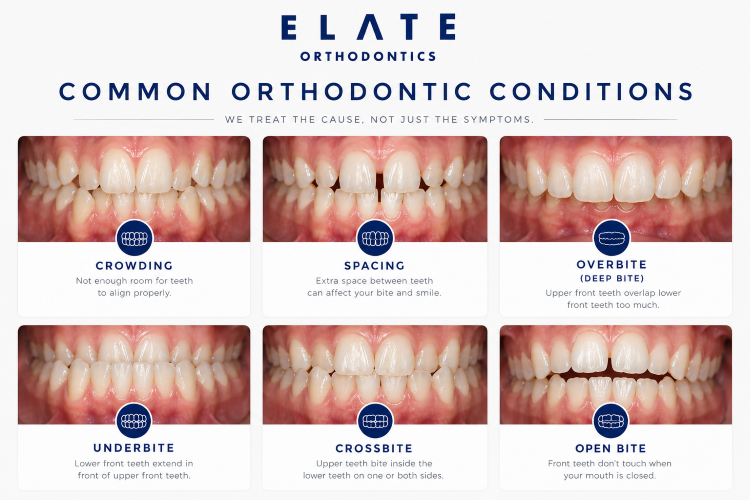
When the upper front teeth extend significantly past the lower front teeth horizontally. Excess overbite (also called overjet) can cause speech issues, increase the risk of trauma to the front teeth, and signal an underlying jaw size discrepancy. Treatable with braces, aligners, and in growing patients, growth modification appliances.
Underbite
When the lower front teeth sit in front of the upper front teeth when biting down. Often skeletal in origin, with the lower jaw growing more than the upper jaw. Best identified early. In growing children, the upper jaw can often be guided forward with a reverse-pull appliance, avoiding the need for jaw surgery later.
Crossbite
When upper teeth fit inside the lower teeth, either at the front of the mouth (anterior crossbite) or on the sides (posterior crossbite). Often caused by a narrow upper jaw. Untreated crossbites can cause uneven jaw growth, asymmetric facial development, and accelerated tooth wear. Palatal expansion is the typical treatment in growing children.
Open Bite
When the upper and lower front teeth do not touch when the back teeth are closed, leaving a vertical gap. Can result from prolonged thumb sucking, tongue thrust habits, or skeletal growth patterns. Treatment often combines orthodontic correction with myofunctional therapy to address the underlying habit and prevent relapse.
Deep Bite
When the upper front teeth cover too much of the lower front teeth when biting down, sometimes completely hiding them. Deep bites accelerate enamel wear, can cause the lower teeth to traumatize the gum tissue behind the upper teeth, and often coincide with TMJ strain. Correction involves intruding the front teeth or erupting the back teeth into a balanced position.
Jaw Misalignment
When the upper and lower jaws are not properly positioned relative to each other, either front-to-back, side-to-side, or vertically. Skeletal jaw discrepancies are best addressed during active growth when orthopedic appliances can guide jaw development. In adults, severe cases may require coordination with an oral surgeon.
Category 2
Tooth Position & Arch Conditions
When teeth do not have enough space to align properly, or when there is too much space between them, the appearance of the smile is affected and so is oral hygiene. Crowded teeth trap plaque and are harder to clean. Spaced teeth can shift over time. Both are highly treatable.
Crowded Teeth
When there is not enough space in the dental arch for all the teeth to align properly. Crowding ranges from mild rotations of single teeth to severe blocking-out of canines and premolars. Treatment may involve creating space through expansion, interproximal reduction, or in select cases, extractions. Most crowding is treatable with braces or clear aligners.
Gapped Teeth (Spacing)
When there are visible gaps between teeth, most commonly between the upper front teeth (a midline diastema). Spacing can result from a tooth size discrepancy, missing teeth, an oversized labial frenum, or simply genetic arch size. Treatable with braces or clear aligners; underlying causes like a frenum may need to be addressed first to prevent relapse.
Crooked Teeth
A general term covering teeth that are rotated, tipped, or out of alignment for any reason. Crooked teeth affect the appearance of the smile and can make brushing and flossing more difficult, increasing the risk of decay and gum disease over time. Most cases respond well to braces or clear aligners regardless of patient age.
Protruding Front Teeth
When the upper front teeth angle outward or sit far ahead of the lower teeth, sometimes called buck teeth. Protrusion is often a sign of a Class II skeletal pattern or thumb sucking history. Children with protruding upper teeth are at higher risk of dental trauma. Best treated during active growth, when both the bite and jaw position can be addressed together.
Midline Misalignment
When the center line between the upper front teeth does not align with the center line between the lower front teeth, or with the midline of the face. Often a sign of asymmetry in tooth position, jaw position, or both. Treatment involves identifying the cause and shifting teeth or guiding jaw growth to bring the midlines into balance.
Narrow Palate
When the upper jaw is too narrow to accommodate the tongue and to fit properly with the lower jaw. A narrow palate is a common underlying cause of crossbite, crowding, and in some cases mouth breathing. Palatal expansion in growing children widens the upper jaw without surgery. After growth, options become more limited.
Category 3
Eruption & Tooth Development Conditions
Sometimes the issue is not where teeth are but whether they erupt at all. Impacted, missing, or extra teeth all affect the bite and the smile. These conditions are often invisible without panoramic X-rays, which is why early evaluation matters so much.
Impacted Teeth
When a tooth fails to erupt into its correct position, often blocked by another tooth, dense bone, or insufficient space. Impacted canines and second molars are the most common cases we manage. Treatment usually combines orthodontic space creation, surgical exposure by an oral surgeon, and orthodontic traction with a gold chain.
Missing Teeth (Congenital)
When one or more permanent teeth never form. Most commonly affects the upper lateral incisors and lower second premolars. Treatment requires careful coordination with a restorative dentist and depends on the patient’s bite, age, and aesthetic goals. Options include orthodontic space closure, or opening space for a future implant or bridge.
Orthodontic Relapse
When teeth shift back toward their original positions after orthodontic treatment, usually due to inconsistent retainer wear. Relapse is one of the most common reasons adults seek a second round of orthodontic care. Most cases are correctable with a focused round of clear aligner therapy followed by a strict retention plan.
Category 4
Airway, Habit & Functional Conditions
Modern orthodontics looks beyond tooth alignment to consider how breathing, tongue posture, and oral habits influence facial growth. These functional conditions can drive bite problems and, when addressed early, often respond well to a combination of orthodontic and behavioral therapy.
Mouth Breathing
Chronic mouth breathing during sleep or daytime is associated with narrower upper jaws, longer face shapes, and increased risk of bite issues. We screen for it, refer to ENTs and sleep specialists when appropriate, and address the orthodontic component when indicated. See our airway orthodontics approach for more.
Tongue Thrust
When the tongue pushes forward against or between the front teeth during swallowing or at rest. Tongue thrust is one of the most common causes of open bite and protrusion of the front teeth. Treatment usually combines orthodontic correction with myofunctional therapy to retrain tongue posture and prevent relapse.
Thumb Sucking Effects
Prolonged thumb or finger sucking past age 4 to 5 can change the position of the front teeth, narrow the upper jaw, and cause anterior open bite. Stopping the habit is the first step. Once it has stopped, orthodontic correction can address the structural changes that remain. In some cases, a habit appliance is used to help the child stop.
Why a Specialist’s Diagnosis Matters
Many of the conditions on this page can be identified by a general dentist. But identifying a condition and diagnosing the cause are different things. A crowded smile in a 9-year-old may be a simple space issue. It may also signal an impacted canine, a skeletal discrepancy, or a tongue posture issue. The treatment plan depends entirely on which it is.
Orthodontists complete two to three additional years of specialty training after dental school, focused exclusively on diagnosing and treating malocclusions and craniofacial development. Dr. Baharvand and Dr. Kang bring this training, along with thousands of treated cases and ongoing continuing education, to every consultation at Elate Orthodontics.
What Sets Our Diagnostic Process Apart
Comprehensive records including digital scans, panoramic X-rays, and clinical photos at every consultation
Identification of every condition present, not just the most obvious one
Honest discussion of treatment options including timing, alternatives, and watchful waiting when appropriate
Coordination with oral surgeons, ENTs, sleep physicians, and restorative dentists when conditions require multidisciplinary care
Clear explanation of every diagnosis using your own X-rays and photos so you understand what we see
See Real Outcomes
Before & After Cases From Our Practice
The conditions described on this page are not abstract. We treat them every week. Our before-and-after gallery shows real Elate Orthodontics patients across the full range of malocclusion types, from mild crowding to severe skeletal discrepancies and impactions. Each case includes the diagnosis, the appliances used, and the outcome.
From Diagnosis to Treatment
How These Conditions Are Treated
Once a condition is diagnosed, the appropriate treatment depends on the patient’s age, growth status, severity, and personal preferences. Most malocclusions are treatable with one or more of the following approaches. Visit our full treatments page for complete details.
Traditional Braces
The gold standard for complex cases including impactions, severe crowding, and skeletal corrections. Versatile and predictable.
Clear Aligners
Invisalign and Angel Aligners for adults and teens. Effective for mild to moderate cases of crowding, spacing, and bite correction.
Palatal Expander
Widens the upper jaw in growing children to correct crossbites, narrow arches, and create space for crowded or impacted teeth.
Pediatric Orthodontics
Phase 1 early interceptive treatment for growing children with developing malocclusions, often using growth modification appliances.
Why Frisco Families Choose Elate Orthodontics
Patients who come to Elate Orthodontics for a complex condition are often surprised by the depth of the consultation. We do not rush. We take comprehensive records, identify everything we see, and walk you through the diagnosis using your own images. Then we build a treatment plan that addresses the cause, not just the symptom. This is how specialty orthodontic care should feel.
Dr. Baharvand and Dr. Kang are a husband-and-wife orthodontic team based in Frisco, with three convenient locations serving families from Frisco, The Colony, Prosper, Little Elm, and surrounding communities. Dr. Baharvand is ABO board-certified and a published clinician whose work has appeared in the American Journal of Orthodontics and Dentofacial Orthopedics.
1,000+
Five-star reviews across 3 locations
ABO
Board-certified orthodontist
Published
AJO-DO cover clinician
Free
Consultation with full diagnostic records
Our Locations
West Frisco
5605 FM 423, Suite 600
Frisco, TX 75036
FM 423 & Lebanon Rd — next to the UPS Store
The Colony
4713 Highway 121, Suite 304
The Colony, TX 75056
FM 423 & Hwy 121 — next to Ross
North Frisco / Prosper
2155 University Dr, Suite 110
Frisco, TX 75033
On 380 across from Cook Children’s Medical Center Prosper
Hours: Mon–Fri 8:00am–5:00pm | 972.538.4343
Not Sure What Condition You or Your Child Has? Let’s Find Out.
Free consultations at all three Elate Orthodontics locations include a complete diagnostic workup: digital scans, panoramic X-rays, clinical photos, and a clear explanation of every condition we identify. No pressure, no surprises, no commitment to treatment.
Also see: All Treatments | Before & After | Meet Dr. B & Dr. Kang | Tribute Family Dentistry