




Crooked Teeth Treatment in Frisco & The Colony, TX
Diagnosis & Correction by Dr. Baharvand & Dr. Kang — Braces, Invisalign, Angel Aligners & Comprehensive Treatment
📞 972.538.4343
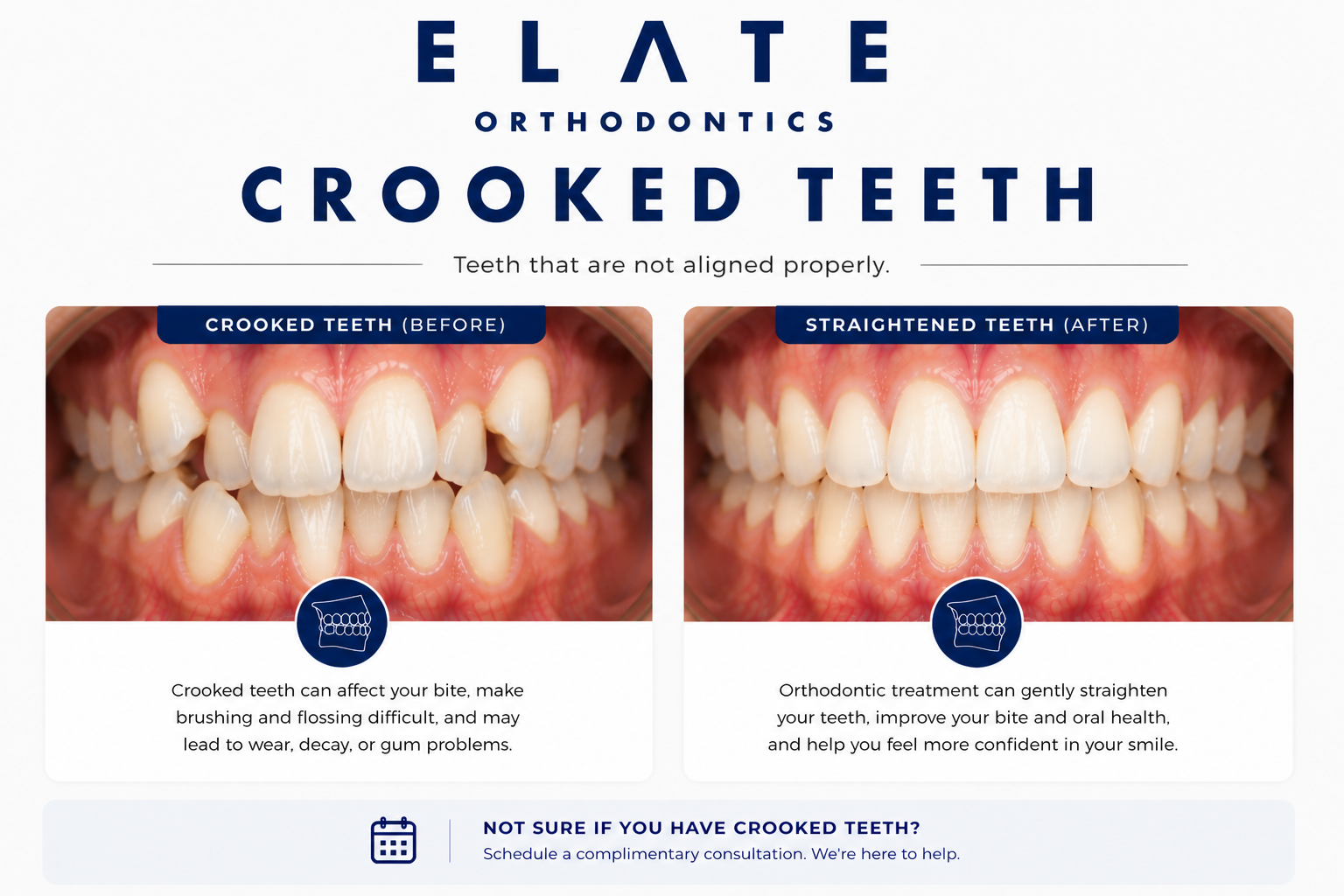
Crooked teeth correction at Elate Orthodontics — straightening teeth at any age with the right approach for your bite
Crooked Teeth — Frisco & The Colony, TX
Crooked Teeth Are Treatable at Any Age — But the Best Approach Depends on Why They’re Crooked
Crooked teeth is the everyday term for teeth that are rotated, tipped, tilted, or out of alignment for any reason. It is the most commonly searched orthodontic concern and the broadest one. Crooked teeth can mean a single rotated incisor, a slightly tilted canine, or an entire arch where multiple teeth are out of line. They can be the result of crowding, lost teeth, eruption issues, prior orthodontic relapse, or simply how the teeth came in. The treatment depends on which.
At Elate Orthodontics, Dr. Kevin Baharvand and Dr. Julia Kang treat crooked teeth in patients across Frisco, The Colony, Prosper, and Little Elm. The good news is that crooked teeth are one of the most treatable conditions in orthodontics, with excellent outcomes at any age. The diagnostic question we focus on is not whether your teeth can be straightened (almost always yes) but what is causing them to be crooked, whether there is a bite issue underneath the alignment problem, and which treatment approach will give you the most stable result.
As an ABO board-certified practice with a published clinician on staff, our diagnostic approach reflects the depth of training that distinguishes specialty orthodontic care. We take comprehensive records at every consultation and explain exactly what we see using your own digital scans, panoramic X-rays, and clinical photos. We then design treatment that addresses both the visible alignment problem and any underlying bite or space issues so the result lasts.
The Common Patterns of Crooked Teeth
Most Common
Rotated Teeth
A rotated tooth is twisted around its own axis, so it does not face forward like its neighbors. Rotations can be subtle (a few degrees of twist) or severe (a tooth turned almost completely sideways). Single rotated teeth are common, particularly with upper lateral incisors and lower premolars, and often happen when there is not quite enough space for the tooth to settle into a flat position.
Rotated teeth are highly treatable with braces or clear aligners, but they are also among the most prone to relapse. Stable rotation correction depends on careful retention strategy after treatment.
Common
Tipped & Tilted Teeth
Tipped teeth lean inward, outward, forward, or backward instead of standing upright in the bone. Tipping often happens when adjacent teeth are missing and a tooth drifts into the empty space. It can also occur with eruption disturbances or after a primary tooth is lost too early. Tipped molars after wisdom tooth pressure or after years of an unrestored missing first molar are particularly common in adults.
Uprighting tipped teeth requires controlled orthodontic forces, often delivered by braces. Aligners can address mild tipping but braces give us more precise control for moderate to severe cases.
Mixed
Generally Misaligned Arches
Many patients have multiple teeth out of alignment in various ways — a rotated incisor here, a tipped premolar there, slight crowding throughout. This is what most people picture when they say “crooked teeth.” Comprehensive orthodontic treatment addresses every tooth simultaneously and brings the entire arch into proper alignment.
For these cases, the treatment plan needs to consider the bite as well as the visible alignment. Straightening teeth without correcting an underlying bite issue often produces an attractive smile that is not stable long-term.
Adult Pattern
Late Adult Crowding & Relapse
Many adults notice their lower front teeth becoming more crooked in their 30s, 40s, and 50s. This is sometimes called “late adult crowding” and is partly due to the natural forward drift of the lower jaw and the pressure of the bite on the front teeth over decades. It is also one of the most common forms of post-orthodontic relapse when retainers are not worn long-term.
Adult crowding and relapse cases respond extremely well to focused short-course orthodontic treatment, often with clear aligners, in 6 to 12 months. See our orthodontic relapse page for more on retreatment options.
Most patients have a combination of these patterns. Comprehensive diagnosis identifies every misalignment and the underlying causes.
Underlying Causes
Why Do Teeth Become Crooked?
Crowding (Not Enough Space)
The single most common cause of crooked teeth is crowding — when there is not enough space in the dental arch for all the teeth to align side by side. Crowded teeth rotate, tip, and overlap because they are competing for limited room. This is partly genetic (smaller jaws inherited from one parent and larger teeth from another) and partly developmental.
Genetics
Tooth size, jaw size, and the relationship between them are largely inherited. If one or both parents had crooked teeth or needed orthodontic treatment, their children have a higher likelihood of developing similar patterns. This is why we often see siblings with similar alignment issues and why family history is one of our routine evaluation questions.
Lost Teeth or Eruption Issues
When a tooth is lost (whether a baby tooth lost too early or an adult tooth lost in injury or extraction), neighboring teeth often drift into the empty space and tip out of alignment. This is one of the most common causes of crooked teeth in adults who have had teeth extracted earlier in life and never replaced them.
Habits & Tongue Thrust
Persistent thumb sucking, tongue thrust, and chronic mouth breathing all influence how teeth erupt and where they end up. The tongue is one of the most powerful forces shaping the dental arches throughout childhood. When tongue posture is off, teeth often follow that pattern. We screen for these factors during evaluation because addressing them is often the difference between stable and unstable correction.
Late Adult Drift
Even adults who had perfectly straight teeth as teenagers often see their lower front teeth drift and crowd over time. This is partly due to natural forward growth of the lower jaw that continues into adulthood and partly due to the daily pressure of the bite. It is one of the most common reasons adults seek orthodontic retreatment and is highly treatable.
Orthodontic Relapse
Many patients who had braces or aligners as teenagers gradually lose their alignment over years or decades when retainers are not worn consistently. This is called orthodontic relapse, and it is the second most common reason adults come to us for treatment. Relapse cases typically respond well to focused short-course treatment with clear aligners.
Why Crooked Teeth Are Worth Addressing
Many patients come to us focused only on the cosmetic side of crooked teeth. The smile in the mirror is what motivated them, and that is a perfectly valid reason to pursue treatment. But crooked teeth carry real functional consequences that often go unrecognized until they become harder to ignore — uneven wear, harder cleaning, increased decay risk, and sometimes bite issues that build pressure on the wrong teeth over time.
Treating crooked teeth is one of the highest-return investments in long-term oral health for most patients. The improvement in cleaning, the reduction in wear, and the support it gives to the bite all compound over decades.
What Untreated Crooked Teeth Can Cause
Increased risk of decay and gum disease from harder-to-clean overlapping or rotated teeth
Uneven wear patterns as some teeth carry more bite force than others
Progressive worsening over time, particularly in adults whose lower front teeth continue to drift
Compensatory chewing patterns that strain the TMJ over years
Self-consciousness about smile appearance affecting confidence in social and professional situations
Speech difficulties when severe misalignment affects how the tongue contacts the teeth
Higher likelihood of fractured or chipped teeth on those that take disproportionate bite force
Treatment Approach
How We Treat Crooked Teeth at Every Age
Crooked teeth are treatable at any age. The treatment options expand during childhood and adolescence because growth is still happening, but adult treatment outcomes are excellent — and modern clear aligner technology has made adult treatment more accessible than ever. The right approach depends on age, the cause of the misalignment, and whether bite correction is needed alongside alignment.
Children (Ages 7–10)
For young children, we focus on identifying causes of crooked teeth that can be intercepted early — crowding driven by a narrow jaw, eruption issues from lingering baby teeth, or habits like thumb sucking. Phase 1 (early interceptive) treatment can address some of these underlying factors before full orthodontic treatment becomes necessary.
Most children with mildly crooked teeth do not need treatment yet. We monitor and intervene only when the timing is right.
Teens (Ages 11–17)
The teen years are the prime treatment window for most crooked teeth cases. Permanent teeth are in, growth is still active, and patients respond well to both braces and clear aligners. Treatment time for comprehensive cases typically ranges from 12 to 24 months depending on severity.
For teens with combined alignment and bite issues, full orthodontic treatment addresses everything at once. Retainer compliance after treatment is critical for keeping teeth straight long-term.
Adults
Adult crooked teeth treatment is one of the fastest-growing categories in orthodontics. Modern Invisalign and Angel Aligner protocols handle most adult alignment cases with excellent outcomes and minimal visibility during treatment. Mild cases — particularly relapse and late adult drift — can sometimes be completed in 6 to 12 months with focused short-course aligner therapy.
For adults with severe crowding or significant bite issues, comprehensive treatment with braces or aligners typically takes 18 to 24 months. We coordinate with restorative dentists when teeth need cosmetic finishing after alignment.
Treatment Options
Treatments We Use to Straighten Crooked Teeth
Invisalign
The most popular adult treatment for crooked teeth and one of the strongest options for teens. Modern Invisalign protocols handle the vast majority of alignment cases — including rotations, tipping, and comprehensive crowding — with excellent outcomes and minimal visibility during treatment. The aligners are removable for eating and brushing.
Angel Aligners
A clear aligner system we offer at Elate Orthodontics for appropriate cases. Like other clear aligner brands, Angel Aligners can correct most alignment cases with treatment plans tailored to each patient’s specific anatomy. A great option for patients seeking aligner therapy at a different price point.
Traditional Braces
The most versatile option for severe crowding, complex rotations, significant tipping, and cases combining alignment with bite correction. Braces give us precise three-dimensional control over each tooth and remain the gold standard for the most demanding orthodontic cases. Compliance is automatic since they are not removable.
Clear Braces
Same effective mechanics as traditional braces with tooth-colored brackets that blend with natural enamel. A great middle-ground option for teens and adults treating crooked teeth who want the predictability of braces with less visibility during treatment. Particularly popular with adult professionals.
Palatal Expander (Pediatric Cases)
For growing children whose crooked teeth are caused by crowding from a narrow upper jaw, a palatal expander widens the arch and creates space for proper alignment. Often used as the first step before comprehensive orthodontic treatment in adolescence. Catching this in time can sometimes avoid the need for extractions later.
Permanent Bonded Retainers
For most crooked teeth corrections — particularly cases with rotations or treatment for late adult drift — we recommend a small wire bonded behind the front teeth as a permanent retainer. This is invisible from the front, easy to maintain, and dramatically reduces the risk of relapse over time. Retention strategy is critical for keeping straightened teeth straight.
Restorative Coordination
For adult patients with worn, chipped, or discolored teeth in addition to misalignment, we coordinate with restorative dentists. The orthodontic phase positions the teeth ideally and the restorative phase finishes the smile with veneers, crowns, or bonding. This sequencing produces the strongest aesthetic outcomes.
Pediatric Orthodontics
For children with developing alignment issues, Phase 1 early interceptive treatment can address underlying causes of crooked teeth before full orthodontic treatment becomes necessary. Includes early space management, expansion, habit appliances, and intercepting eruption issues.
AAO Recommendation
It’s Never Too Early or Too Late to Address Crooked Teeth
The American Association of Orthodontists recommends an evaluation by age 7. For crooked teeth, the early evaluation lets us identify whether the misalignment is part of a developing pattern that benefits from interceptive treatment, or whether it is best monitored until adolescence for comprehensive care. Most children evaluated at age 7 do not need treatment yet, but the timing decisions made at this age affect the entire orthodontic trajectory.
For adults, the right time to address crooked teeth is when you decide you want to. There is no biological deadline. Modern adult orthodontics — particularly clear aligners — has dramatically expanded what is possible at any age, with excellent outcomes and minimal visibility during treatment.
See Real Outcomes
Crooked Teeth Cases From Our Practice
Our before-and-after gallery includes real crooked teeth corrections at Elate Orthodontics, ranging from teen comprehensive cases corrected with braces to adult relapse and late drift cases corrected with short-course clear aligners. Each case shows the diagnosis, the appliances used, and the final result.
Common Questions
Crooked Teeth FAQ
Am I too old to get my crooked teeth fixed?
No. Adult orthodontics is one of the fastest-growing categories in our practice, and we treat patients in their 40s, 50s, 60s, and beyond with excellent outcomes. Healthy teeth and bone are far more important than age. Modern clear aligners and clear braces have made adult treatment more accessible than ever, with minimal visibility during the months of treatment.
Can Invisalign fix crooked teeth?
Yes — clear aligners now handle the vast majority of crooked teeth cases, including rotations, tipping, and comprehensive crowding. Modern Invisalign and Angel Aligner protocols include precision attachments and refined movements that produce excellent outcomes. Severe cases or those requiring significant bite correction may still benefit from braces, but for most patients, aligners are an excellent option.
Why have my teeth gotten more crooked as I’ve gotten older?
Adult late drift is real and very common. The lower jaw continues to grow forward subtly throughout life, and the daily pressure of biting gradually crowds the lower front teeth. If you had braces as a teenager and stopped wearing your retainer, this drift includes orthodontic relapse. If you never had braces, it may be the first time the crowding has become noticeable. Either way, focused short-course treatment with clear aligners typically addresses it in 6 to 12 months.
How long will it take to straighten my teeth?
Treatment time depends on severity and the underlying cause. Mild cases — including most adult relapse and late drift — can sometimes be completed in 6 to 12 months. Moderate cases typically take 12 to 18 months. Comprehensive cases involving significant crowding, rotations, or bite correction usually take 18 to 24 months. We give you a realistic timeline at consultation based on your specific case.
Will my teeth get crooked again after treatment?
They will if you do not wear your retainer. Teeth have a lifelong tendency to drift, and retainer compliance is the single biggest factor in long-term stability. We typically recommend a small wire bonded permanently behind the front teeth combined with a removable retainer for the back teeth. With proper retention, your results can last for life.
Is treatment for crooked teeth covered by insurance?
Most PPO dental insurance plans include orthodontic benefits that apply to crooked teeth treatment. Coverage varies by plan, with some covering teen treatment more generously than adult treatment. We are in-network with most major PPO carriers and offer flexible financing through Cherry to make treatment accessible regardless of insurance coverage.
Why Frisco & The Colony Patients Choose Elate Orthodontics for Crooked Teeth
Crooked teeth is the most common condition we treat. Outcomes depend less on the technology and more on the depth of the diagnosis, the experience to identify when bite correction is needed alongside alignment, and the discipline to plan retention properly. Dr. Baharvand and Dr. Kang have managed thousands of crooked teeth cases across the full spectrum, from straightforward teen alignment to complex adult cases combining late drift, relapse, and restorative coordination.
Dr. Baharvand and Dr. Kang are a husband-and-wife orthodontic team based in Frisco, with three convenient locations serving families across Frisco, The Colony, Prosper, and Little Elm. Dr. Baharvand is ABO board-certified and a published clinician whose work has appeared in the American Journal of Orthodontics and Dentofacial Orthopedics.
1,000+
Five-star reviews across 3 locations
ABO
Board-certified orthodontist
Published
AJO-DO cover clinician
Free
Consultation with full diagnostic records
Our Locations
West Frisco
5605 FM 423, Suite 600
Frisco, TX 75036
FM 423 & Lebanon Rd — next to the UPS Store
The Colony
4713 Highway 121, Suite 304
The Colony, TX 75056
FM 423 & Hwy 121 — next to Ross
North Frisco / Prosper
2155 University Dr, Suite 110
Frisco, TX 75033
On 380 across from Cook Children’s Medical Center Prosper
Hours: Mon–Fri 8:00am–5:00pm | 972.538.4343
Ready to Straighten Your Teeth? Let’s Map Out the Right Plan.
Free consultations at all three Elate Orthodontics locations include a complete diagnostic workup: digital scans, panoramic X-rays, clinical photos, and a clear explanation of what’s causing your misalignment. We design treatment that addresses both the visible alignment and any underlying issues. No pressure, no surprises, no commitment to treatment.
Also see: All Conditions We Treat | Gapped Teeth | Overbite | Underbite | Crossbite | Before & After