





Deep Bite Treatment in Frisco & The Colony, TX
Diagnosis & Correction by Dr. Baharvand & Dr. Kang — Braces, Invisalign, Angel Aligners & Bite Turbos
📞 972.538.4343
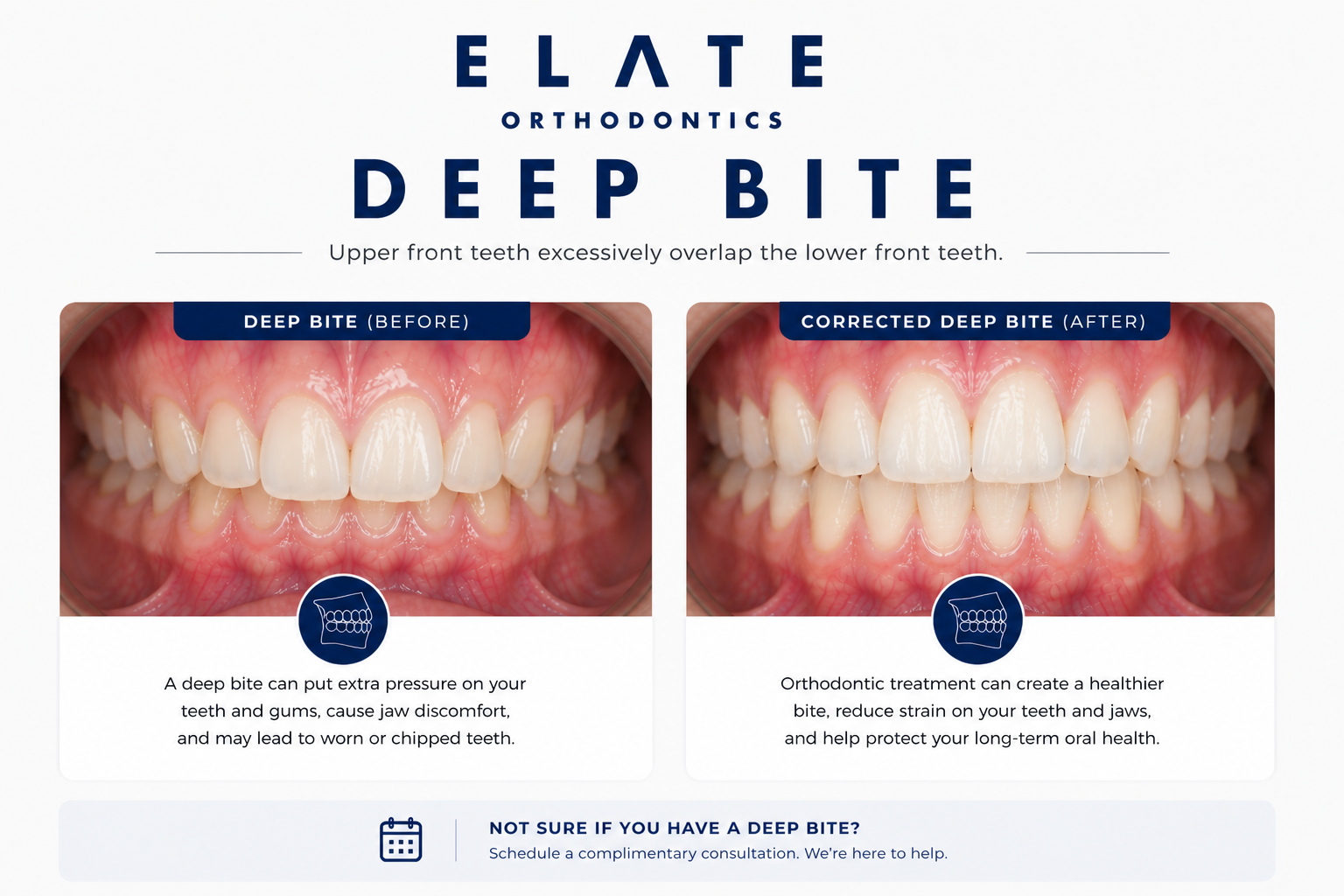
Deep bite correction at Elate Orthodontics — protecting front teeth from cumulative wear and tissue damage
Deep Bite — Frisco & The Colony, TX
When Upper Teeth Cover Too Much of the Lower Teeth, the Damage Builds Quietly Over Years
A deep bite is a malocclusion where the upper front teeth cover too much of the lower front teeth when biting down. In severe cases, the upper teeth completely hide the lower teeth, and the lower teeth bite into the gum tissue behind the uppers. A normal bite has the upper teeth covering about 1 to 2 millimeters of the lowers. A deep bite covers significantly more, often 50 percent or more of the lower tooth height. The most severe deep bites, where upper teeth cover 100 percent of the lowers, are called “100 percent deep bites” and warrant urgent attention.
At Elate Orthodontics, Dr. Kevin Baharvand and Dr. Julia Kang treat deep bites in patients across Frisco, The Colony, Prosper, and Little Elm. Deep bite is one of the most common adult complaints we see and one of the most underdiagnosed conditions in orthodontics. Many adults arrive in their 30s, 40s, or 50s with worn front teeth, chipped enamel, chronic jaw fatigue, or unexplained TMJ pain — all driven by a deep bite that was never corrected. The damage from a deep bite is cumulative and largely preventable.
As an ABO board-certified practice with a published clinician on staff, our diagnostic approach reflects the depth of training that distinguishes specialty orthodontic care. We take comprehensive records at every consultation and explain exactly what we see using your own digital scans, panoramic X-rays, and clinical photos. For deep bite cases, we evaluate not just the depth of the overlap but also the wear patterns on your existing teeth and the position of your jaw joints.
Deep Bite vs. Overbite (And Why the Distinction Matters)
Deep Bite (Vertical)
Deep bite measures vertical overlap. It describes how far down the upper front teeth cover the lower front teeth when biting. A normal vertical overlap is around 1 to 2 millimeters. Deep bites cover 50 percent or more of the lower tooth height. The most severe cases reach 100 percent coverage, where the lower teeth disappear entirely behind the uppers when biting down.
Deep bites cause damage primarily through wear and tissue trauma. The lower teeth often bite into the gum tissue behind the upper teeth, and the front teeth carry forces they were not designed to bear.
Overjet (Horizontal Overbite)
Overjet, sometimes loosely called overbite, measures horizontal distance — how far the upper front teeth stick out in front of the lower front teeth. The general public uses the word “overbite” to describe both vertical and horizontal patterns, which is why the clinical distinction matters during diagnosis.
Many patients have both deep bite and excessive overjet at the same time, but the treatment approach for each component differs. We diagnose them separately and treat the dominant problem first. See our overbite page for more on horizontal overbite and combined cases.
A complete diagnosis evaluates both vertical and horizontal components separately. Treatment depends on which dimension is causing the most damage and dysfunction.
Underlying Causes
What Causes a Deep Bite?
Some patients are genetically predisposed to a horizontal, forward-rotating growth pattern of the lower jaw. This produces a short-face appearance with strong masseter muscles and a deep bite. Skeletal deep bites tend to be more challenging to correct fully because the underlying jaw geometry resists opening the bite, and they often coexist with bruxism and TMJ strain.
When back teeth are missing or have been lost without replacement, the back support of the bite collapses. The lower jaw rotates upward and the front teeth take on more of the bite force, deepening the overlap over time. This is a common cause of acquired deep bite in adults and a strong reason to replace missing teeth promptly.
As back teeth wear down from years of grinding or as fillings and crowns shorten the bite over time, the front teeth come together more deeply. This creates a feedback loop where a developing deep bite accelerates front tooth wear, which further deepens the bite. Catching this cycle early is essential.
Many patients with Class II malocclusion (where the upper jaw is positioned ahead of the lower jaw) also present with a deep bite. The two often coexist because the same underlying skeletal pattern produces both. Comprehensive treatment usually addresses both components together.
Chronic teeth grinding wears down the back teeth faster than the front teeth, gradually deepening the bite. Bruxism and deep bite often appear together and reinforce each other. Patients who grind their teeth during sleep frequently develop deep bite patterns over time, and patients with deep bites often clench more strongly because of how the bite functions.
Like other malocclusions, deep bite has a strong hereditary component. Tooth size, jaw shape, and growth direction are all inherited. If one or both parents have a deep bite, their children are at higher likelihood of developing one. Family evaluations help identify developing patterns early.
Why Untreated Deep Bite Is Worth Addressing
Deep bite is the quietest of the bite conditions. It often does not look dramatic from the outside. Many patients live with it for decades without realizing it is the source of their worn front teeth, chipped enamel, headaches, or sore jaws. The damage accumulates slowly and is largely silent until the consequences arrive in the form of restorative dental work, TMJ pain, or sudden tooth fractures.
Many of the patients we see in their 40s, 50s, and 60s with extensive front tooth wear had a deep bite that was never identified or corrected when they were younger. Catching and correcting deep bite earlier prevents this slow-motion damage from accumulating.
What Happens If Deep Bite Is Left Untreated
Accelerated wear and chipping of the upper and lower front teeth
Lower teeth biting into the gum tissue behind the upper front teeth, causing tissue trauma and recession
Loss of front tooth length over time as enamel wears away
Chronic jaw fatigue, clenching, and TMJ strain
Headaches and facial muscle tension related to overworked masseter muscles
Need for extensive restorative work later — crowns, veneers, or full mouth rehabilitation — to repair worn-down teeth
Progressive deepening of the bite as teeth continue to wear, creating a feedback loop
Increased risk of tooth fracture from forces concentrated on the front teeth
Treatment Approach
How We Treat Deep Bite at Every Age
Deep bite treatment depends on the patient’s age, the severity of the overlap, the wear pattern on the teeth, and whether back teeth are missing. The mechanical principle is consistent across ages: we either intrude (push down) the front teeth, erupt (lift) the back teeth, or do both, until the bite settles into a balanced relationship.
Children (Ages 7–10)
In growing children, deep bites caused by a horizontal skeletal pattern can sometimes be intercepted using growth modification. The goal is to allow the back teeth to erupt vertically while restraining the front teeth, so the bite settles into a more open, balanced position as the patient grows.
Most children evaluated at age 7 with a developing deep bite do not need immediate treatment — we monitor and intervene when the timing is right.
Teens (Ages 11–17)
The teen years are an excellent treatment window for deep bite. Permanent teeth are in, growth is still active, and the back teeth can still be erupted into a deeper, more supportive contact. Comprehensive treatment with braces or clear aligners, often using bite turbos to disengage the front teeth, produces predictable results in 18 to 24 months.
Teens with combined deep bite and Class II malocclusion are addressed simultaneously using elastics, bite blocks, and sometimes growth modification.
Adults
Adult deep bite treatment focuses on intruding the front teeth and supporting the back teeth where needed, often using TADs (temporary anchorage devices) or precision attachments with clear aligners. For adults with significant front tooth wear, we coordinate with a restorative dentist so that final crowns or veneers are placed once the bite is corrected and stable.
For adults with severe skeletal deep bites where orthodontic treatment alone cannot create a stable result, we coordinate with experienced oral surgeons. We will tell you honestly which path is realistic for your case.
Treatment Options
Treatments We Use to Correct Deep Bite
Traditional Braces
The most versatile option for moderate to severe deep bites. Braces give us precise control to intrude the front teeth using carefully shaped archwires and to use bite-opening mechanics like reverse curves. The gold standard for complex deep bite cases and for cases requiring TADs.
Clear Braces
Same effective mechanics as traditional braces with tooth-colored brackets that blend with natural enamel. A great option for teens and adults treating deep bite who want the predictability of braces with less visibility.
Invisalign
Modern Invisalign protocols include precision bite ramps and attachments that effectively intrude the front teeth and open the bite. The aligners themselves disengage the bite during wear, reducing front tooth wear while treatment progresses. A strong option for cooperative teens and adults with mild to moderate deep bite.
Angel Aligners
A clear aligner system we offer at Elate Orthodontics for appropriate cases. Like other clear aligner brands, Angel Aligners can correct mild to moderate deep bites with precision attachments and bite-opening mechanics tailored to each patient’s anatomy.
Bite Turbos & Bite Ramps
Small bonded buttons placed on the back of the upper front teeth or the chewing surface of the back teeth. They prevent the front teeth from continuing to bite together during treatment, allowing the back teeth to erupt and the bite to open. A common adjunct to braces or aligners in deep bite treatment.
Temporary Anchorage Devices (TADs)
TADs are small mini-implants placed in the bone that serve as fixed anchor points. For adults with severe deep bites, TADs allow predictable intrusion of the front teeth — one of the most effective ways to open a deep bite without surgery. TADs have transformed adult deep bite treatment.
Restorative Coordination
For adult patients with significant front tooth wear from years of deep bite, we coordinate with a restorative dentist. The bite is corrected first orthodontically, the worn teeth are temporized as needed, and final crowns or veneers are placed once the bite is stable. This sequencing protects the long-term outcome.
Orthognathic Surgery (Severe Adult Cases)
For adults with severe skeletal deep bites where orthodontic treatment alone cannot produce a stable, healthy bite, we coordinate with experienced oral surgeons for jaw surgery combined with orthodontic treatment. Reserved for cases that genuinely require it.
AAO Recommendation
Catch Deep Bites Before Cumulative Damage Begins
The American Association of Orthodontists recommends an evaluation by age 7. For deep bite, this matters because correcting it during growth and adolescence is far easier than correcting it after years of wear and tissue trauma have accumulated. The bite mechanics are simpler when teeth are still erupting and the jaw is still growing.
For adults who already have a deep bite, the right time for treatment is now — before more enamel is lost. Modern adult orthodontics offers excellent outcomes with clear aligners or clear braces, often coordinated with restorative dental work for the most damaged cases.
See Real Outcomes
Deep Bite Cases From Our Practice
Our before-and-after gallery includes real deep bite corrections at Elate Orthodontics, ranging from teen cases corrected with braces and bite turbos to adult cases corrected with clear aligners and TADs, including cases with restorative coordination for worn front teeth. Each case shows the diagnosis, the appliances used, and the final result.
Common Questions
Deep Bite FAQ
Deep bite measures vertical overlap — how far down the upper front teeth cover the lower front teeth. Overbite is sometimes used as a general term but most often refers to overjet, the horizontal distance the upper teeth stick out in front. Deep bite is about vertical depth, overjet is about horizontal projection. The two often coexist but require different treatment approaches.
Yes, for mild to moderate deep bites in cooperative patients. Modern Invisalign protocols include precision bite ramps and attachments that intrude the front teeth and open the bite. The aligners themselves disengage the bite during wear, helping protect the front teeth during treatment. Severe skeletal cases may require traditional braces with TADs.
If your upper front teeth cover more than half of the lower front teeth when biting down, that meets the clinical threshold for deep bite. Other warning signs include front teeth that are noticeably worn or chipped, gum irritation behind the upper front teeth from the lower teeth biting into the tissue, chronic jaw fatigue, headaches, or unexplained TMJ discomfort. A consultation with comprehensive records will tell you definitively.
In most cases, yes. Deep bites tend to deepen over time as enamel wears down on the back teeth, as fillings or crowns gradually shorten the bite, and as the front teeth absorb more of the bite force. This creates a feedback loop where the deepening bite accelerates further wear. Catching and correcting deep bite earlier prevents this slow-motion damage.
Most comprehensive deep bite treatments take 18 to 24 months. Adult cases using TADs to intrude front teeth typically take 18 to 30 months depending on severity. Cases coordinated with restorative dental work may extend longer to allow proper sequencing of orthodontic and restorative phases. We give you a realistic timeline at consultation based on your specific case.
Most PPO dental insurance plans include orthodontic benefits that apply to deep bite treatment, particularly when there is documented functional concern such as tissue trauma, accelerated tooth wear, or TMJ symptoms. Coverage varies by plan. We are in-network with most major PPO carriers and offer flexible financing through Cherry to make treatment accessible regardless of insurance coverage.
Why Frisco & The Colony Families Choose Elate Orthodontics for Deep Bite Correction
Deep bite is one of the most underdiagnosed conditions in orthodontics. The depth of the diagnosis, the recognition of cumulative wear patterns, and the willingness to coordinate with restorative dentists when needed are what separate good outcomes from great ones. Dr. Baharvand and Dr. Kang have managed deep bite cases across the full spectrum, from teen cases corrected with bite turbos and aligners to complex adult cases requiring TADs and restorative coordination.
Dr. Baharvand and Dr. Kang are a husband-and-wife orthodontic team based in Frisco, with three convenient locations serving families across Frisco, The Colony, Prosper, and Little Elm. Dr. Baharvand is ABO board-certified and a published clinician whose work has appeared in the American Journal of Orthodontics and Dentofacial Orthopedics.
1,000+
Five-star reviews across 3 locations
ABO
Board-certified orthodontist
Published
AJO-DO cover clinician
Free
Consultation with full diagnostic records
Our Locations
5605 FM 423, Suite 600
Frisco, TX 75036
FM 423 & Lebanon Rd — next to the UPS Store
4713 Highway 121, Suite 304
The Colony, TX 75056
FM 423 & Hwy 121 — next to Ross
2155 University Dr, Suite 110
Frisco, TX 75033
On 380 across from Cook Children’s Medical Center Prosper
Hours: Mon–Fri 8:00am–5:00pm | 972.538.4343
Worried About Worn Teeth or Jaw Pain? It Might Be a Deep Bite.
Free consultations at all three Elate Orthodontics locations include a complete diagnostic workup: digital scans, panoramic X-rays, clinical photos, and a careful evaluation of wear patterns. We identify whether a deep bite is the source of your symptoms and what treatment will protect your teeth long-term. No pressure, no surprises, no commitment to treatment.
Also see: All Conditions We Treat | Overbite | Underbite | Crossbite | Open Bite | Before & After