




Crossbite Treatment in Frisco & The Colony, TX
Anterior & Posterior Crossbite Correction by Dr. Baharvand & Dr. Kang — Palatal Expanders, Braces, Invisalign & Angel Aligners
📞 972.538.4343
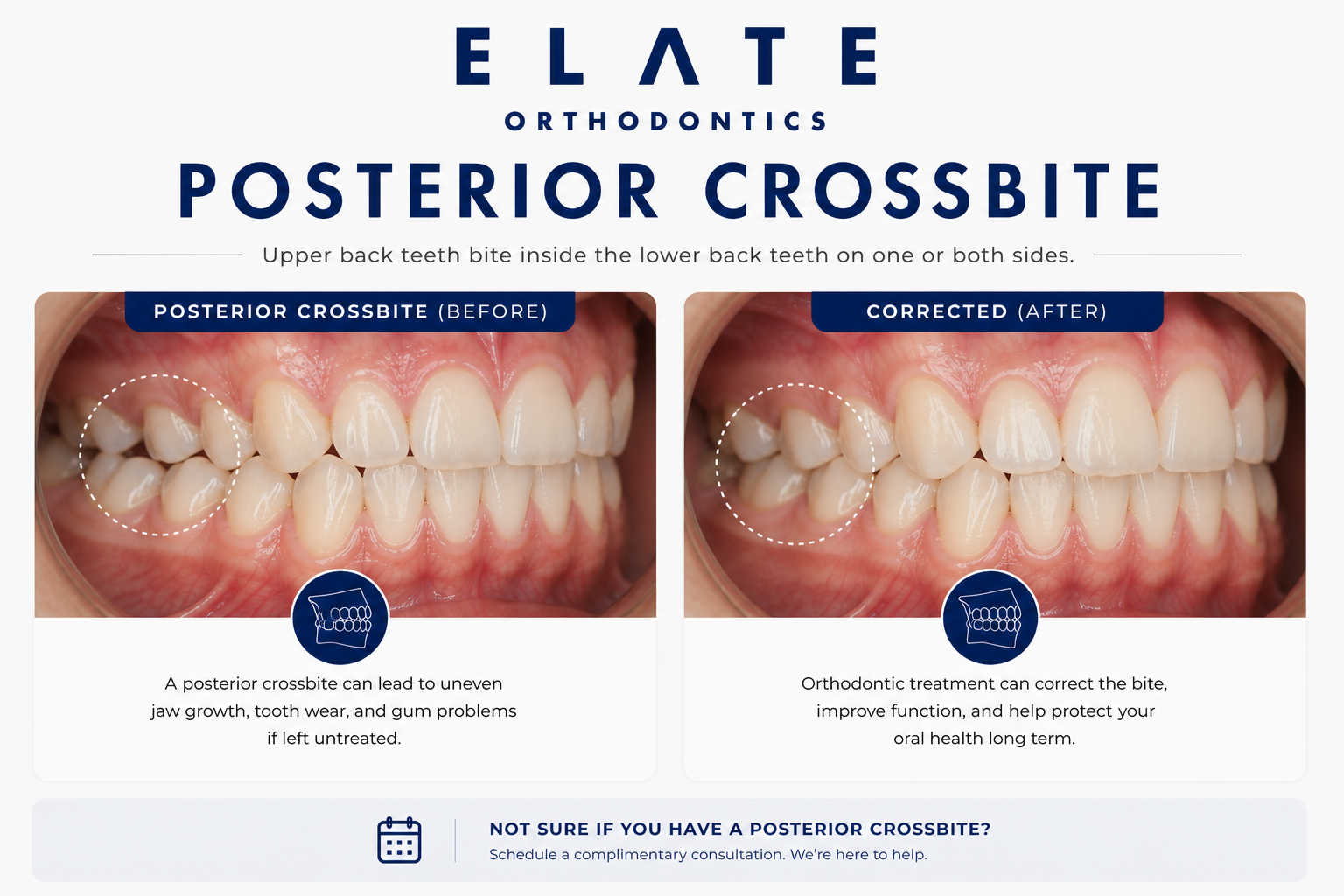
Crossbite correction at Elate Orthodontics — diagnosed early to guide healthy jaw growth
Crossbite — Frisco & The Colony, TX
When Upper Teeth Bite Inside Lower Teeth, the Whole Bite Develops Off-Track
A crossbite is a bite condition where one or more upper teeth fit inside the lower teeth instead of outside, where they belong. It can occur at the front of the mouth (anterior crossbite, where upper front teeth bite behind lower front teeth) or on the sides (posterior crossbite, where upper back teeth bite inside lower back teeth). It can affect a single tooth, several teeth, or the entire arch. Crossbites are most often caused by a narrow upper jaw, but they can also result from individual tooth tipping, eruption issues, or skeletal asymmetry.
At Elate Orthodontics, Dr. Kevin Baharvand and Dr. Julia Kang treat crossbites in patients across Frisco, The Colony, Prosper, and Little Elm. Crossbite is one of the most important conditions to catch early. An untreated posterior crossbite can drive asymmetric jaw growth and force the lower jaw to shift to one side every time a child closes down. Over years, this functional shift can become a real skeletal asymmetry. Catching it at age 7 to 10 with a palatal expander often eliminates the problem entirely. Catching it at age 30 is a much harder conversation.
As an ABO board-certified practice with a published clinician on staff, our diagnostic approach reflects the depth of training that distinguishes specialty orthodontic care. We take comprehensive records at every consultation and explain exactly what we see using your own digital scans, panoramic X-rays, and clinical photos. For crossbite cases, identifying which teeth are involved and whether the underlying jaw is narrow changes the entire treatment plan.
The Two Types of Crossbite (And Why the Difference Matters)
Posterior Crossbite
A posterior crossbite involves the back teeth, where one or more upper molars or premolars bite inside the lower teeth. It most often results from a narrow upper jaw that has not developed wide enough to fit properly over the lower jaw. Posterior crossbites can be unilateral (affecting one side only) or bilateral (affecting both sides).
Unilateral posterior crossbites are particularly important to catch early because the patient often shifts the lower jaw to one side to bite comfortably. Over years, this functional shift drives the entire jaw to grow asymmetrically. Treatment with a palatal expander in growing children is highly effective and often resolves the issue completely.
Anterior Crossbite
An anterior crossbite involves the front teeth, where one or more upper front teeth bite behind the lower front teeth instead of in front of them. It can affect a single tooth or several. Sometimes anterior crossbite is the early sign of a developing skeletal underbite (Class III malocclusion). Other times it is purely dental, caused by a tooth that has tipped or erupted in the wrong position.
Anterior crossbites should be evaluated and treated promptly. A single upper tooth biting behind a lower tooth concentrates damaging forces in one spot, accelerating wear and sometimes causing recession of the lower gum tissue. Treatment ranges from simple appliances in growing children to braces or aligners in older patients.
Some patients have both anterior and posterior components. Comprehensive diagnosis identifies every aspect of the crossbite and determines the right treatment plan.
Underlying Causes
What Causes a Crossbite?
The most common cause of posterior crossbite. The upper jaw is too narrow to fit properly over the lower jaw, so the back teeth fall inside the lower teeth. Narrow upper jaws are often associated with mouth breathing, a high palate, and crowding. Easily addressed with a palatal expander in growing children.
Jaw shape and width are strongly inherited. If one or both parents had a narrow palate or crossbite, their children are at higher likelihood of developing the same pattern. We often recommend evaluating siblings of patients we treat for crossbite.
When a child consistently breathes through the mouth, the tongue rests low rather than against the roof of the mouth. The tongue is one of the natural forces that shapes upper jaw width during growth. Without that pressure, the upper jaw often develops narrower, contributing to crossbite. We screen for airway and tongue posture issues during evaluation.
Persistent thumb sucking or pacifier use past age 4 to 5 can narrow the upper jaw and create posterior crossbite. The constant inward pressure of the thumb or pacifier deforms the developing palate. Stopping the habit is the first step. Once stopped, orthodontic correction can address the structural changes.
Sometimes an anterior crossbite develops because a baby tooth refuses to fall out, forcing the permanent tooth to erupt behind it. Or a permanent tooth simply erupts in the wrong direction. These are often single-tooth crossbites that respond quickly to focused treatment.
In some patients, the upper or lower jaw has grown asymmetrically, with one side wider or longer than the other. This produces a unilateral crossbite. Skeletal asymmetries need to be evaluated carefully because the treatment approach differs from a simple narrow palate.
Why an Untreated Crossbite Is Worth Addressing Early
Crossbite is one of the conditions where the price of waiting is highest. A unilateral posterior crossbite forces a growing child to shift the lower jaw to one side every time they close down. Years of asymmetric closing translate into asymmetric growth. What started as a tooth position issue can become a true facial asymmetry by adolescence.
Anterior crossbites are equally important to address. A single upper tooth biting behind a lower tooth concentrates abnormal forces and often causes lower gum recession that may not fully recover even after orthodontic correction.
What Happens If Crossbite Is Left Untreated
Asymmetric jaw growth from chronic functional shifting in unilateral crossbites
Accelerated and uneven tooth wear, particularly on the teeth in crossbite
Gum recession on lower teeth in anterior crossbite
Crowding of upper teeth from insufficient arch width
TMJ strain from compensating for the bite mismatch
Loss of the non-surgical expansion option once the midpalatal suture fuses, typically between ages 11 and 13
Progression toward a developing skeletal underbite when anterior crossbite is left uncorrected
Treatment Approach
How We Treat Crossbite at Every Age
Crossbite treatment depends heavily on the patient’s age and whether the underlying jaw is narrow. Younger patients have more options because the upper jaw bones have not yet fused at the midpalatal suture. Once those bones fuse, expansion becomes more limited and sometimes requires surgical assistance.
Children (Ages 7–10) — Best Window
This is the prime treatment window for posterior crossbite caused by a narrow upper jaw. A palatal expander gently widens the upper jaw at the midpalatal suture, where the two halves of the palate meet. Treatment is highly effective, often takes 6 to 12 months, and frequently eliminates the need for further skeletal intervention later.
Anterior crossbites at this age are typically corrected with focused tooth movement using simple appliances or partial braces.
Teens (Ages 11–17)
The midpalatal suture often begins fusing during the teen years. Conventional palatal expansion is still possible in many cases, particularly in younger teens. For older teens, the response varies. Crossbite correction in this age group typically combines expansion with full braces or clear aligners to coordinate the bite.
For mild crossbites caused by tooth position rather than skeletal narrowness, braces or aligners alone may be sufficient.
Adults
In adults, the midpalatal suture is typically fused. Mild to moderate crossbites can still be corrected with braces or clear aligners by tipping the teeth into a corrected position. For adults who need true skeletal expansion of the upper jaw, surgically-assisted rapid palatal expansion (SARPE) is an option, performed in coordination with an oral surgeon.
Single-tooth anterior crossbites in adults usually respond well to focused tooth movement with braces or aligners and a focus on protecting the gum tissue during correction.
Treatment Options
Treatments We Use to Correct Crossbite
Palatal Expander
The gold standard for posterior crossbite caused by a narrow upper jaw, especially in growing children. The expander gently widens the upper jaw at the midpalatal suture, creating a wider arch and resolving the crossbite at its source. Treatment is well-tolerated, takes about 6 to 12 months, and produces stable results when followed by retention.
Traditional Braces
Versatile and effective for crossbite cases involving multiple teeth or where individual tooth tipping is needed. Braces are often used after expansion in younger patients to coordinate the entire bite, and as a primary treatment for crossbites in teens and adults.
Clear Braces
Same effective mechanics as traditional braces with tooth-colored brackets. A great option for teens and adults treating crossbites who want the predictability of braces with less visibility during treatment.
Invisalign
Clear aligners can correct mild to moderate dental crossbites and many single-tooth crossbites in cooperative patients. Modern Invisalign protocols include arch coordination and selective elastics that help finish bite correction. Severe skeletal crossbites usually require expansion or surgical coordination instead.
Angel Aligners
A clear aligner system we offer at Elate Orthodontics for appropriate cases. Like other clear aligner brands, Angel Aligners can correct mild to moderate dental crossbites with a treatment plan tailored to each patient’s specific anatomy and bite goals.
Surgically-Assisted Rapid Palatal Expansion (SARPE)
For adults with significant skeletal narrowness where conventional expansion is no longer possible, SARPE combines a small surgical procedure with an expander to achieve true skeletal widening. We coordinate with experienced oral surgeons for these cases. Reserved for patients who genuinely need it and where we are confident in the outcome.
AAO Recommendation
Crossbite Is One of the Top Reasons for the Age-7 Evaluation
The American Association of Orthodontists recommends an evaluation by age 7. Crossbite is one of the most important reasons for this recommendation. A posterior crossbite caught at age 7 to 10 typically responds beautifully to a palatal expander. The same patient at age 25 may need surgically-assisted expansion to achieve the same result. The biology of the midpalatal suture gives us a window, and that window closes earlier than most parents realize.
If a pediatric dentist has flagged a crossbite, or if you have noticed your child shifting the lower jaw to one side when biting down, do not wait. An evaluation does not commit you to treatment. It simply identifies what is happening and when intervention will be most effective.
See Real Outcomes
Crossbite Cases From Our Practice
Our before-and-after gallery includes real crossbite corrections at Elate Orthodontics, ranging from early Phase 1 cases corrected with palatal expansion to comprehensive teen and adult cases corrected with braces or aligners. Each case shows the diagnosis, the appliances used, and the final result.
Common Questions
Crossbite FAQ
Anterior crossbite involves the front teeth, where one or more upper front teeth bite behind the lower front teeth. Posterior crossbite involves the back teeth, where one or more upper molars or premolars bite inside the lower teeth. Posterior crossbites are more common and usually caused by a narrow upper jaw. Anterior crossbites are sometimes early signs of a developing underbite.
Crossbites should be evaluated by age 7 per AAO recommendations. Posterior crossbites caused by a narrow upper jaw respond best to palatal expansion between ages 7 and 10, when the midpalatal suture is still open. Anterior crossbites should be addressed promptly at any age to prevent gum recession on the lower teeth and progression toward an underbite.
Yes, for mild to moderate dental crossbites and many single-tooth crossbites in cooperative patients. Modern Invisalign protocols can tip teeth into corrected positions and coordinate the arches. Skeletal crossbites caused by a truly narrow upper jaw typically require palatal expansion before or during aligner therapy. We will give you an honest assessment at your consultation.
It can, particularly with unilateral posterior crossbites where the child shifts the lower jaw to one side every time they close down. Years of asymmetric closing translate into asymmetric jaw growth. This is one of the strongest reasons to evaluate and treat crossbites early. Once true skeletal asymmetry develops, treatment becomes more complex.
Palatal expansion in young children typically takes 6 to 12 months including the active expansion and stabilization phase. Comprehensive treatment combining expansion with braces or aligners usually takes 18 to 24 months total. Single-tooth anterior crossbite corrections can sometimes be completed in 6 to 12 months. Adult cases involving SARPE take longer due to the surgical and recovery components.
Most PPO dental insurance plans include orthodontic benefits that apply to crossbite treatment, especially when there is a documented functional concern such as a unilateral shift. Coverage varies by plan. We are in-network with most major PPO carriers and offer flexible financing through Cherry to make treatment accessible regardless of insurance coverage.
Why Frisco & The Colony Families Choose Elate Orthodontics for Crossbite Correction
Crossbite is one of the most common reasons pediatric dentists refer young patients for an orthodontic evaluation. The depth of the diagnosis, the experience to identify whether the crossbite is dental or skeletal, and the timing of intervention are what separate good outcomes from great ones. Dr. Baharvand and Dr. Kang have managed crossbite cases across the full spectrum, from simple single-tooth corrections to complex bilateral expansions and adult SARPE coordination.
Dr. Baharvand and Dr. Kang are a husband-and-wife orthodontic team based in Frisco, with three convenient locations serving families across Frisco, The Colony, Prosper, and Little Elm. Dr. Baharvand is ABO board-certified and a published clinician whose work has appeared in the American Journal of Orthodontics and Dentofacial Orthopedics.
1,000+
Five-star reviews across 3 locations
ABO
Board-certified orthodontist
Published
AJO-DO cover clinician
Free
Consultation with full diagnostic records
Our Locations
5605 FM 423, Suite 600
Frisco, TX 75036
FM 423 & Lebanon Rd — next to the UPS Store
4713 Highway 121, Suite 304
The Colony, TX 75056
FM 423 & Hwy 121 — next to Ross
2155 University Dr, Suite 110
Frisco, TX 75033
On 380 across from Cook Children’s Medical Center Prosper
Hours: Mon–Fri 8:00am–5:00pm | 972.538.4343
Suspect a Crossbite? The Sooner We Look, the More Options You Have.
Free consultations at all three Elate Orthodontics locations include a complete diagnostic workup: digital scans, panoramic X-rays, clinical photos, and a clear explanation of whether your or your child’s crossbite is dental, skeletal, or a combination. No pressure, no surprises, no commitment to treatment.
Also see: All Conditions We Treat | Overbite | Underbite | All Treatments | Before & After | Meet Dr. B & Dr. Kang