

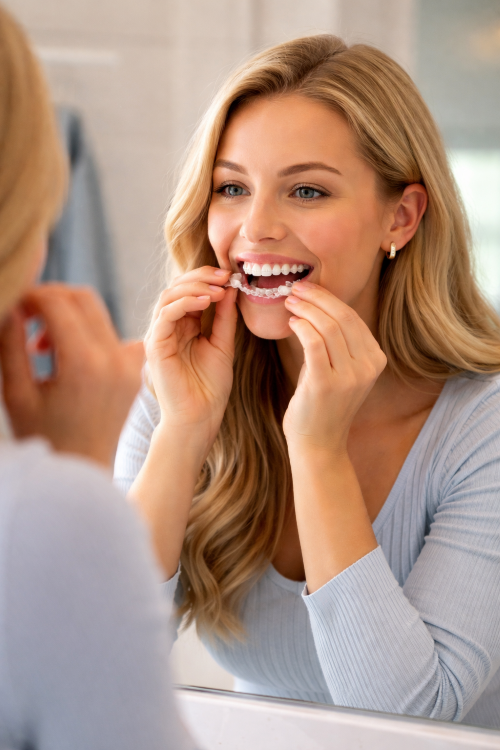
12 min read • By Dr. Kevin Baharvand, Diplomate, American Board of Orthodontics
SHORT ANSWER
When people search for Invisalign, they almost always mean clear aligners generally. Invisalign is one brand among several, and it is the one most people name because it advertised the most. We use Angel Aligners for the majority of our clear aligner patients and Invisalign where it suits the case better. Both work. At our offices they cost the same as metal braces, because we price on case complexity rather than on which appliance you choose. The thing that actually determines your result is not the brand on the tray. It is whether the case was diagnosed properly and whether you wear them.
ON THIS PAGE
- Invisalign is a brand, not a category
- The systems we use, and why
- Why Angel Aligners for most patients
- Where Invisalign is still the right call
- What it costs in Frisco, and financing
- What treatment actually looks like
- Aligners for teenagers
- When aligners are the wrong choice
- The daily reality of wearing them
- Refinements, and why most cases need them
- Comparing offices
- FAQ
Invisalign is a brand, not a category
Families across Frisco, The Colony, Little Elm, and Prosper type Invisalign into Google every day, and one of the first things worth clearing up is that most of them do not specifically want Invisalign. They want clear aligners. Invisalign is a brand name that became the generic term, the way people say Kleenex for tissues or Band-Aid for adhesive bandages.
That distinction matters to you for a practical reason. If you assume the brand is the treatment, you will shop for the brand instead of shopping for the orthodontist, and those are very different searches. Aligner systems are tools. The outcome depends on the diagnosis behind the plan and on how the case is managed over the following year or two.
I say this as someone who uses Invisalign. It is a capable system. It is just not the only one, and it is not automatically the right one for a given patient.
The systems we use, and why
We offer both Angel Aligners and Invisalign, plus traditional and ceramic braces. Here is roughly how the options compare for the decision most patients are actually making.
| Angel Aligners | Invisalign | Braces | |
|---|---|---|---|
| Visibility | Nearly invisible | Nearly invisible | Visible, less so in ceramic |
| Anchorage points | Built into the tray in many cases | Composite attachments bonded to teeth | Brackets bonded to teeth |
| Depends on your wear | Heavily | Heavily | Not at all |
| Complex bite correction | Good in planned cases | Good in planned cases | Most predictable |
| Cost at Elate | Same as braces | Same as braces | Same as braces |
That last row is the unusual one in this market. Most practices charge a premium for aligners. We priced it flat deliberately, because I did not want the appliance conversation to secretly be a money conversation. Choose based on your case and your life, not your budget.
Why Angel Aligners for most patients
Angel Aligner has been in the clear aligner market for over two decades and has treated more than a million patients globally. The company puts roughly eleven percent of annual revenue into research and development, which is high for the sector, and it shows in a few specific places. Our Angel Aligners page has the full clinical detail. Here is the short version of why we reach for it first.
Anchorage built into the tray
This is the difference that matters most day to day. Aligners need anchorage points to grip and rotate teeth. With most systems those are small composite bumps bonded onto your enamel, and they pop off. Every one that pops off is an unscheduled visit and a tray that stops tracking properly until it is replaced.
Angel builds much of that anchorage into the tray itself. Fewer bonded pieces means fewer things to fail, fewer emergency visits, and less enamel work at debond. For a busy adult or a family juggling school schedules, that is a real quality-of-life difference rather than a spec sheet item.
Material that stays clear
Aligner plastic can dull or discolor over a wear cycle, which patients notice because the whole point was invisibility. The material holds its clarity well through the tray’s lifespan, which matters more to people than they expect it to before starting.
Planning software
The planning platform uses algorithmic staging to sequence movements. I want to be careful how I describe this, because every aligner company markets AI now and the word does a lot of undeserved work in this industry. Software does not diagnose your case. It helps stage a plan that a person designed and is responsible for. Useful, not magic.
Worth being direct about a bias here: I have a preference, and preferences in this industry are often shaped by lab relationships and pricing. Mine is based on how many attachment failures I stopped seeing. But you are entitled to ask any orthodontist why they favor a system, and to be suspicious if the answer is entirely about the technology and never about their own experience with it.
Where Invisalign is still the right call
We keep Invisalign in the practice for good reasons, and I would rather explain those than pretend one system wins every time.
It has the largest accumulated case library in the industry, which means more documented experience with unusual movements. Some specific auxiliary features suit particular cases. And a fair number of patients arrive having researched it specifically, sometimes having started elsewhere, and continuity with a familiar system is occasionally the sensible choice.
If you come in wanting Invisalign specifically, you will not get a lecture. You will get an honest read on whether it fits your case, and if another option would serve you better, you will hear why and then decide.
What it costs in Frisco, and financing
Across this market, clear aligner treatment generally runs somewhere around $4,000 to $6,500, and braces somewhat lower. At our offices they are the same number, set by how complex the case is.
Most adult patients here land between $150 and $300 a month depending on down payment and length of plan. No credit check financing is available. Our finance calculator will give you a monthly figure before you ever come in.
Three things people leave on the table. Many employer dental plans carry an orthodontic lifetime maximum, often somewhere around $1,000 to $2,500, and plenty of adults assume it only applies to children. Health savings and flexible spending accounts cover orthodontic treatment with pre-tax dollars. And when you compare quotes between offices, ask for total cost of finished treatment including retainers and refinements, not the monthly payment, because a monthly figure can be made to look small simply by stretching the term.
What treatment actually looks like
The consultation
Free, and you should leave knowing whether you need treatment at all, what your options are, roughly how long it will take, and what it costs. If a consultation ends without those four things, it was a sales appointment.
Digital scanning
A digital scanner replaces the impression trays and putty most people remember unfondly. It takes a few minutes, produces a 3D model of your teeth, and that model is what the plan gets built on. Combined with x-rays, this is the diagnostic foundation, and I would be wary of any office proposing aligners without it.
Fabrication and starting
Trays are manufactured to the approved plan and typically arrive within a few weeks. At the start visit we fit the first set, place any needed attachments, and show you how to seat and remove them properly. Seating them properly matters more than people assume, because a tray that is not fully seated is not delivering the movement it was designed for.
Progress checks
Aligner patients typically come in every eight to ten weeks, less often than braces patients, since you change trays at home. Some check-ins can be handled remotely with photos, which helps when a visit is not clinically necessary. We run two offices in Frisco and one in The Colony, so you can move between them depending on which is easier that week.
Retention
Not the end of treatment, the permanent part of it. Teeth move for life, and the retainer plan should be explained to you at the beginning rather than presented as a surprise at the finish. Ask any office whether retainers are included in the quoted price, because that is a common place for a headline number to be made to look better.
Aligners for teenagers
Teen aligners are a legitimate option and teen-specific versions include wear indicators, small blue markers that fade with wear, so we can tell whether the trays are being worn rather than relying on a self-report.
Whether they suit a specific teenager depends on the teenager, not their age. Some fifteen-year-olds are meticulous. Some adults lose three sets of trays in a year. The conversation I would rather have with a family is an honest one about the individual kid, because a teen who will not wear trays is better served by braces and there is nothing wrong with saying so out loud.
Also worth mentioning: some kids actively want braces, largely because of the colors. That sounds trivial and it is not. A kid who is enthusiastic about their appliance is a kid who takes care of it.
When aligners are the wrong choice
A page like this should say where the product stops working, so here it is.
The clearest case against aligners is compliance. If you know, honestly, that something removable will spend time in a drawer, braces will give you a better result in less time. This is the most common reason aligner cases run long, and nobody is judged for saying it up front.
Some movements are also less predictable in trays than in braces, particularly certain rotations, significant bite correction, and closing large extraction spaces. Those cases can often still be done with aligners by a planner who knows the limits, but braces remain more direct.
And skeletal problems are a different category entirely. If the issue is where your jaws sit rather than where your teeth sit, no appliance moves bone. That is a conversation about what treatment can and cannot do, and occasionally about surgery.
The brand on the tray is the least important variable in your treatment. The diagnosis, the planning, and whether you wear them are the whole game.
The daily reality nobody describes at the consultation
Aligners are marketed on what they are not. Not visible, not fixed, not restrictive. Less gets said about what they actually ask of you every day, and that is the part that decides whether treatment goes well.
You take them out to eat. That sounds like freedom until you are at a work lunch, a birthday party, or a long meeting with snacks. Every time you eat, the trays come out, and before they go back in you should brush, or at minimum rinse thoroughly. People who snack throughout the day find this the hardest adjustment, and some of them genuinely eat less as a result, which is a side effect rather than a feature.
Twenty-two hours a day means roughly two hours out. Three meals plus brushing uses most of that. There is not much slack in the budget, which is why the honest question at a consultation is not whether you like the idea of aligners but whether this routine fits your actual week.
Cleaning and care
Rinse the trays whenever they are out, and brush them gently with a soft brush and cool water. Hot water warps the plastic, which is the single most common way people ruin a set. Coloured or scented soaps leave residue and taste. There are cleaning crystals and tablets available, and they are useful but not essential if you are consistent.
Keep the case with you. The overwhelming majority of lost aligners are wrapped in a napkin at a restaurant and thrown away, and a replacement tray costs time as well as money because the sequence pauses while it is made.
Travel and disruption
Aligners travel well, which is a genuine advantage over braces. Bring your current set, the next set, and the previous set. If you lose one on a trip, dropping back to the previous tray holds your position until you get home, which is much better than skipping forward. Tell us before a long trip and we can often send you ahead with several sets.
Speech and the first week
Expect a slight lisp for a few days. It resolves for nearly everyone and far faster than with lingual braces, because the trays are thin and do not sit where your tongue meets the palate. Expect pressure and mild soreness for a day or two with each new tray, strongest at the start and diminishing as treatment progresses.
Refinements, and why nearly everyone needs them
Here is something that surprises patients partway through, so it is better said now. Most aligner cases require a second round of trays near the end, called refinement. New scans are taken, a revised plan is made, and a shorter series finishes the details.
This is not a failure and it does not mean something went wrong. Teeth do not track perfectly to a digital prediction, and the last few degrees of rotation or the final bite settling routinely need a fresh series. It is normal enough that planning for it is part of a competent treatment plan rather than a surprise.
What matters is whether refinements are included in your quoted price. At some offices they are billed separately, and a quote that excludes them is not comparable to one that includes them. Ask directly. It is one of the most useful questions you can put to any practice you are comparing, alongside whether retainers are included.
Comparing offices without getting lost in brand names
If you are getting more than one opinion, and for anything beyond a simple case you should, the useful comparisons are not about which system each office sells.
- Did they take full records before proposing a plan, or quote you from a glance?
- Is the total price inclusive of retainers and refinements?
- Did an orthodontist build the treatment plan, or a treatment coordinator?
- Did they explain what happens if aligners do not track as planned?
- Were you told about braces as an alternative, or only offered the one thing?
That last point is the one I would weigh most heavily. An office where every patient somehow needs the same appliance is running a business model rather than making a diagnosis. A good consultation should occasionally end with a recommendation you did not walk in wanting.
Frequently asked questions
Is Invisalign the same thing as clear aligners?
No. Invisalign is a brand of clear aligner, the way Kleenex is a brand of tissue. It is the best known because it advertised the most. Several other systems exist, and the one your orthodontist uses matters less than whether they diagnosed your case correctly.
Why does Elate use Angel Aligners for most patients?
Mainly the anchorage points. Angel builds them into the tray itself rather than bonding composite attachments to your enamel, which means fewer pieces to pop off and fewer unscheduled repair visits. We still use Invisalign where it is the better fit for a specific case.
Do clear aligners cost more than braces here?
Not at our offices. We price on case complexity rather than appliance, so aligners cost the same as metal braces. Most practices in this market charge a premium for aligners, which is worth knowing when you compare quotes.
How many hours a day do I have to wear them?
Twenty-two, which realistically means you take them out to eat and to brush and otherwise they stay in. This is the single biggest predictor of whether aligner treatment finishes on time. If you know that will be a struggle, braces are the more honest choice.
Can teenagers use clear aligners?
Many can, and teen-specific versions include wear indicators so we can see whether the trays are actually being worn. Whether it suits a particular teenager depends more on the individual than on their age. Some teens are excellent with trays and some are much better served by braces.
Can I drink coffee with my aligners in?
Only water goes in with the trays in. Coffee stains them, and anything sugary or acidic gets trapped against your enamel for hours, which is how people end up with decalcification from an appliance that was supposed to be easier on their teeth.
Find out which system fits your case
Free consultation with real records, and a straight answer about your options. Two Frisco offices plus The Colony.
You may also be interested in these
- Clear Aligners vs Invisalign: What Is Actually Different
- Is Invisalign Worth It? A Complete Guide
- Can You Drink Water With Aligners On?
Why families trust Elate Orthodontics
1,000+ five-star reviews • 3 offices (two in Frisco, one in The Colony) • D Magazine Best Dentist 2026 • Living Magazine Readers’ Choice 2026
With over 1,000 five-star reviews across three locations, Elate Orthodontics is led by Dr. Kevin Baharvand, DMD, MS, a Diplomate of the American Board of Orthodontics, whose clinical work was recently selected for the cover of the American Journal of Orthodontics and Dentofacial Orthopedics, the most prestigious peer-reviewed journal in the field, and a national speaker on clear aligner treatment. Alongside Dr. Julia Kang, DMD, MS, both Boston University graduates and members of the Omicron Kappa Upsilon national honor society, our husband-and-wife team has been recognized as D Magazine Best Dentist 2026, Living Magazine Readers’ Choice 2026 Best Orthodontist in Frisco & Plano, Readers’ Choice Best Orthodontist in The Colony, Best New Business by the Chamber of Commerce, Nextdoor Neighborhood Favorite, and featured in Orthotown and Authority Magazine.
We serve families through three convenient offices in West Frisco, North Frisco, and The Colony, each staffed by the same trusted team, equipped with advanced technology, and committed to the personalized approach that consistently helps patients finish treatment sooner than expected. From braces and clear braces to Angel Aligners, we offer treatment for every age and every stage of life. We stay in-network with most insurance plans and offer flexible financing to make exceptional orthodontic care accessible for every family we serve.
Need general and family dentistry too? Our sister practice, Tribute Family Dentistry, provides dental care for all ages.
Book a free consultation: 972.538.4343
About the author
Dr. Kevin Baharvand, DMD, MS, is a Diplomate of the American Board of Orthodontics and a national speaker on clear aligner treatment. He practices at Elate Orthodontics in West Frisco, North Frisco, and The Colony, Texas.